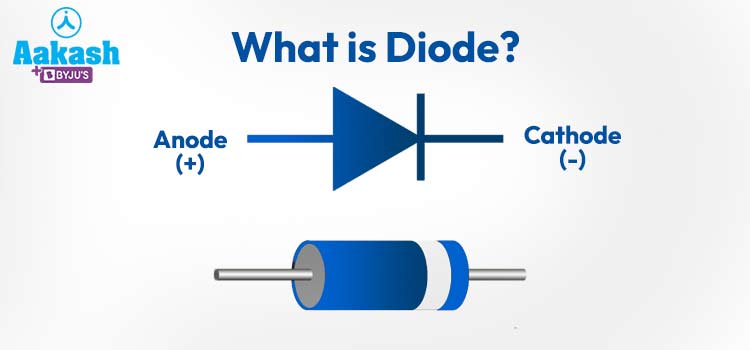

A diode is a fundamental two-terminal electronic component that plays a critical role in modern electronics. It is one of the simplest semiconductor devices and is widely used in various electronic circuits due to its unique electrical properties. The diode allows current to flow in only one direction, acting as a one-way valve for electric current.
Working Principle of Diodes:
Diodes are typically made from semiconductor materials such as silicon, germanium, or gallium arsenide. The basic working principle of a diode is based on the concept of “p-n junction.” A p-n junction is formed by joining a region of semiconductor material with an excess of positive charge carriers (p-type) to another region with an excess of negative charge carriers (n-type).
In the p-type region, there is an abundance of holes, which are positively charged carriers, while the n-type region has a surplus of electrons, which are negatively charged carriers. When these two regions come into contact, the electrons from the n-type region diffuse across the junction to recombine with the holes in the p-type region. This results in the formation of a depletion region, which is an area devoid of charge carriers.
Forward Bias:
When a voltage is applied across the diode in such a way that the positive terminal of the voltage source connects to the p-type region and the negative terminal connects to the n-type region, the diode is said to be “forward-biased.” This applied voltage reduces the width of the depletion region, allowing current to flow easily through the diode.
In the forward-biased condition, the diode behaves like a closed switch, and current can pass through it with minimal resistance. The amount of current that flows through the diode depends on the voltage applied and the characteristics of the semiconductor material.
Reverse Bias:
Conversely, if the voltage is applied in the opposite direction, with the positive terminal connected to the n-type region and the negative terminal to the p-type region, the diode is “reverse-biased.” In this state, the width of the depletion region increases, preventing the flow of current through the diode.
In the reverse-biased condition, the diode acts like an open switch, blocking the current flow. However, if the reverse bias voltage exceeds a certain threshold, known as the “reverse breakdown voltage,” the diode may experience a phenomenon called “avalanche breakdown” or “zener breakdown.” In this state, the diode conducts significantly, allowing current to flow in the reverse direction.
Types of Diodes:
Various types of diodes have been developed to suit different applications. Some common types include:
Rectifier Diodes: Used in power supplies to convert alternating current (AC) to direct current (DC).
Light-Emitting Diodes (LEDs): Emit light when current passes through them and are used in displays, indicators, and lighting applications.
Zener Diodes: Specifically designed to operate in the reverse breakdown region, used as voltage regulators and surge protectors.
Schottky Diodes: Known for their fast switching speed and low forward voltage drop, used in high-frequency applications.
Photodiodes: Designed to detect light and convert it into an electric current, commonly used in light sensors and communication systems.
Applications:
Diodes find widespread use in various electronic devices and systems, including:
- Power supplies and rectification circuits
- Signal demodulation in communication systems
- Voltage regulation and stabilization
- Light emission in displays and indicators
- Laser diodes in optical communication and medical devices
- Photovoltaic cells in solar panels
- Overvoltage protection circuits
- Microwave and radio-frequency applications
In conclusion, the diode’s ability to control the flow of electric current, coupled with its diverse range of applications, makes it an indispensable component in modern electronics, enabling the functionality of numerous devices we rely on in our daily lives.
FAQs about Diodes
1. What is the purpose of a diode in an electronic circuit?
A diode serves as a one-way valve for electric current in electronic circuits. Its primary purpose is to allow current to flow in one direction (forward-biased) while blocking it in the opposite direction (reverse-biased). This characteristic is crucial for rectification, signal demodulation, voltage regulation, and many other electronic applications.
2. Can a diode conduct current in both directions?
No, a diode can only conduct current in one direction. When it is forward-biased (positive voltage on the anode, negative voltage on the cathode), current flows through the diode. However, when it is reverse-biased (positive voltage on the cathode, negative voltage on the anode), the diode blocks the current, acting as an insulator.
3. How do I identify the polarity of a diode?
Diodes are typically marked with a stripe or band on one end, which indicates the cathode (negative terminal). The opposite end without the stripe corresponds to the anode (positive terminal). Alternatively, datasheets or product labels provide information on the diode’s polarity, voltage ratings, and other specifications.
4. What is the “forward voltage drop” in a diode?
When a diode is forward-biased, it experiences a small voltage drop across its terminals. This voltage drop is commonly known as the “forward voltage drop.” The value of the forward voltage drop depends on the type of diode and the semiconductor material used. For silicon diodes, it is typically around 0.7 volts, while for Schottky diodes, it can be lower (around 0.3 volts).
5. Can a diode be used as an on/off switch?
Yes, a diode can function as a switch in some circuits. When the diode is forward-biased (conducting state), it behaves like a closed switch, allowing current to flow. When it is reverse-biased (non-conducting state), it acts like an open switch, preventing the current from passing through. This property makes diodes useful for various applications, such as rectification and signal modulation, where on/off control is required. However, for more complex switching operations, other semiconductor devices like transistors are often used.