
In the world of telecommunications and electronics, signals are the carriers of information, transmitting data across vast distances and enabling communication between devices. However, these signals are often encoded in complex ways for efficient transmission. Demodulation, a fundamental process in signal processing, plays a crucial role in deciphering these encoded signals and extracting the original information they carry.
Defining Demodulation:
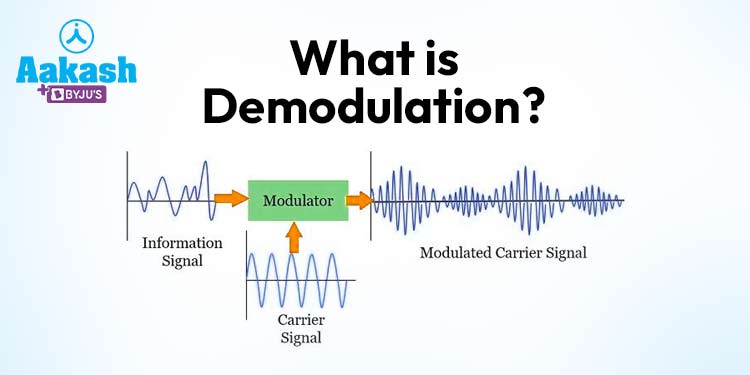
Demodulation, also known as “detecting” or “recovery,” is the process of extracting the original modulating signal from a carrier signal that has been modulated. Modulation is the technique of altering the characteristics of a carrier signal – such as amplitude, frequency, or phase – to encode information. Common types of modulation include amplitude modulation (AM), frequency modulation (FM), and phase modulation (PM).
Importance of Demodulation:
The need for demodulation arises because modulated signals are often not directly interpretable by humans or electronic devices. These modulated signals are more resilient to noise and can efficiently traverse transmission mediums, but their complexity requires demodulation for meaningful usage.
The Demodulation Process:
Demodulation involves the reversal of the modulation process. In other words, it aims to recover the original baseband signal, which carries the information, from the modulated carrier signal. The demodulation process varies based on the type of modulation used. Here are a few examples:
Amplitude Modulation (AM): In AM demodulation, the process involves removing the carrier frequency and isolating the varying amplitude signal, which represents the original information.
Frequency Modulation (FM): FM demodulation focuses on measuring the rate of change of the carrier frequency to retrieve the varying frequency, which encodes the original data.
Phase Modulation (PM): PM demodulation revolves around measuring the phase shift of the carrier signal to obtain the phase changes that represent the underlying information.
Applications of Demodulation:
Demodulation finds applications in numerous fields, including telecommunications, broadcasting, wireless communication, and data transmission. Some common applications include:
Radio and Television Broadcasting: Demodulation is used to recover audio and video signals from modulated radio and television transmissions.
Wireless Communication: In mobile networks, demodulation helps extract the encoded data from the carrier signal, allowing devices to access voice and data services.
Digital Communication: In digital communication systems, demodulation converts digital signals back into their original digital form, ensuring accurate data transmission.
Radar and Sonar Systems: Demodulation is essential in radar and sonar systems to process reflected signals and extract information about targets or underwater features.
Medical Imaging: In applications like magnetic resonance imaging (MRI), demodulation is used to extract image information from the received radio frequency signals.
Challenges and Advances:
As technology advances, demodulation techniques have become more sophisticated, allowing for better accuracy, noise reduction, and enhanced data recovery. Digital signal processing techniques, software-defined radios, and advanced algorithms have revolutionized the demodulation process, enabling efficient handling of complex modulation schemes and improving the overall reliability of communication systems.
In Conclusion:
Demodulation serves as the bridge between the encoded signals used for efficient transmission and the meaningful information they carry. By reversing the modulation process, demodulation plays a pivotal role in various industries, allowing us to decipher and utilize the wealth of data being transmitted through the airwaves and communication channels. It is a fundamental process that enables our interconnected world to function seamlessly.
FAQs about Demodulation
1. What is demodulation, and why is it necessary?
Demodulation is the process of extracting the original information signal from a carrier signal that has been modulated. Modulation techniques alter carrier signal properties for efficient transmission, making demodulation essential to recover meaningful data from these encoded signals.
2. How does demodulation work for different modulation types?
Demodulation techniques vary based on the type of modulation. For example, in amplitude modulation (AM), the varying amplitude is recovered, while frequency modulation (FM) involves extracting changes in frequency. Phase modulation (PM) demodulation focuses on recovering phase shifts in the carrier signal to retrieve the original information.
3. What are the practical applications of demodulation?
Demodulation finds applications in various fields. It is used in radio and television broadcasting to extract audio and video signals, in wireless communication for data retrieval from carrier signals, and in medical imaging to process signals in technologies like MRI. Radar systems also rely on demodulation to extract information from reflected signals.
4. How has technology advanced demodulation processes?
Advancements in technology have led to more sophisticated demodulation techniques. Digital signal processing, software-defined radios, and advanced algorithms have improved accuracy, noise reduction, and data recovery. These advances enable better handling of complex modulation schemes and enhance the reliability of communication systems.
5. Can you demodulate digital signals?
Yes, demodulation is also applied to digital signals. In digital communication systems, demodulation converts digital signals back to their original form, ensuring accurate data transmission. Digital demodulation is integral to various modern communication technologies, including cellular networks and Internet communication.