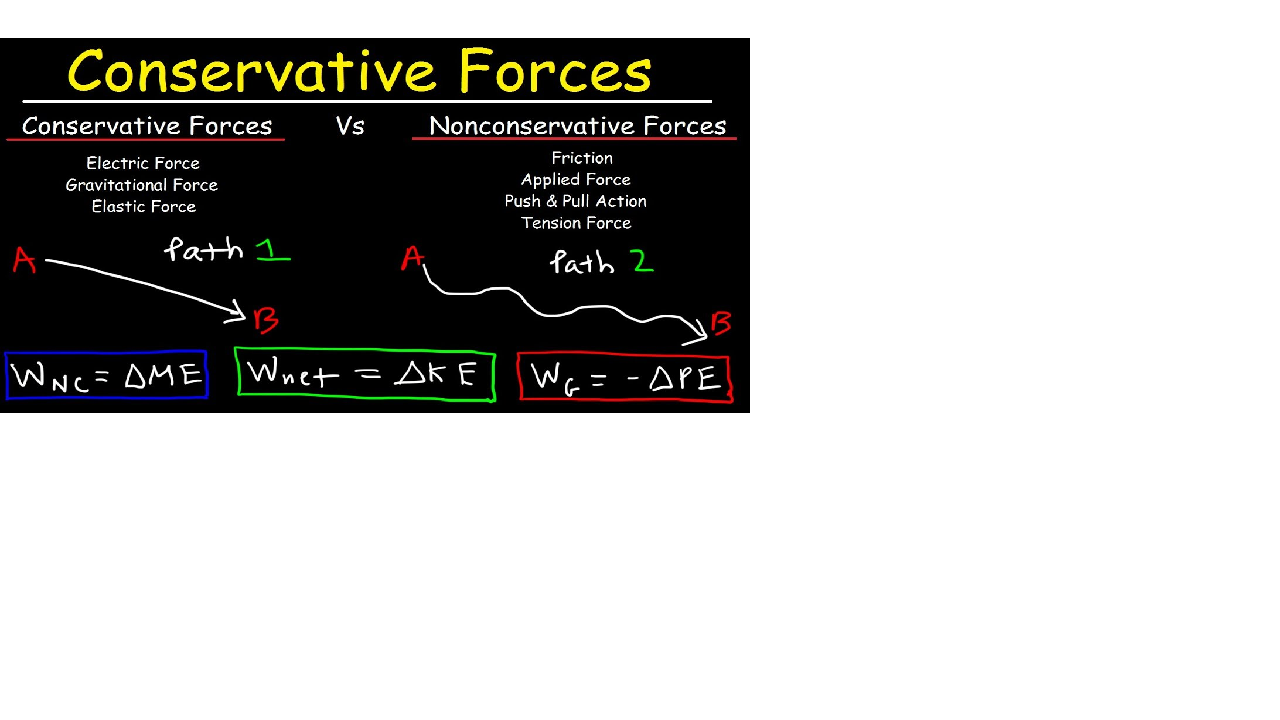

A conservative force is a type of force that, when applied to an object, performs work that is independent of the path taken by the object. In other words, the work done by a conservative force on an object depends solely on the initial and final positions of the object, regardless of the specific path it follows between the two points.
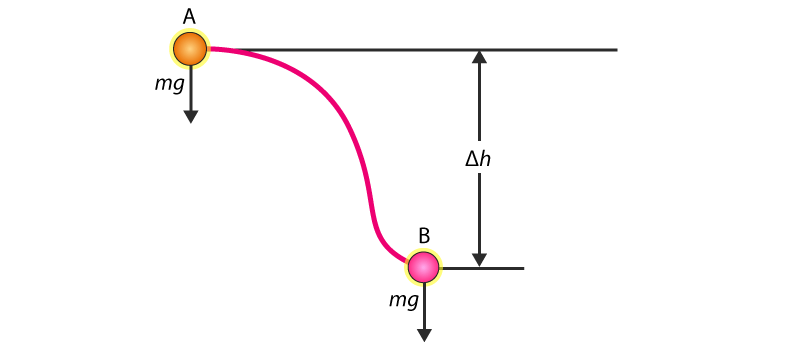
Key Properties of Conservative Forces:
Conservation of Mechanical Energy: One of the key properties of conservative forces is their ability to conserve mechanical energy. The total mechanical energy of an object, which is the sum of its potential and kinetic energies, remains constant when only conservative forces are acting on it. This principle, known as the conservation of mechanical energy, provides valuable insights into the behavior of systems influenced by conservative forces.
Irrelevance of Path: As mentioned earlier, the work done by conservative forces is path-independent. This characteristic implies that the work done by the force on an object moving in a closed loop is always zero. Any energy gained or lost by the object in a closed path is completely recovered as it returns to its starting point. Consequently, the net work done by a conservative force in a closed loop is always zero.
Examples of Conservative Forces:
Gravitational Force: The force of gravity is a classic example of a conservative force. When an object moves vertically in the gravitational field, the work done by gravity depends only on the initial and final heights. The path taken by the object does not affect the amount of work done. This property enables the conservation of mechanical energy in various scenarios, such as objects falling freely, pendulums swinging, or planets orbiting around a star.
Elastic Force: The force exerted by a stretched or compressed spring is another example of a conservative force. As an object attached to a spring oscillates back and forth, the work done by the spring force depends solely on the initial and final displacements of the object. This property ensures the conservation of mechanical energy in systems involving springs, such as a mass-spring system.
Electrostatic Force: The force between electrically charged particles, such as the force between two oppositely charged ions, follows the principles of conservative forces. The work done by the electrostatic force is independent of the path taken by the charged particles and depends solely on the initial and final positions of the particles.