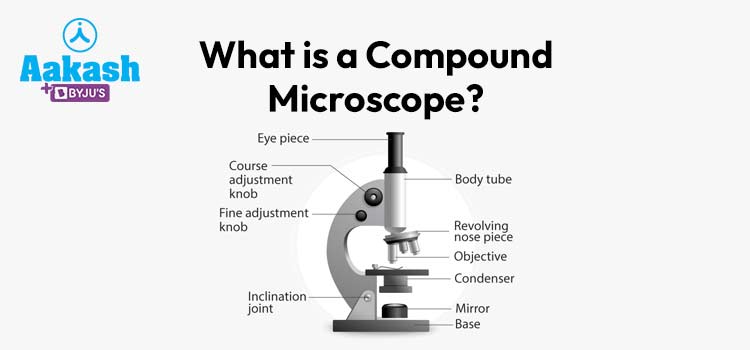

A compound microscope is a versatile and essential tool used in scientific research, education, and various fields of study to observe and magnify small objects or organisms that are otherwise invisible to the naked eye. It is one of the most common types of microscopes and plays a pivotal role in advancing our understanding of the microscopic world.
Components of a Compound Microscope:
Eyepiece (Ocular): The eyepiece is the part you look through and contains a lens that further magnifies the image formed by the objective lens. Typical compound microscopes have a magnification of 10x for the eyepiece.
Objective Lenses: Compound microscopes have multiple objective lenses with varying magnification levels. These lenses are attached to a rotating turret or nosepiece, allowing users to switch between different levels of magnification (typically 4x, 10x, 40x, and 100x). The combined magnification of the eyepiece and objective lenses determines the total magnification of the microscope.
Stage: The stage is a flat platform where the specimen is placed for observation. It usually includes a specimen holder or clips to secure the slide in place.
Condenser: The condenser is located under the stage and focuses light onto the specimen, providing better illumination. Some microscopes have adjustable condensers to control the intensity and angle of the light.
Illuminator: The illuminator is a light source located either at the base or above the condenser. In modern microscopes, this is typically an LED bulb, providing consistent and controllable lighting.
Coarse and Fine Focus Knobs: These knobs are used to adjust the focus of the microscope. The coarse focus knob moves the stage up and down rapidly for initial focusing, while the fine focus knob allows for precise focusing.
Diaphragm: The diaphragm is located under the stage and controls the amount of light passing through the condenser. By adjusting the diaphragm, one can enhance or decrease the brightness and contrast of the image.
How Does a Compound Microscope Work?
The functioning of a compound microscope relies on the principles of optics. When light passes through the specimen on the stage, it interacts with the structures and objects within the specimen. The objective lens collects this light and forms a magnified real image. The eyepiece then further magnifies this real image, and the viewer sees an enlarged and inverted virtual image.
By switching between objective lenses with different magnification powers and adjusting the focus, users can explore the specimen at various levels of detail. The highest level of magnification is achieved by using the oil immersion objective, which requires a drop of immersion oil to minimize light scattering.
Applications of Compound Microscopes:
Compound microscopes have numerous applications across various disciplines:
Biology and Medicine: Biologists and medical professionals use compound microscopes to study cells, tissues, microorganisms, and bacteria. These observations aid in diagnosing diseases and understanding biological processes.
Education: Compound microscopes are integral to science education. They enable students to explore the microscopic world and develop a deeper understanding of biological and cellular structures.
Quality Control and Research: In industries such as pharmaceuticals and materials science, compound microscopes are used for quality control, research, and development of new products.
Forensics: Forensic experts use microscopes to analyze trace evidence like hair, fibers, and fingerprints, helping to solve criminal cases.
Environmental Science: Microscopes play a crucial role in environmental studies, where researchers analyze microorganisms and pollutants to assess ecosystem health.
Conclusion:
The compound microscope has revolutionized our understanding of the microscopic world, providing valuable insights across a range of scientific disciplines. With its ability to magnify and explore the unseen, this indispensable tool continues to drive progress and innovation in various fields of study.
Frequently Asked Questions (FAQs) about Compound Microscopes:
1. What is the difference between a compound microscope and other types of microscopes?
A compound microscope uses two sets of lenses (objective and eyepiece) to magnify the specimen, whereas other microscopes, like stereo microscopes, use separate optical paths for each eye to provide a three-dimensional view. Electron microscopes, on the other hand, use electrons to achieve much higher magnifications and are suitable for studying ultra-small structures.
2. How do I choose the right magnification for my observation?
Choosing the right magnification depends on the size of the specimen and the level of detail you want to observe. Start with the lowest magnification (usually 4x) to locate and center the specimen, then increase the magnification for finer details. For higher magnifications (40x and 100x), oil immersion may be necessary to maintain clarity.
3. Can I use a compound microscope to view living organisms?
Yes, compound microscopes can be used to view living organisms. However, the specimens should be adequately prepared to minimize motion and ensure clear observation. Wet mounts, where the specimen is suspended in liquid, or specialized chambers to maintain humidity are commonly used for viewing living organisms.
4. Why is proper illumination important in a compound microscope?
Proper illumination is crucial to achieve a clear and well-contrasted image. The condenser and diaphragm control the amount and direction of light passing through the specimen. Adjusting the illumination optimizes the image quality, preventing under- or over-illumination that could affect the clarity of the observed structures.
5. Can I use a smartphone to capture images through a compound microscope?
Yes, you can use a smartphone to capture images or videos through a compound microscope. Attach your smartphone’s camera lens over the eyepiece, aligning it properly, and adjust the focus. Many microscopes also have digital camera attachments for direct image capture onto a computer or other devices.
Remember that while smartphone-based imaging is convenient, it may not match the quality and precision of dedicated microscope cameras for professional or research purposes.