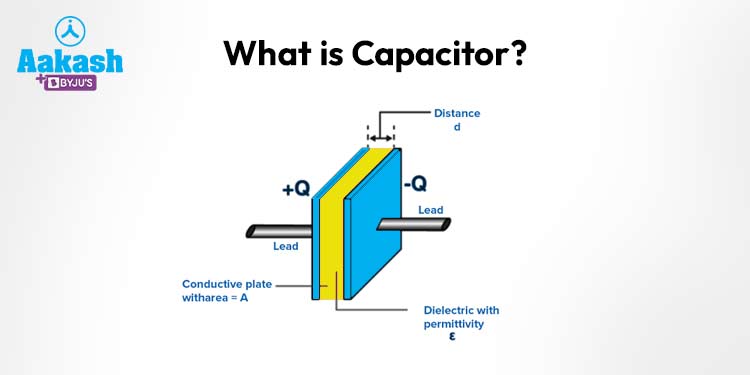

A capacitor is a fundamental electronic component that plays a crucial role in a wide range of electronic circuits and systems. It is an energy storage device that stores and releases electrical energy in the form of an electric field. Capacitors are used in countless applications, from simple electronic gadgets to complex industrial machinery, and they are essential for enabling various functions within electronic devices.
Construction and Working Principle:
A capacitor is typically composed of two conductive plates separated by a dielectric material. The conductive plates are often made of materials like aluminum, tantalum, or other metals, while the dielectric material can be made from materials such as ceramic, paper, plastic, or electrolytic solutions.
When a voltage difference (potential) is applied across the plates, an electric field is established between them. Electrons accumulate on one plate (the negatively charged plate) while an equal number of electrons are drawn away from the other plate (the positively charged plate). This separation of charge creates an electric potential difference between the plates, leading to the storage of electric energy in the form of an electrostatic field.
Capacitance:
The measure of a capacitor’s ability to store electric charge is called capacitance, denoted by the symbol ‘C’. The capacitance of a capacitor depends on several factors, including the surface area of the plates, the distance between them, and the properties of the dielectric material. Capacitance is measured in Farads (F), with smaller units like microfarads (μF) and picofarads (pF) being more common in practice due to the usually small values of capacitance encountered in electronic circuits.
Mathematically, the capacitance of a capacitor is defined as:
C = Q / V,
where:
C is the capacitance in Farads,
Q is the charge stored on the plates in Coulombs, and
V is the voltage across the plates in Volts.
Applications:
Capacitors serve various important functions in electronic circuits, including but not limited to:
Energy Storage: Capacitors are used to store electrical energy for short durations and then release it rapidly. This property makes them useful in applications like camera flashes, power backup systems, and pulse-forming networks.
Filtering and Decoupling: Capacitors are employed in filtering noise and stabilizing voltage levels. They smooth out fluctuations in power supply, ensuring stable and reliable operation of electronic devices.
Timing Circuits: Capacitors, in combination with resistors, can be used to create timing circuits, oscillators, and phase shifters in applications such as clock generation and signal synchronization.
Coupling and Decoupling: Capacitors are used for coupling and decoupling AC and DC signals between different stages of electronic circuits, ensuring the efficient transfer of signals while blocking unwanted DC components.
Signal Processing: In audio and radio-frequency circuits, capacitors are crucial for tuning and shaping signals, enabling the selection of specific frequency ranges and improving signal quality.
Voltage Regulation: Capacitors can assist in maintaining a stable voltage across load fluctuations, preventing voltage drops or spikes in electronic systems.
Conclusion:
In the realm of electronics, capacitors are indispensable components that enable a wide range of functions critical to the operation of electronic devices. Their ability to store and release electrical energy and shape signals makes them a vital tool for engineers and designers in various industries, contributing to the advancement of technology and the convenience of modern life.
FAQs About Capacitors:
1. What is a capacitor and how does it work?
A capacitor is an electronic component consisting of two conductive plates separated by a dielectric material. When a voltage is applied across the plates, an electric field forms between them, leading to the accumulation of charge. This stored energy can be released when needed.
2. What is capacitance, and how is it measured?
Capacitance is a measure of a capacitor’s ability to store charge. It is measured in Farads (F) and indicates the ratio of stored charge to the voltage applied. For example, a capacitor with 1 Farad of capacitance stores 1 Coulomb of charge for every Volt of potential difference.
3. What are some common applications of capacitors?
Capacitors find numerous applications in electronics, such as energy storage in camera flashes, smoothing power supplies to prevent voltage fluctuations, timing circuits for oscillators and phase shifters, coupling and decoupling AC and DC signals, and filtering noise in audio and radio-frequency circuits.
4. Do all capacitors have the same properties, or are there different types?
Capacitors come in various types, each with unique properties. Some common types include electrolytic capacitors for high capacitance and voltage applications, ceramic capacitors for compact size and moderate capacitance, and tantalum capacitors known for stability and reliability.
5. Can capacitors store energy indefinitely, and are there any limitations?
Capacitors can store energy for a limited time, but their charge can gradually leak due to the inherent resistance of the dielectric material. This phenomenon, called self-discharge, imposes a practical limit on how long capacitors can retain their stored energy without replenishment.