
Have you ever wondered why objects float in water or why hot air balloons rise in the sky? The answer lies in the fascinating principle of buoyancy. Buoyancy is the upward force exerted by a fluid on an object immersed in it, and it plays a significant role in our daily lives. In this blog post, we will explore the concept of buoyancy, its underlying principles, and its practical applications.
Buoyancy is a fundamental principle in fluid mechanics, attributed to the ancient Greek mathematician and scientist Archimedes. According to Archimedes’ principle, an object immersed in a fluid experiences an upward buoyant force equal to the weight of the fluid displaced by the object.
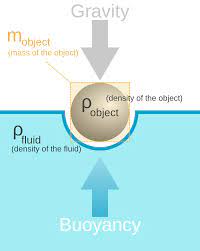
The buoyant force arises due to the pressure difference between the top and bottom of the submerged object. The pressure at the bottom of the object is greater than at the top, creating a net upward force. This force opposes the weight of the object, resulting in either a buoyant force greater than the weight (causing the object to float) or a buoyant force less than the weight (causing the object to sink).
Factors Affecting Buoyancy
Several factors influence the buoyant force experienced by an object:
The volume of the Displaced Fluid:
The greater the volume of fluid displaced by an object, the greater the buoyant force. This is why larger objects tend to experience greater buoyancy.
The density of the Fluid:
The density of the fluid plays a crucial role. If the density of the object is less than the density of the fluid, it will float. Conversely, if the density of the object is greater than the density of the fluid, it will sink.
The density of the Object:
The density of the object relative to the density of the fluid determines its buoyancy. An object with a lower density than the fluid will float, while an object with a higher density will sink.
Applications of Buoyancy
Shipbuilding and Maritime Industry:
Buoyancy plays a pivotal role in shipbuilding, ensuring that ships float and remain stable in water. Ship designers consider buoyancy when determining the size, shape, and weight distribution of a vessel to ensure proper flotation and stability.
Water Transport and Submarines:
Understanding buoyancy is essential for designing boats, submarines, and other watercraft. By controlling the buoyant force, these vehicles can float, submerge, and resurface as needed.
Swimming and Water Sports:
Buoyancy assists swimmers in staying afloat by counteracting their weight. Life jackets and floatation devices leverage buoyancy to provide safety and support in water activities.
Hot Air Balloons:
Hot air balloons utilize the principle of buoyancy to rise in the air. By heating the air inside the balloon, it becomes less dense than the surrounding cool air, resulting in a buoyant force that lifts the balloon and its passengers upward.
Density-based Separation Techniques:
Buoyancy is employed in various separation techniques, such as flotation, where substances with different densities can be separated by exploiting their buoyant properties.
Conclusion:
Buoyancy is a fascinating force that governs the behavior of objects submerged in fluids. Whether it’s the flotation of boats, the rise of hot air balloons, or the enjoyment of swimming, buoyancy is an essential principle with practical applications in our daily lives. Understanding buoyancy helps us comprehend the interactions between objects and fluids, enabling advancements in engineering, transportation, and various scientific fields. So, the next time you witness an object floating effortlessly or a balloon soaring high, remember the incredible force of buoyancy at work.
FAQs
What is buoyancy?
Buoyancy is the upward force exerted by a fluid on an object immersed in it. It is responsible for objects floating in water or other fluids.
How does buoyancy work?
Buoyancy is based on Archimedes' principle, which states that an object immersed in a fluid experiences an upward force equal to the weight of the fluid it displaces. This upward force opposes the weight of the object, determining whether it floats or sinks.
What factors affect buoyancy?
Several factors influence buoyancy, including the volume of the fluid displaced by the object, the density of the fluid, and the density of the object itself relative to the fluid.
How does the volume of the displaced fluid affect buoyancy?
The greater the volume of fluid displaced by an object, the greater the buoyant force it experiences. This is why larger objects tend to float more easily.
How does the density of the fluid affect buoyancy?
If the density of the fluid is greater than the density of the object, the object will float. If the density of the fluid is less than the density of the object, the object will sink.
How does the density of the object affect buoyancy?
The density of the object relative to the density of the fluid determines its buoyancy. An object with lower density than the fluid will float, while an object with higher density will sink.
How do hot air balloons work based on buoyancy?
Hot air balloons work by heating the air inside the balloon, making it less dense than the surrounding air. The resulting buoyant force lifts the balloon and its passengers upward.
Can buoyancy be applied to gases as well?
Yes, buoyancy applies to gases as well as liquids. The principle of buoyancy can be used to understand the behavior of objects submerged in gases, such as in the case of hot air balloons.