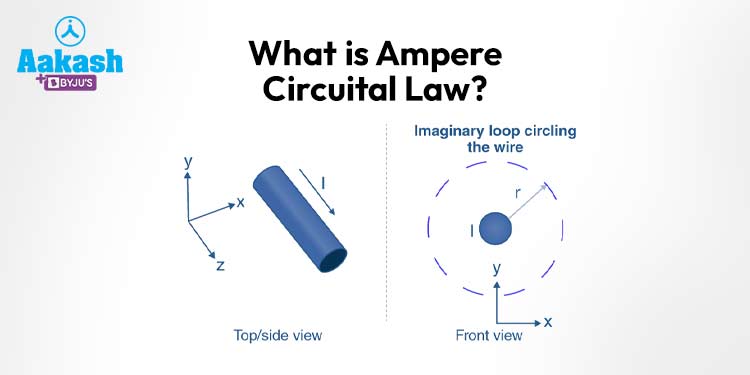

In the intricate tapestry of electromagnetism, few principles are as fundamental and elegant as Ampere’s Circuital Law. Named after the French physicist André-Marie Ampère, this law serves as a cornerstone in understanding the relationship between electric currents and the magnetic fields they create. Ampere’s Circuital Law, often considered a companion to Gauss’s Law for electric fields, provides a bridge between electricity and magnetism, illuminating the intricate dance of charges and fields in the universe.
The Essence of Ampere’s Circuital Law:
Ampere’s Circuital Law states that the magnetic field created by an electric current is proportional to the current flowing through a closed loop and inversely proportional to the distance from the current. In mathematical terms, it can be expressed as:
∮B·dl = μ₀ * I,
where:
∮B·dl represents the line integral of the magnetic field B around a closed loop (the circulation of the magnetic field).
μ₀ is the permeability of free space, a fundamental constant in physics.
I denotes the current passing through the loop.
Unveiling the Implications:
This law reveals the inherent link between electric currents and magnetic fields, emphasizing that electric currents are the source of magnetic fields. When an electric current flows through a conductor, it generates a magnetic field encircling the conductor. Ampere’s Circuital Law quantifies the strength of this magnetic field, allowing scientists and engineers to predict and manipulate magnetic interactions in various scenarios.
Integral to Electromagnetic Phenomena:
Ampere’s Circuital Law plays a pivotal role in understanding and predicting a range of electromagnetic phenomena, including the behavior of magnets, transformers, and even the operation of electric motors. It underpins Maxwell’s equations, a set of fundamental equations that describe how electric and magnetic fields interact and propagate through space. These equations are the foundation of classical electromagnetism and have profound implications for modern technology.
Limitations and Extensions:
While Ampere’s Circuital Law is exceptionally powerful, it has its limitations. The law is accurate for steady currents and situations where there are no changing electric fields. However, in cases involving time-varying electric fields or rapidly changing currents, the law needs to be extended to incorporate the concept of displacement current. This refinement was introduced by James Clerk Maxwell, culminating in Maxwell’s modification of Ampere’s Law, which is one of the four Maxwell’s equations governing electromagnetism.
Conclusion:
Ampere’s Circuital Law stands as a testament to the interconnectedness of the fundamental forces governing our universe. It shines a light on the profound relationship between electric currents and magnetic fields, unveiling the intricate symphony that shapes the world around us. From powering our homes to enabling the technology that defines the modern age, Ampere’s Circuital Law continues to guide our understanding of electromagnetism and inspire technological advancements that shape our future.
FAQs about Ampere’s Circuital Law
1. What is Ampere’s Circuital Law, and what does it describe?
Ampere’s Circuital Law is a fundamental principle in electromagnetism that establishes a relationship between electric currents and the magnetic fields they create. It states that the line integral of the magnetic field around a closed loop is proportional to the electric current passing through the loop and inversely proportional to the distance from the current. In simple terms, it quantifies how electric currents generate magnetic fields.
2. How is Ampere’s Circuital Law mathematically expressed?
Ampere’s Circuital Law is mathematically expressed as ∮B·dl = μ₀ * I, where ∮B·dl represents the line integral of the magnetic field B around a closed loop, μ₀ is the permeability of free space (a constant), and I is the electric current passing through the loop.
3. What are the practical implications of Ampere’s Circuital Law?
Ampere’s Circuital Law is essential for understanding and predicting various electromagnetic phenomena. It forms the basis for predicting the behavior of magnets, transformers, and electric motors. It also contributes to the formulation of Maxwell’s equations, which describe how electric and magnetic fields interact and propagate through space.
4. Are there any limitations to Ampere’s Circuital Law?
Yes, Ampere’s Circuital Law has limitations. It is accurate for steady currents and situations without changing electric fields. However, it requires modification when dealing with time-varying electric fields or rapidly changing currents. James Clerk Maxwell’s modification of Ampere’s Law, known as Maxwell’s modification, addresses these limitations and forms one of the four fundamental Maxwell’s equations.
5. How does Ampere’s Circuital Law relate to other laws in electromagnetism?
Ampere’s Circuital Law is closely related to other fundamental laws in electromagnetism, such as Gauss’s Law for electric fields. Together with Faraday’s Law of electromagnetic induction and Gauss’s Law for Magnetism, Ampere’s Circuital Law forms a set of four Maxwell’s equations that summarize the behavior of electric and magnetic fields and their interactions. These equations provide a comprehensive framework for understanding electromagnetism.