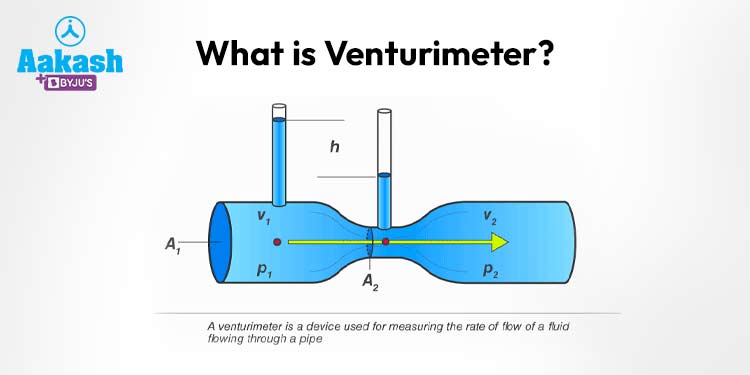

A Venturi meter, often referred to as a Venturi tube, is a specialized device used to measure the flow of fluid in a pipeline. It is named after its inventor, Giovanni Battista Venturi, an Italian physicist who developed the concept in the 18th century. This ingenious instrument has found wide application in various industries, from water supply systems and chemical plants to oil refineries and even aerospace engineering.
Principle of Operation:
The Venturi meter operates on the principle of fluid dynamics known as the Venturi effect. When a fluid (liquid or gas) passes through a constricted section of a pipe, its velocity increases while the pressure decreases. This phenomenon is a result of the conservation of energy and Bernoulli’s principle, which states that as the velocity of a fluid increases, its pressure decreases, and vice versa.
The basic structure of a Venturi meter consists of three main sections: an inlet section, a throat, and an outlet section. The inlet section gradually narrows down to the throat and then expands again in the outlet section. As the fluid enters the Venturi meter, it accelerates through the narrowing throat, causing a decrease in pressure. This pressure drop is measured and used to calculate the flow rate of the fluid.
Flow Measurement:
The key feature of a Venturi meter is its ability to accurately measure the flow rate of a fluid. By measuring the pressure difference between the inlet and throat sections, engineers can determine the velocity of the fluid and subsequently calculate its volumetric or mass flow rate. This makes the Venturi meter particularly valuable in situations where precise flow measurement is crucial, such as in industrial processes, water distribution systems, and environmental monitoring.
Advantages and Applications:
Accurate Flow Measurement: Venturi meters are known for their high accuracy and reliability in measuring fluid flow, especially in scenarios with turbulent or varying flow conditions.
Low-Pressure Drop: Unlike some other flow measurement devices, Venturi meters cause a minimal pressure drop in the pipeline, reducing energy losses and ensuring efficient fluid transport.
Wide Range of Fluids: Venturi meters can be used to measure a wide range of fluids, from liquids like water and chemicals to gases like air and steam.
Industrial Processes: They are extensively used in industries such as oil and gas, water treatment, pharmaceuticals, and food processing, where precise flow measurement is essential for quality control and process optimization.
Environmental Monitoring: Venturi meters play a role in environmental studies by helping to monitor water and air flows in natural systems and industrial emissions.
Aerospace Applications: In aerospace engineering, Venturi meters are employed in various systems, including aircraft fuel and hydraulic systems, to ensure proper fluid management.
Conclusion:
The Venturi meter stands as a testament to the fusion of scientific principles and engineering ingenuity. Its ability to accurately measure fluid flow has made it an indispensable tool in countless industries, contributing to efficient processes, quality control, and environmental stewardship. Whether it’s managing the flow of water in a municipal distribution network or optimizing the performance of a complex industrial process, the Venturi meter continues to play a vital role in modern engineering and fluid dynamics.
FAQs About Venturi Meters
1. What is a Venturi meter, and how does it work?
A Venturi meter is a flow measurement device used to gauge the flow rate of fluids in pipelines. It operates based on the Venturi effect, where a constriction in the pipe leads to increased fluid velocity and decreased pressure. This pressure drop is utilized to calculate the flow rate accurately.
2. Where are Venturi meters commonly used?
Venturi meters find applications in various industries such as water supply, oil and gas, chemical manufacturing, aerospace engineering, and environmental monitoring. They are used whenever precise measurement of fluid flow is essential for process optimization, quality control, or regulatory compliance.
3. How accurate are Venturi meters in measuring fluid flow?
Venturi meters are known for their high accuracy, particularly under challenging flow conditions. Their design minimizes pressure losses, making them suitable for scenarios where accurate measurement is critical, such as in industries requiring precise control over fluid quantities.
4. Can Venturi meters measure both liquids and gases?
Yes, Venturi meters are versatile and can measure the flow of both liquids and gases. They are commonly used to measure various fluids, including water, chemicals, air, steam, and even fuel in aerospace systems.
5. Are there any limitations or considerations when using Venturi meters?
While Venturi meters offer accurate flow measurements, there are a few considerations to keep in mind. These include the potential for clogging if the fluid contains solid particles, the need for proper installation to ensure accurate readings, and the requirement for specific fluid properties to ensure optimal performance.