
A spherical mirror is a reflective surface that has the shape of a section of a sphere. It is widely used in various optical devices, such as telescopes, microscopes, and even everyday objects like mirrors and car headlights. Spherical mirrors have unique properties that allow them to manipulate light and create different types of images.
There are two main types of spherical mirrors: concave and convex mirrors. A concave mirror is curved inward, like the inner surface of a spoon, while a convex mirror is curved outward, resembling the outer surface of a spoon. The curvature of the mirror determines its focal length and affects the behavior of light rays that interact with it.
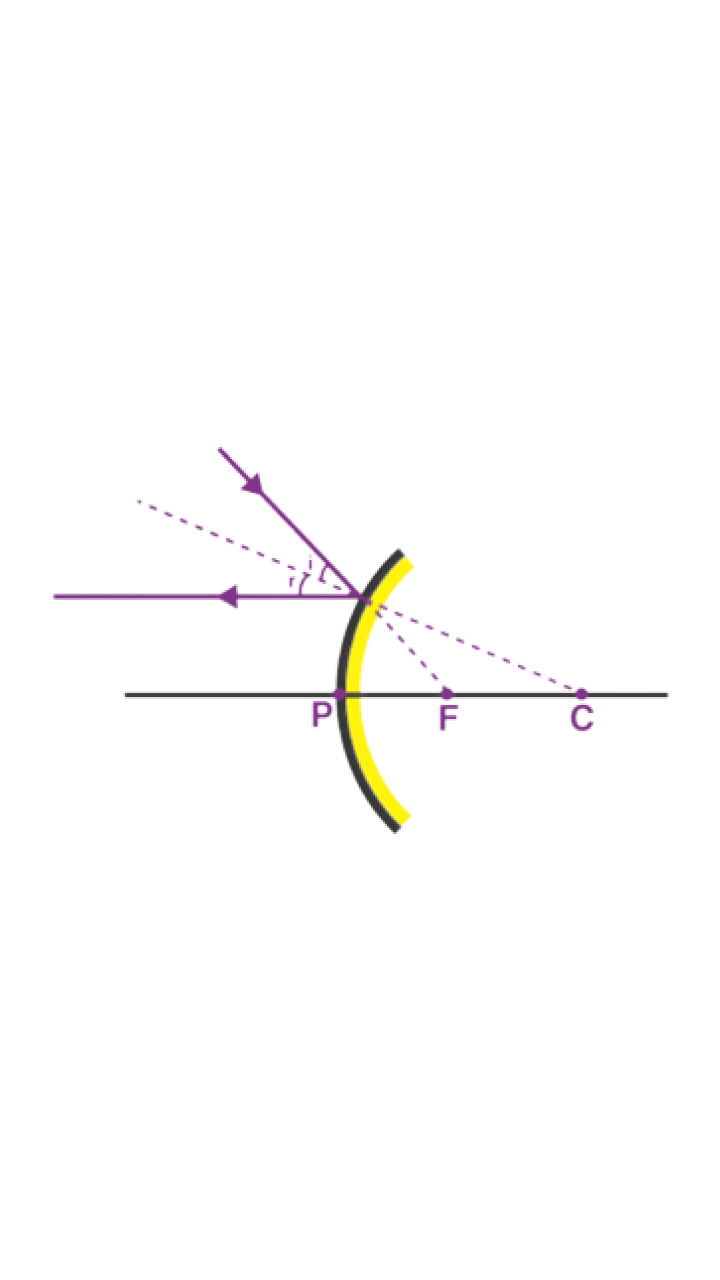
When light rays encounter a spherical mirror, they undergo reflection according to the laws of reflection. The laws state that the incident ray, the reflected ray, and the normal (a line perpendicular to the mirror’s surface) all lie in the same plane. The angle of incidence, formed between the incident ray and the normal, is equal to the angle of reflection, formed between the reflected ray and the normal.
In a concave mirror, the reflected rays converge to a point in front of the mirror known as the focal point (F). This point is located along the principal axis of the mirror, which is an imaginary line passing through its center of curvature (C) and the midpoint of the mirror’s surface. The distance between the focal point and the mirror is called the focal length (f).
Concave mirrors are often used for focusing light. When an object is placed beyond the focal point of a concave mirror, an inverted and magnified real image is formed between the focal point and the mirror. As the object moves closer to the mirror, the image size increases while moving farther away from the mirror reduces the image size. When the object is located at the focal point or inside the focal length, the mirror forms a virtual and magnified image on the same side as the object.
On the other hand, convex mirrors have a focal point and a focal length, but they diverge the reflected rays instead of converging them. This divergence causes the reflected rays to appear as if they originate from a point behind the mirror. Consequently, convex mirrors produce virtual, erect, and diminished images. Due to their ability to provide a wider field of view and a smaller focal length, convex mirrors are commonly used in applications that require a wider perspective, such as security mirrors and side-view mirrors in vehicles.
In addition to their diverse applications, spherical mirrors are also governed by specific formulas and equations. The mirror equation, which relates the object distance (p), image distance (q), and focal length (f) of a spherical mirror, is given by:
1/f = 1/p + 1/q
This equation provides a mathematical understanding of the relationship between the object, image, and focal length in spherical mirrors.