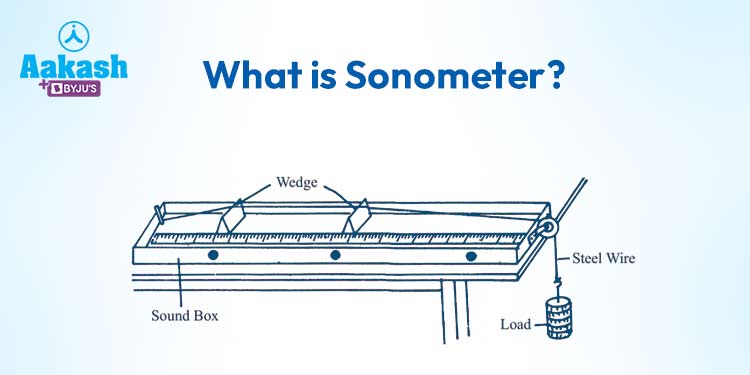

A sonometer, also known as a monochord, is a scientific instrument used to study the fundamental principles of sound, particularly the characteristics of vibrating strings and the production of musical tones. The name “sonometer” is derived from the Greek words “sonus,” meaning sound, and “metron,” meaning measure. Developed over centuries, the sonometer has played a significant role in the exploration of acoustics and the understanding of sound waves.
Design and Components:
The basic design of a sonometer consists of a hollow wooden box with a long, thin wire or string stretched across it. The string is usually made of a material such as steel or nylon. One end of the string is fixed to a sturdy anchor point on the box, while the other end is connected to a tensioning mechanism. This mechanism allows the user to adjust the tension in the string, which in turn affects the pitch of the sound produced when the string is plucked or struck.
The box of the sonometer typically has a graduated scale along its length, enabling precise measurements of the length of the vibrating segment of the string. This scale is used to investigate the relationship between the length of a vibrating string and the frequency of the sound it produces.
Working Principle:
When the string of the sonometer is plucked or set into motion, it vibrates at a specific frequency, creating sound waves that travel through the air. The tension in the string and its length both influence the frequency of vibration and, consequently, the pitch of the sound produced. This relationship is fundamental to the study of musical tones and their harmonics.
Sonometers are often used in experiments to demonstrate the concepts of harmonics and overtones. By lightly touching the string at specific fractions of its length, researchers can create nodes and antinodes, effectively changing the frequency and altering the pitch of the sound produced. This manipulation helps illustrate the mathematical relationships governing the production of musical intervals and chords.
Applications:
Sonometers have applications in various fields, including physics, music, and education. In physics, they are used to study the principles of wave behavior, frequency, and resonance. Musicians and music educators use sonometers to teach students about the physics of sound production in musical instruments, helping them understand concepts like pitch, timbre, and harmonics.
Historical Significance:
The sonometer has a long history, dating back to ancient civilizations. The ancient Greek philosopher and mathematician Pythagoras is often credited with some of the earliest work related to the study of vibrating strings and their mathematical relationships. He observed that the ratios of string lengths could produce harmonious musical intervals.
In conclusion, a sonometer is a versatile scientific instrument that has played a crucial role in unraveling the mysteries of sound and acoustics. By examining the vibrations of strings and their interactions with air molecules, the sonometer has deepened our understanding of the science behind music and sound, influencing fields ranging from physics to music composition.
FAQs about Sonometers:
1. What is a sonometer used for?
A sonometer, also known as a monochord, is used to study the fundamental principles of sound, particularly the behavior of vibrating strings and the production of musical tones. It helps explore concepts like pitch, frequency, harmonics, and resonance.
2. How does a sonometer work?
A sonometer consists of a long string stretched across a wooden box. When the string is plucked or set into motion, it vibrates at a specific frequency, creating sound waves. The tension in the string and its length influence the pitch of the sound produced. By manipulating the length and touching specific points on the string, researchers can demonstrate concepts like harmonics and overtones.
3. What are harmonics and overtones?
Harmonics are multiples of the fundamental frequency at which a string vibrates. Overtones, on the other hand, are higher frequencies produced simultaneously with the fundamental frequency. Sonometers are used to explore the relationships between the fundamental frequency and its harmonics and overtones, crucial in understanding musical timbre and chord structure.
4. What historical significance does the sonometer hold?
The sonometer’s history dates back to ancient times, with Pythagoras being credited for some of the earliest work related to vibrating strings. He discovered that specific ratios of string lengths could produce harmonious musical intervals. This historical significance showcases the enduring role of the sonometer in shaping our understanding of sound.
5. What are the applications of sonometers beyond acoustics?
While primarily used to study sound and acoustics, sonometers have broader applications. In the field of physics, they help explore wave behavior, frequency, and resonance. In music education, sonometers serve as tools to teach students about the science of sound production in musical instruments, aiding in their comprehension of concepts like pitch and harmonics.