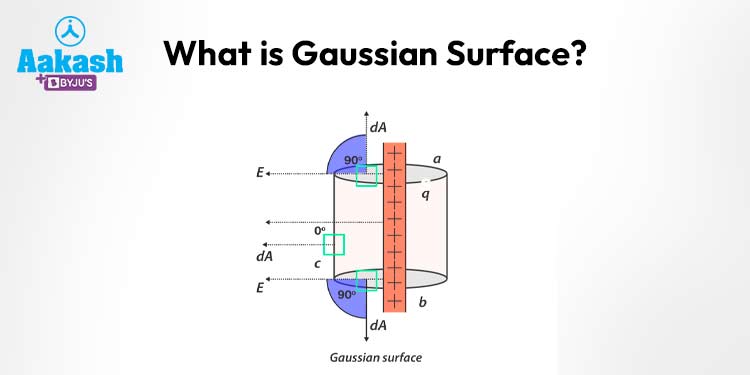

In the realm of electromagnetism, Gaussian surfaces play a pivotal role in simplifying the calculations of electric fields and charges, particularly in the context of electrostatics. A Gaussian surface is a conceptual construct that aids in the application of Gauss’s law, a fundamental principle in physics. Let’s delve into the intricacies of Gaussian surfaces and explore their significance in unraveling the mysteries of electrostatic phenomena.
Defining Gaussian Surface:
A Gaussian surface is an imaginary or hypothetical closed surface that is carefully chosen to enclose a charge distribution. The selection of this surface is guided by its shape, symmetry, and the nature of the charge configuration under consideration. The primary purpose of introducing a Gaussian surface is to simplify the calculations of electric fields and flux through the application of Gauss’s law.
Gaussian surfaces are strategically chosen to exploit symmetries inherent in the charge distribution. These symmetries may include spherical, cylindrical, or planar symmetry, which results in a uniform electric field across the Gaussian surface. Consequently, the integration of the electric field over the closed surface becomes simplified, reducing complex vector calculations to straightforward scalar operations.
Through the application of Gauss’s law, one can determine the electric field at points both inside and outside the Gaussian surface. This approach is particularly useful when dealing with symmetric charge distributions, as it allows for the derivation of electric fields without having to perform intricate vector calculus.
Examples of Gaussian Surfaces:
Spherical Charge Distribution: When dealing with a spherically symmetric charge distribution, a Gaussian surface in the form of a concentric sphere is often chosen. The resulting electric field is radial and has the same magnitude at all points on the Gaussian surface.
Infinite Line of Charge: For an infinitely long, uniformly charged line, a cylindrical Gaussian surface is employed. This simplifies the calculation of the electric field around the charged line.
Infinite Sheet of Charge: In the case of an infinite, uniformly charged sheet, a planar Gaussian surface can be used. The electric field above and below the sheet is found to be uniform and directed perpendicular to the surface.
Conclusion:
Gaussian surfaces provide a powerful tool for solving complex electrostatic problems by capitalizing on the principles of symmetry and Gauss’s law. Their strategic selection and utilization simplify the calculation of electric fields and flux associated with different charge distributions. By employing Gaussian surfaces, physicists and engineers can gain deeper insights into the behavior of electric fields, making it easier to analyze and understand a wide range of electrostatic phenomena.
Frequently Asked Questions (FAQs) About Gaussian Surfaces
1. What is a Gaussian surface, and why is it used in electrostatics?
A Gaussian surface is an imaginary closed surface chosen to simplify calculations involving electric fields and charges in electrostatics. It allows us to apply Gauss’s law, relating the electric flux through the surface to the net charge enclosed within it. Gaussian surfaces are strategically chosen based on symmetry in charge distributions, making calculations more manageable.
2. How does Gauss’s law simplify calculations using Gaussian surfaces?
Gauss’s law relates the electric flux through a Gaussian surface to the enclosed charge. When dealing with symmetric charge distributions, the electric field can be considered constant across the surface, simplifying integration. This law helps us calculate electric fields in cases where direct vector calculations might be complex.
3. Can you provide examples of Gaussian surfaces and their applications?
Certainly! A common example is a spherical Gaussian surface used for spherically symmetric charge distributions. For an infinite line of charge, a cylindrical Gaussian surface is chosen. In the case of an infinite sheet of charge, a planar Gaussian surface is employed. These surfaces help derive electric fields with ease, especially when dealing with symmetrical setups.
4. Are Gaussian surfaces real physical objects?
No, Gaussian surfaces are conceptual constructs. They don’t have a physical presence but are chosen based on their mathematical convenience. The main purpose of Gaussian surfaces is to simplify calculations, making it easier to analyze and understand electric fields and charges in electrostatics.
5. Are Gaussian surfaces used only in electrostatics?
While Gaussian surfaces find significant application in electrostatics, they are also utilized in other areas of electromagnetism, such as magnetostatics. In magnetostatics, they help calculate magnetic fields using an analogous approach. However, Gaussian surfaces are most commonly associated with simplifying electrostatic calculations due to their effectiveness in exploiting symmetries.