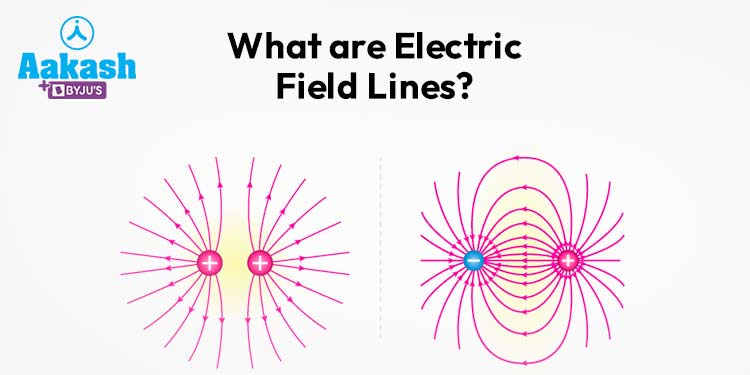

Electricity is an integral part of our modern lives, powering devices, lighting our homes, and driving technological advancements. But have you ever wondered how electric charges interact with each other, creating invisible forces that govern the behavior of charged particles? This is where the concept of electric field lines comes into play, providing a visual representation of the complex electric fields that surround charged objects.
Understanding Electric Fields:
Before delving into electric field lines, let’s grasp the fundamental concept of electric fields. An electric field is a region in space where a charged object experiences a force due to the presence of another charged object. These fields extend outwards from positively charged objects and inwards towards negatively charged objects. Electric fields are vector quantities, meaning they have both magnitude and direction.
Visualizing Electric Field Lines:
Electric field lines serve as a powerful tool for visualizing electric fields and understanding the interactions between charges. These lines are imaginary curves that depict the direction of the electric field at every point in space surrounding a charged object. They emerge radially from positive charges and converge radially towards negative charges.
The density of electric field lines indicates the strength of the electric field. When the lines are closer together, the field is stronger, and when they are farther apart, the field is weaker. These lines never intersect, ensuring that the direction of the electric field is clear at any given point.
Key Characteristics of Electric Field Lines:
Originating and Terminating Points: Electric field lines start from positive charges and terminate on negative charges. This illustrates the flow of electric influence from positive to negative charges.
Perpendicular to Surfaces: Electric field lines are always perpendicular to the surface of a charged object. This property assists in understanding how charges affect neighboring objects.
Uniform vs. Non-Uniform Fields: In a uniform electric field, the field lines are evenly spaced and parallel. In a non-uniform field, the lines are closer together where the field is stronger and farther apart where the field is weaker.
Indicating Relative Strength: The density of field lines provides an intuitive understanding of the relative strength of electric fields in different regions.
No Crossings: Electric field lines never cross, ensuring a clear representation of the direction of the electric field at any point.
Applications and Importance:
Electric field lines find application in various areas of science and engineering. They help engineers design capacitors, electrostatic precipitators, and other devices that rely on controlling electric fields. In physics education, these lines simplify the visualization of complex field patterns, aiding in the explanation of intricate concepts.
Understanding electric field lines is crucial for comprehending the behavior of charged particles, electromagnetic interactions, and the principles underlying various electrical devices. By providing a tangible representation of the invisible forces that shape our electrical world, electric field lines bridge the gap between the abstract world of theoretical physics and the tangible reality of everyday technology.
Frequently Asked Questions (FAQs) about Electric Field Lines:
1. What are electric field lines?
Electric field lines are imaginary curves used to visually represent the direction and strength of an electric field around a charged object. They provide a way to intuitively understand how electric charges influence their surroundings by depicting the paths that positive test charges would follow in the field.
2. How are electric field lines drawn?
Electric field lines are drawn as continuous curves that originate from positive charges and terminate on negative charges. They are always perpendicular to the surface of charged objects and never intersect. The density of the lines indicates the strength of the electric field, with closer lines representing stronger fields.
3. What information do electric field lines convey?
Electric field lines convey several key insights about electric fields. They illustrate the direction of the electric field at any point, demonstrate the flow of electric influence from positive to negative charges, and reveal the relative strength of the field in different regions. The pattern of field lines also helps us understand how charges interact with neighboring objects.
4. Do electric field lines have any real physical existence?
No, electric field lines are a conceptual tool used for visualization and understanding. They help us grasp the behavior of electric fields and the forces acting on charged particles, but they do not have a physical presence. They serve as a useful representation of an abstract concept.
5. How do electric field lines relate to electric potential?
Electric field lines and electric potential are closely related concepts. Electric potential is a scalar quantity that describes the energy per unit charge at a point in an electric field. The direction of the electric field lines points from regions of higher potential to lower potential. In other words, the electric field is the negative gradient of the electric potential, and electric field lines provide a visual representation of this gradient.