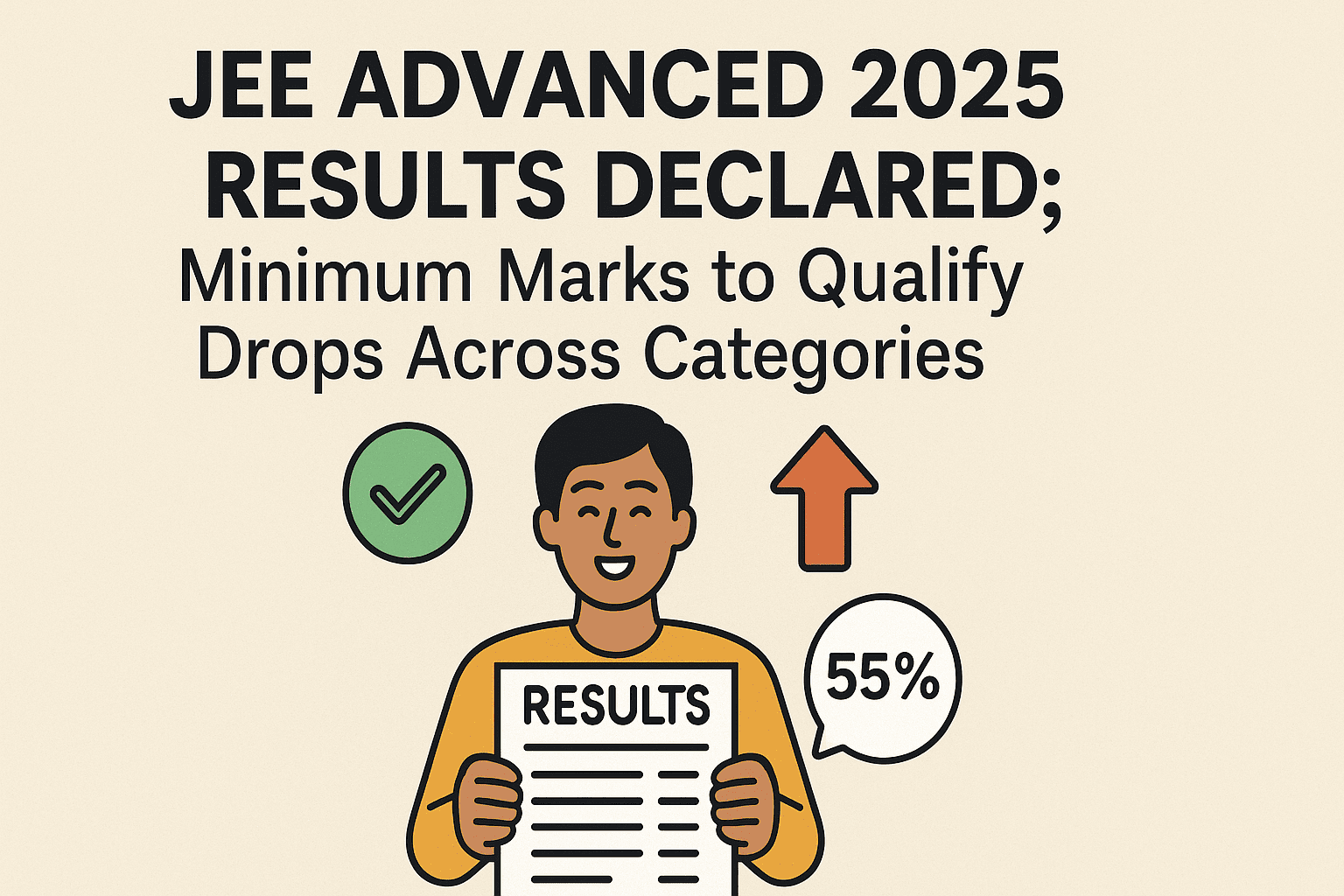

The JEE Advanced 2025 results have been officially declared by IIT Kanpur, along with the much-anticipated cutoff marks. This year, the minimum qualifying marks have dropped across all categories, making it slightly easier for candidates to secure a place in the rank list. Over 1.8 lakh students appeared for the exam, with more than 54,000 qualifying.
The reduction in cutoff marks reflects the increased difficulty level of the paper. The official website, jeeadv.ac.in, now hosts the final answer key, scorecards, and category-wise qualifying details.
Candidates who qualified can now participate in the JoSAA 2025 counseling for admissions to prestigious IITs and other top engineering institutes in India.
JEE Advanced 2025 Result Declared by IIT Kanpur
The Indian Institute of Technology (IIT) Kanpur has officially declared the JEE Advanced 2025 results on June 2, 2025. Candidates who appeared for the exam can now check their results on the official website, jeeadv.ac.in. Along with the results, the final answer key has also been released. This year, over 1.8 lakh candidates appeared for the exam, and approximately 54,378 candidates have qualified.
JEE Advanced 2025 Minimum Qualifying Marks (Subject-Wise)
To be included in the JEE Advanced 2025 rank list, candidates must meet both subject-wise and aggregate minimum marks. The qualifying marks have been reduced across all categories this year:
- Common Rank List (CRL): Minimum 5.83% in each subject and 20.56% aggregate.
- GEN-EWS & OBC-NCL: Minimum 5.25% in each subject and 18.50% aggregate.
- SC, ST, PwD: Minimum 2.92% in each subject and 10.28% aggregate.
- Preparatory Course: Minimum 1.46% in each subject and 5.14% aggregate.
How to Check JEE Advanced 2025 Result Online?
To access your JEE Advanced 2025 result:
- Visit the official website: jeeadv.ac.in.
- Click on the “JEE Advanced 2025 Result” link.
- Enter your roll number, date of birth, and registered mobile number.
- View and download your scorecard for future reference.
The scorecard will display your total marks, category-wise rank, and qualifying status.
What to Do After Qualifying: JoSAA 2025 Counselling Details
Qualified candidates of JEE Advanced 2025 can take part in the Joint Seat Allocation Authority (JoSAA) counselling process, which starts from June 3, 2025, at 5 PM. JoSAA manages the seat allocation for admissions into 118 participating institutes, including IITs, NITs, IIITs, and other Government Funded Technical Institutes (GFTIs).
The counseling process is conducted online and consists of several important steps such as online registration, filling in preferred choices of colleges and courses, locking the choices, and seat allotment rounds.
After seat allocation, candidates must confirm their admission by uploading required documents and paying the seat acceptance fee. It is important to check the schedule carefully and complete each step on time. Delays or errors can result in losing the allotted seat.
JEE Advanced 2025 Toppers and Highest Scores
Rajit Gupta from the IIT Delhi zone has secured All India Rank (AIR) 1 in JEE Advanced 2025 by scoring an impressive 332 out of 360 marks. Interestingly, another candidate, Saksham Jindal, also achieved the same score of 332.
However, due to tie-breaking rules based on subject-wise marks and other factors, Rajit Gupta was awarded the top rank.
Their exceptional performance reflects the high level of competition and dedication required to succeed in one of India’s toughest engineering entrance exams.
JEE Advanced 2025 Cutoff Marks: Category-Wise Breakdown
The cutoff marks for JEE Advanced 2025 have been reduced across all categories compared to the previous year. This adjustment reflects the increased difficulty level of the exam. The minimum aggregate marks required for inclusion in the rank list are:
- Common Rank List (CRL): 76 marks
- GEN-EWS & OBC-NCL: 66 marks
- SC & ST: 37 marks
- Preparatory Course: 18 marks
Best Books and Resources for JEE Advanced Preparation
| Subject | Book/Resource Name | Author/Publisher | Purpose |
| Physics | Concepts of Physics Vol 1 & 2 | H.C. Verma | Clear concepts and practice problems |
| Understanding Physics Series | D.C. Pandey (Arihant) | Topic-wise theory and objective questions | |
| Chemistry | Organic Chemistry | Morrison & Boyd | In-depth explanation of organic chemistry |
| Physical Chemistry | O.P. Tandon | Conceptual clarity and numerical problems | |
| Modern Approach to Chemical Calculations | R.C. Mukherjee | Numerical problems in physical chemistry | |
| Mathematics | IIT Mathematics | M.L. Khanna | Wide range of problems for practice |
| Objective Mathematics for JEE | R.D. Sharma | Basic to advanced level questions | |
| Previous Years | 11 Years JEE Advanced Solved Papers | MTG | Past year solved papers with solutions |
| Mock Tests | JEE Advanced Rankers Test Series 2025 | Physics Wallah (PW) | Practice mock tests and revision |
JEE Advanced 2025 Cutoff and Result FAQs
Q1: What is the minimum aggregate percentage required for the Common Rank List in JEE Advanced 2025?
The minimum aggregate percentage for the Common Rank List (CRL) in JEE Advanced 2025 is 20.56%, which means students must score at least this percentage to be eligible for ranking.
Q2: When does the JoSAA 2025 counselling process begin?
The JoSAA 2025 counselling process will start on June 3, 2025, at 5 PM. Qualified candidates must register, fill out choices, and take part in seat allotment rounds on the official portal.
Q3: Who topped the JEE Advanced 2025 exam?
Rajit Gupta, from the IIT Delhi zone, is the JEE Advanced 2025 topper. He secured 332 out of 360 marks, placing him first among over 180,000 candidates.
Q4: How can I check my JEE Advanced 2025 result?
To check your result, visit jeeadv.ac.in, click the result link, and enter your roll number, date of birth, and registered mobile number to view your scorecard and rank details.
Q5: What are some recommended resources for JEE Advanced preparation?
Helpful resources include Mtg 11 Year PYQ Book, the 47 Years’ Solved Papers Set, and the PW Rankers Test Series 2025. These cover past questions, mock tests, and concept-based learning.