
Mirrors have been integral to human life for centuries, serving not only as tools for personal grooming but also as instruments for scientific exploration and artistic expression. Two distinct types of mirrors that play significant roles in our understanding of optics are concave and convex mirrors. These mirrors exhibit unique reflective properties that have practical applications ranging from magnification to the formation of images.
Concave Mirror: Diving into the Depths
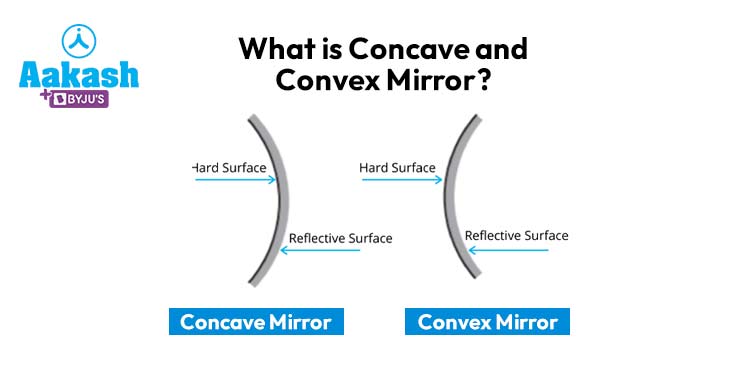
A concave mirror is a reflective surface that curves inwards, resembling the inner surface of a sphere. This curvature causes parallel light rays that strike the mirror to converge or come together at a point known as the focal point. The focal point lies along the principal axis of the mirror, which is an imaginary line perpendicular to the mirror’s center.
One of the most fascinating features of a concave mirror is its ability to form both real and virtual images. When an object is placed beyond the focal point, a real and inverted image is formed between the focal point and the mirror. On the other hand, when the object is positioned between the mirror’s surface and its focal point, a virtual and magnified image is formed on the same side as the object. This virtual image is upright and can be seen by looking into the mirror.

Convex Mirror: Expanding Perspectives
In contrast to the concave mirror, a convex mirror curves outward, resembling the outer surface of a sphere. This outward curvature causes parallel light rays to diverge or spread out upon reflection, creating the illusion that they originate from a single point known as the focal point. Unlike the concave mirror, the focal point of a convex mirror is a virtual point located behind the mirror itself.
Convex mirrors are widely recognized for their ability to create virtual images that are smaller, erect, and seemingly located behind the mirror’s surface. These mirrors are often used for security and surveillance purposes in various settings, including stores, parking lots, and road intersections, as they provide a wide field of view.
Key Differences and Applications
Image Formation: Concave mirrors can create both real and virtual images, whereas convex mirrors only form virtual images.
Focal Point: Concave mirrors have a real focal point, while convex mirrors have a virtual focal point.
Image Characteristics: Concave mirrors can create larger or smaller images, depending on the object’s position, while convex mirrors always produce smaller virtual images.
Applications: Concave mirrors are used in telescopes, makeup mirrors, and headlights. Convex mirrors find applications in security mirrors, rearview mirrors, and outdoor surveillance systems.
In summary, concave and convex mirrors exhibit distinct reflective behaviors due to their varying curvatures. Understanding their properties allows us to harness their potential for various practical purposes, from enhancing our visibility to enabling the exploration of distant celestial objects. These mirrors not only reflect light but also reflect the ingenuity and scientific curiosity of humanity.
FAQs about Concave and Convex Mirrors
1. What is a concave mirror, and how does it differ from a convex mirror?
A concave mirror is a reflective surface that curves inwards, resembling the inner surface of a sphere. It can create both real and virtual images, depending on the position of the object. On the other hand, a convex mirror curves outward like the outer surface of a sphere and only produces virtual images.
2. How does a concave mirror form images?
A concave mirror can form real and inverted images when the object is placed beyond its focal point. These images are formed between the focal point and the mirror’s surface. When the object is positioned between the mirror’s surface and its focal point, a virtual and magnified image is formed on the same side as the object.
3. What is the focal point of a convex mirror?
In a convex mirror, the focal point is a virtual point located behind the mirror itself. Unlike concave mirrors, which have a real focal point, the focal point of a convex mirror is a point from which divergent light rays appear to originate after reflection.
4. What are the practical applications of concave and convex mirrors?
Concave mirrors find applications in various fields such as telescopes, makeup mirrors, and headlights. They are used to magnify images and focus light. Convex mirrors are commonly used in security mirrors, rearview mirrors, and outdoor surveillance systems due to their ability to provide a wide field of view.
5. How do convex mirrors affect the size and orientation of images?
Convex mirrors always create virtual images that are smaller, erect (upright), and located behind the mirror’s surface. These images appear farther away and are reduced in size compared to the actual object, making them useful for situations where a broad view is necessary, such as in traffic safety and surveillance.
These frequently asked questions shed light on the characteristics, properties, and applications of concave and convex mirrors, which play significant roles in optics, imaging, and practical everyday scenarios.