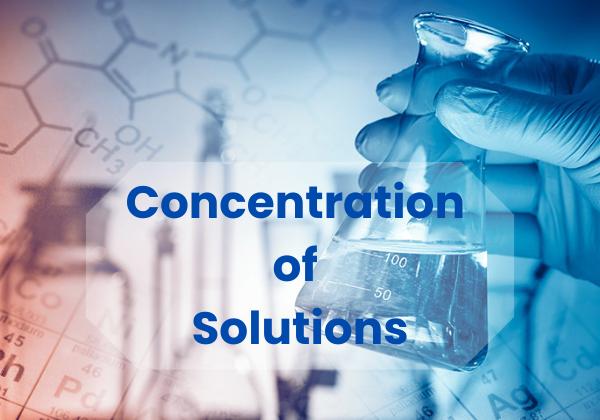

The concentration of a solution is a fundamental concept in chemistry that describes the amount of solute dissolved in a solvent. It plays a crucial role in various chemical processes and applications, from industrial manufacturing to laboratory experiments. This article provides a detailed explanation of different aspects of solution concentration, including types, significance, and methods of measuring concentration.
What is Solution Concentration?
Solution concentration refers to the quantity of solute present in a given quantity of solution or solvent. It provides insight into the strength or potency of a solution. Concentration can be expressed in different ways, including percentage, molarity, and normality, each serving specific purposes depending on the context of its application.
Types of Concentration
The concentration of a solution is a critical concept in chemistry that denotes the amount of solute present in a given amount of solution or solvent. Understanding the different types of concentration helps in accurately describing and manipulating solutions for various applications, whether in laboratory experiments, industrial processes, or everyday tasks. These types include percentage concentration, molarity, normality, molality, and units like parts per million (PPM) and parts per billion (PPB). Each type offers a unique way of expressing concentration, tailored to specific needs and contexts, providing insights into the solution’s composition and behavior.
Percentage Concentration
Percentage concentration is one of the simplest ways to express concentration. It indicates the amount of solute present in 100 parts of the solution. This can be expressed as mass percent, volume percent, or weight/volume percent:
- Mass Percent: This represents the mass of the solute divided by the total mass of the solution, multiplied by 100. For example, if a solution contains 10 grams of solute in 90 grams of solvent, the mass percent is 10100×100=10%\frac{10}{100} \times 100 = 10\%10010×100=10%.
- Volume Percent: This refers to the volume of solute divided by the total volume of the solution, multiplied by 100. It is commonly used when both solute and solvent are liquids. For instance, if 30 milliliters of alcohol is added to 70 milliliters of water, the volume percent of alcohol is 30100×100=30%\frac{30}{100} \times 100 = 30\%10030×100=30%.
- Weight/Volume Percent: This is used when the solute is in a solid form and the solvent is a liquid. It is the mass of solute divided by the volume of solution, multiplied by 100. For example, a solution with 5 grams of salt in 500 milliliters of water has a weight/volume percent of 5500×100=1%\frac{5}{500} \times 100 = 1\%5005×100=1%.
Molarity
Molarity (M) is a measure of the number of moles of solute per liter of solution. It is widely used in laboratory settings because it directly relates to the number of molecules of solute in a solution. Molarity provides a precise measure of concentration and is essential for preparing solutions with accurate amounts of solute. For instance, a 1 M solution contains 1 mole of solute in every liter of solution.
Normality
Normality (N) is a measure of concentration equivalent to the number of equivalents of solute per liter of solution. It is particularly useful in acid-base reactions and redox reactions. Normality considers the reactive capacity of the solute, which can vary depending on the type of reaction. For example, in a reaction where 1 mole of an acid reacts with 1 mole of base, the normality of the acid solution is equal to its molarity.
Molality
Molality (m) refers to the number of moles of solute per kilogram of solvent. Unlike molarity, which is based on the total volume of the solution, molality is based on the mass of the solvent. This measure is particularly useful in situations where temperature changes can affect the volume of the solution. Molality provides a consistent measure of concentration regardless of temperature fluctuations.
Parts Per Million (PPM) and Parts Per Billion (PPB)
PPM and PPB are units used to describe very dilute concentrations. PPM indicates the number of parts of solute per million parts of solution, while PPB indicates the number of parts per billion. These units are often used in environmental chemistry and quality control to measure trace amounts of substances.
Importance of Solution Concentration
Solution concentration plays a crucial role in a wide array of scientific and industrial applications, making it fundamental to chemistry and related fields. Accurately knowing the concentration of a solution is essential for understanding its properties, such as reactivity, solubility, and the rate of chemical reactions. It influences the formulation of products, from pharmaceuticals to industrial chemicals, ensuring efficacy and safety. In analytical chemistry, precise concentration measurements are vital for accurate results and reproducibility. Moreover, in environmental science, concentration data helps monitor pollutants and ensure regulatory compliance. Thus, grasping the concept of solution concentration is key to optimizing processes, ensuring quality, and solving practical problems in numerous disciplines.
Chemical Reactions
The concentration of solutions is crucial in chemical reactions, as it affects the reaction rate and equilibrium. Higher concentrations generally increase the frequency of collisions between reactant molecules, leading to faster reactions. Accurate concentration measurements are necessary to ensure reactions proceed as intended and yield the desired products.
Pharmaceuticals and Medicine
In the pharmaceutical industry, the concentration of active ingredients in medications must be precisely controlled to ensure efficacy and safety. Incorrect concentrations can lead to ineffective treatment or adverse effects. Understanding and measuring concentration are vital for developing and administering pharmaceutical products.
Environmental Science
Concentration measurements are essential in environmental science to monitor pollutant levels in air, water, and soil. Accurate concentration data help assess environmental quality, identify contamination sources, and implement remediation strategies.
Industrial Applications
In various industries, solution concentration affects product quality and manufacturing processes. For example, in the textile industry, the concentration of dye solutions influences the color intensity and uniformity of fabrics. In the food industry, concentration measurements ensure the consistency and safety of food products.
Laboratory Experiments
In laboratory settings, concentration is fundamental for preparing solutions with specific properties. Accurate concentration measurements ensure the reproducibility of experiments and the reliability of results. Researchers use concentration to control variables, test hypotheses, and draw meaningful conclusions from their studies.
Methods for Measuring Concentration
Accurate measurement of concentration is essential for understanding and manipulating chemical solutions in various scientific and industrial applications. Several methods are employed to determine the concentration of a solution, each suited to different types of substances and precision requirements. Techniques range from straightforward approaches, such as gravimetric and volumetric analysis, to more sophisticated instrumental methods like spectrophotometry and chromatography. Each method provides unique insights into the concentration levels, enabling precise formulation, quality control, and research. Understanding these methods helps ensure accurate data, supports effective experimentation, and enhances the reliability of results across diverse fields, including chemistry, biology, and environmental science.
Spectroscopy
Spectroscopic techniques, such as UV-Vis spectroscopy, are used to measure the concentration of solutes based on their absorbance of light. By comparing the absorbance of a solution with a calibration curve, researchers can determine the concentration of the solute.
Titration
Titration is a quantitative method used to determine the concentration of a solute by reacting it with a solution of known concentration (titrant). The endpoint of the reaction, often indicated by a color change, helps calculate the concentration of the solute in the sample.
Gravimetric Analysis
Gravimetric analysis involves measuring the mass of a solute or product to determine concentration. By precipitating the solute and weighing it, researchers can calculate the concentration based on the mass of the precipitate.
Refractometry
Refractometry measures the change in light refraction as it passes through a solution. The refractive index, which varies with concentration, helps determine the concentration of the solute.
Electrochemical Methods
Electrochemical methods, such as ion-selective electrodes, measure the concentration of ions in a solution based on their electrical activity. These methods are used for determining ion concentrations in various applications, including environmental and clinical analyses.
Understanding the concentration of a solution is essential for various scientific, industrial, and practical applications. From basic percentage concentration to advanced methods like spectroscopy and titration, accurate measurement and comprehension of concentration play a crucial role in ensuring the effectiveness and safety of chemical processes and products. Whether in a laboratory, pharmaceutical industry, or environmental monitoring, mastering the concept of solution concentration enhances our ability to control and optimize chemical systems.
Concentration of Solution FAQs
What is meant by the concentration of a solution?
Answer: The concentration of a solution refers to the amount of solute present in a given quantity of solvent or solution. It indicates how much solute is dissolved in the solvent and is typically expressed in various units such as molarity, molality, or weight percent.
How do different types of concentration affect a solution?
Answer: Different types of concentration, such as molarity, molality, and weight percent, offer various ways to express how much solute is in a solution. These types are used depending on the specific requirements of the experiment or application, and they can impact calculations related to reaction rates, equilibrium, and solution properties.
Why is it important to measure the concentration of a solution accurately?
Answer: Accurate measurement of solution concentration is crucial for precise scientific research, quality control in manufacturing, and proper formulation in pharmaceuticals and chemistry. It ensures that reactions occur as expected, products meet quality standards, and experimental results are reliable.
What are some common methods for measuring the concentration of a solution?
Answer: Common methods for measuring concentration include gravimetric analysis, volumetric analysis, spectrophotometry, and chromatography. Each method has its own applications and is chosen based on the nature of the solution and the required precision.
How can concentration affect the properties of a solution?
Answer: The concentration of a solution can influence its physical and chemical properties, such as boiling point, freezing point, density, and reactivity. Higher concentrations typically lead to more intense color, increased viscosity, and different reaction rates, impacting how the solution behaves in various conditions.
| Topic | Description | Format |
|---|---|---|
| Concentration of solution Class 9 | Concepts and definitions related to the concentration of solutions for Class 9 | Text |
| Ways of expressing concentration of solution PDF | Different methods to express the concentration of a solution (PDF) | |
| Concentration of solution formula | Formulas used to calculate the concentration of solutions | Text |
| Concentration of solution problems With answers | Practice problems on concentration of solutions along with their answers | Text |
| Concentration of solution example | Examples illustrating the calculation and expression of solution concentration | Text |
| 3 types of concentration of solution | Description of three main types of solution concentrations | Text |
| Concentration of solution in Chemistry | Detailed explanation of concentration in the context of Chemistry | Text |
| Numericals on concentration of solution class 9 with answers PDF | Numerical problems for Class 9 students with solutions (PDF) |