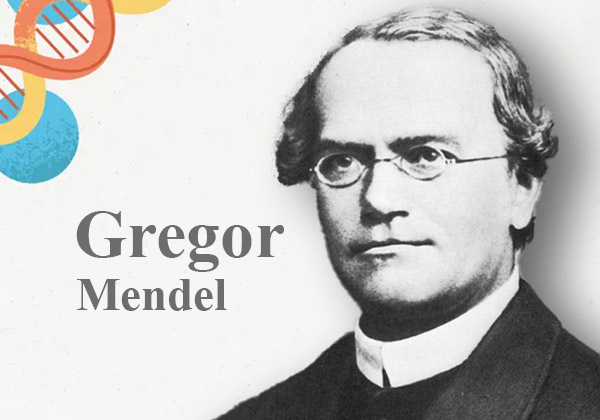

Genetics, the study of heredity and variation in living organisms, owes much of its foundational principles to Gregor Mendel, often hailed as the Father of Genetics. His pioneering work laid the groundwork for our understanding of how traits are passed from one generation to the next.
Gregor Mendel’s Early Life
Gregor Mendel, an Augustinian friar born in 1822 in what is now the Czech Republic, initially pursued a religious vocation but soon developed a keen interest in science and mathematics.
Experiments with Pea Plants
Mendel conducted groundbreaking experiments using pea plants in the monastery garden. He meticulously tracked traits such as seed color, pod shape, and plant height across generations.
Key Discoveries of Gregor Mendel
Through his experiments, Mendel formulated two fundamental principles of inheritance:
- The Law of Segregation: Each individual has two alleles (gene forms), one inherited from each parent, which segregate during gamete formation.
- The Law of Independent Assortment: Genes for different traits segregate independently of one another during the formation of gametes.
Recognition and Legacy of Gregor Mendel
Mendel’s work, published in 1865 but largely overlooked in his lifetime, gained recognition in the early 20th century when scientists rediscovered his experiments and recognized their significance. His insights laid the foundation for modern genetics and are integral to fields such as agriculture, medicine, and evolutionary biology.
Gregor Mendel’s contributions to genetics are immeasurable. His laws of inheritance remain fundamental to our understanding of genetics today, making him a pivotal figure in the history of science. By unraveling the mysteries of heredity, Mendel’s work continues to inspire and guide scientists in unlocking the secrets of life itself, reminding us of the power of observation, experimentation, and perseverance in advancing scientific knowledge.
Who is Known as the Father of Genetics?
Genetics, the study of heredity and variation in living organisms, owes much of its foundational principles to Gregor Mendel, often hailed as the Father of Genetics. His pioneering work laid the groundwork for our understanding of how traits are passed from one generation to the next.
Gregor Mendel’s Early Life
Gregor Mendel, an Augustinian friar born in 1822 in what is now the Czech Republic, initially pursued a religious vocation but soon developed a keen interest in science and mathematics.
Experiments with Pea Plants
Mendel conducted groundbreaking experiments using pea plants in the monastery garden. He meticulously tracked traits such as seed color, pod shape, and plant height across generations.
Key Discoveries of Gregor Mendel
Through his experiments, Mendel formulated two fundamental principles of inheritance:
- The Law of Segregation: Each individual has two alleles (gene forms), one inherited from each parent, which segregate during gamete formation.
- The Law of Independent Assortment: Genes for different traits segregate independently of one another during the formation of gametes.
Recognition and Legacy of Gregor Mendel
Mendel’s work, published in 1865 but largely overlooked in his lifetime, gained recognition in the early 20th century when scientists rediscovered his experiments and recognized their significance. His insights laid the foundation for modern genetics and are integral to fields such as agriculture, medicine, and evolutionary biology.
Gregor Mendel’s contributions to genetics are immeasurable. His laws of inheritance remain fundamental to our understanding of genetics today, making him a pivotal figure in the history of science. By unraveling the mysteries of heredity, Mendel’s work continues to inspire and guide scientists in unlocking the secrets of life itself, reminding us of the power of observation, experimentation, and perseverance in advancing scientific knowledge.
Who is Known as the Father of Genetics? FAQs
Q1. Who is Gregor Mendel?
Ans. Gregor Mendel, an Augustinian friar and scientist, is recognized as the Father of Genetics for his pioneering work with pea plants in the 19th century. His experiments laid the foundation for our understanding of how traits are inherited from one generation to the next.
Q2. What were Gregor Mendel's key discoveries?
Ans. Mendel formulated two fundamental principles of inheritance: the Law of Segregation and the Law of Independent Assortment. These laws explain how traits are passed down through generations and how different traits can appear independently of each other.
Q3. Why is Gregor Mendel called the Father of Genetics?
Ans. Mendel's experiments with pea plants were revolutionary because they provided the first clear explanation of how traits are inherited. His work demonstrated the existence of discrete units of inheritance, which we now call genes.
Q4. What is the significance of Mendel's work in genetics?
Ans. Mendel's discoveries laid the groundwork for modern genetics and evolutionary biology. His principles of inheritance are fundamental to fields such as agriculture, medicine, and biotechnology, shaping our understanding of genetic diversity and hereditary diseases.
Q5. How did Mendel's work impact scientific thinking?
Ans. Initially overlooked, Mendel's work gained prominence in the early 20th century when scientists rediscovered his experiments. His insights sparked a revolution in biology, transforming the study of heredity from a descriptive field into a quantitative science based on experimental evidence.