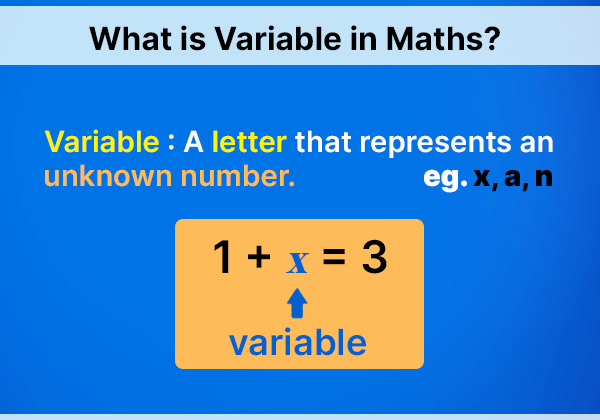

Variables are foundational concepts in mathematics, and they play a crucial role in various mathematical operations, equations, and functions. Understanding what a variable is and how it works is essential for anyone studying mathematics, whether at a basic or advanced level. This article delves into the concept of variables, explaining their significance, different types, uses in equations, and practical applications.
Understanding Variables: The Basics
In mathematics, a variable is a symbol or letter that represents a number or value that can change or vary. The term “variable” comes from the idea that these symbols can take on different values in different situations. For example, in the equation x+5=10x + 5 = 10x+5=10, the letter xxx is a variable. It represents a number that, when added to 5, gives the result 10.
Variables are usually denoted by letters such as x, y, or z, but any symbol can be used as a variable. They are an essential tool in algebra, calculus, and many other branches of mathematics.
Types of Variables in Mathematics
Variables can be classified into different types based on how they are used in mathematical equations and expressions. Here are some of the most common types:
1. Independent Variables
An independent variable is a variable that stands alone and isn’t affected by other variables in an equation. It is often the input in a function or equation, where its value determines the output. For example, in the equation y=2x+3y = 2x + 3y=2x+3, x is the independent variable because it is the input value that determines the value of y.
2. Dependent Variables
A dependent variable is a variable that depends on the value of the independent variable. Its value is determined by the equation or function. In the equation y=2x+3y = 2x + 3y=2x+3, y is the dependent variable because its value depends on the value of x.
3. Constant Variables
A constant variable is a variable that does not change its value. It is a fixed number within an equation or expression. For example, in the equation y=2x+3y = 2x + 3y=2x+3, the number 2 and 3 are constants. They remain the same regardless of the values of x or y.
4. Dummy Variables
Dummy variables are used in functions or equations to represent a general form of a variable. They often appear in summation, integration, and other operations where the variable itself is not as important as the process being performed. For example, in the summation ∑i=1ni\sum_{i=1}{n} i∑i=1ni, the variable iii is a dummy variable.
5. Random Variables
In statistics and probability, a random variable is a variable whose value is subject to randomness or uncertainty. It represents the outcomes of a random process. For example, in a coin toss, the outcome (heads or tails) can be represented by a random variable.
Variables in Equations
Variables are integral components of equations, and they serve various purposes depending on the type of equation. Here are some common types of equations that involve variables:
1. Linear Equations
A linear equation is an equation that represents a straight line when graphed on a coordinate plane. It has one or more variables, and the highest power of the variable is 1. An example of a linear equation is 2x+3=72x + 3 = 72x+3=7. Here, x is the variable, and solving the equation gives the value of x.
| Equation | Type | Description |
| y=2x+5y = 2x + 5y=2x+5 | Linear | Represents a straight line |
| 3x−4=23x – 4 = 23x−4=2 | Linear | Simple linear equation |
2. Quadratic Equations
A quadratic equation is an equation where the highest power of the variable is 2. It takes the form ax2+bx+c=0ax^2 + bx + c = 0ax2+bx+c=0, where a, b, and c are constants. For example, x2−4x+4=0x^2 – 4x + 4 = 0x2−4x+4=0 is a quadratic equation.
| Equation | Type | Description |
| x2−4x+4=0x^2 – 4x + 4 = 0x2−4x+4=0 | Quadratic | Represents a parabola when graphed |
| y=x2+6x+9y = x^2 + 6x + 9y=x2+6x+9 | Quadratic | Another example of a quadratic equation |
3. Polynomial Equations
A polynomial equation is an equation involving a polynomial expression, which can have multiple terms and variables with different powers. For example, x3+2×2−x+5=0x3 + 2×2 – x + 5 = 0x3+2×2−x+5=0 is a polynomial equation.
| Equation | Type | Description |
| x3+2×2−x+5=0x^3 + 2x^2 – x + 5 = 0x3+2×2−x+5=0 | Polynomial | Involves a polynomial expression |
| y=4×3−2x+7y = 4x^3 – 2x + 7y=4×3−2x+7 | Polynomial | Polynomial equation with multiple terms |
4. Exponential Equations
Exponential equations are equations where the variable appears in the exponent. For example, 2x=82x = 82x=8 is an exponential equation. These types of equations are common in growth and decay problems.
| Equation | Type | Description |
| 2x=82^x = 82x=8 | Exponential | Represents exponential growth or decay |
| y=5e2xy = 5e^{2x}y=5e2x | Exponential | Involves an exponential function |
5. Logarithmic Equations
Logarithmic equations involve logarithms of variables. For example, logx=2\log{x} = 2logx=2 is a logarithmic equation. These equations are often used to solve problems involving exponential growth and decay.
| Equation | Type | Description |
| logx=2\log{x} = 2logx=2 | Logarithmic | Involves the logarithm of a variable |
| logy=log(x+3)\log{y} = \log{(x+3)}logy=log(x+3) | Logarithmic | Another example of a logarithmic equation |
Variables in Functions
Variables are also crucial in functions, which are mathematical relationships between two or more variables. A function defines how one variable (the dependent variable) changes in relation to another variable (the independent variable).
1. Linear Functions
A linear function is a function that creates a straight line when graphed. It has the general form y=mx+by = mx + by=mx+b, where m is the slope, and b is the y-intercept.
2. Quadratic Functions
A quadratic function creates a parabolic shape when graphed. It has the general form y=ax2+bx+cy = ax2 + bx + cy=ax2+bx+c, where a, b, and c are constants.
3. Polynomial Functions
Polynomial functions involve polynomial expressions and can have multiple terms with different powers of the variable.
| Function | Type | Graph Shape |
| y=2x+3y = 2x + 3y=2x+3 | Linear | Straight line |
| y=x2−4x+4y = x^2 – 4x + 4y=x2−4x+4 | Quadratic | Parabola |
| y=x3+2×2−x+5y = x^3 + 2x^2 – x + 5y=x3+2×2−x+5 | Polynomial | Complex curve |
Practical Applications of Variables
Variables are not just abstract concepts; they have practical applications in various fields, including science, engineering, economics, and everyday life. Here are some examples:
1. Science and Engineering
In science and engineering, variables are used to model physical phenomena, conduct experiments, and analyze data. For example, in physics, variables like velocity, time, and acceleration are used to describe the motion of objects.
2. Economics
In economics, variables like price, demand, and supply are used to model and analyze market behavior. For instance, the equation Qd=a−bPQ_d = a – bPQd=a−bP models the demand for a product, where QdQ_dQd is the quantity demanded, P is the price, and a and b are constants.
3. Everyday Life
Variables are also used in everyday situations, such as budgeting, where income and expenses are variables that determine savings. For example, if you have a budget equation S=I−ES = I – ES=I−E, where SSS is savings, III is income, and EEE is expenses, changing the value of III or EEE affects your savings.
Variables are a fundamental concept in mathematics, providing the flexibility to represent unknown values, model real-world situations, and solve complex problems. Whether you are solving a simple algebraic equation or analyzing a complex function, understanding variables and their types is essential for mastering mathematics. With this knowledge, you can confidently tackle equations, functions, and real-life scenarios that involve variables, enhancing your mathematical skills and problem-solving abilities.
Variables in Mathematics FAQs
Q1. What is a variable in mathematics?
Ans: A variable in mathematics is a symbol, usually a letter, that represents a number or value that can change or vary. It is used in equations, expressions, and functions to denote unknown or changing quantities. For example, in the equation x+3=7x + 3 = 7x+3=7, xxx is the variable representing an unknown value.
Q2. How are independent and dependent variables different?
Ans: An independent variable is the input or cause that determines the outcome of an equation or function, and it stands alone without being affected by other variables. A dependent variable, on the other hand, is the output or effect that depends on the value of the independent variable. For example, in the function y=2x+3y = 2x + 3y=2x+3, xxx is the independent variable, and yyy is the dependent variable.
Q3. Can a variable be a constant in any situation?
Ans: While variables typically represent values that can change, in some cases, they can act as constants within specific contexts. For example, in an equation like y=3x+5y = 3x + 5y=3x+5, the numbers 3 and 5 are constants because they do not change, while xxx is the variable. However, the term "constant variable" is usually used to describe variables that remain fixed in a particular scenario, though they may change in a different context.
Q4. What is the role of variables in functions?
Ans: Variables play a crucial role in functions, where they represent the inputs and outputs of mathematical relationships. In a function, the independent variable is the input that you control or change, and the dependent variable is the output that depends on this input. For example, in the function f(x)=x2f(x) = x2f(x)=x2, xxx is the independent variable, and f(x)f(x)f(x) is the dependent variable representing the square of xxx.
Q5. How are variables used in real-life applications?
Ans: Variables are widely used in real-life applications, such as in science, engineering, economics, and everyday problem-solving. For example, in a physics equation like F=maF = maF=ma (where F is force, mmm is mass, and a is acceleration), variables help model physical phenomena. In economics, variables like price and quantity are used to analyze market behavior. In everyday life, variables can be used to calculate budgets, determine travel times, and solve various practical problems.