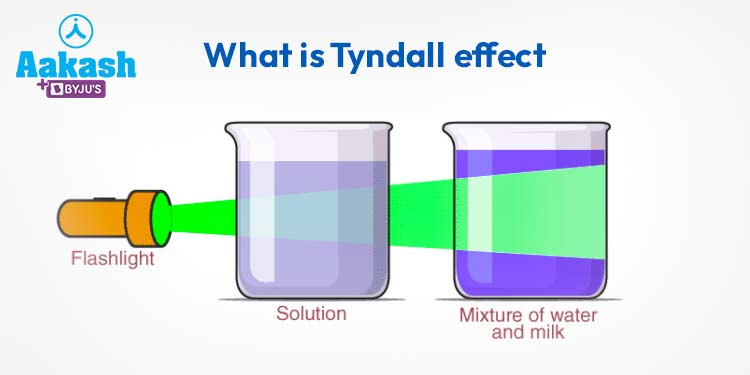

The world around us is filled with marvels, both seen and unseen. Among these phenomena, the Tyndall Effect stands as a captivating example of the interplay between light and matter. Named after the 19th-century Irish scientist John Tyndall, this phenomenon sheds light, quite literally, on the intriguing behavior of dispersed particles in a medium.
At its core, the Tyndall Effect refers to the scattering of light by colloidal particles or other small particles suspended in a transparent medium. This enchanting effect is what gives the sky its blue hue, transforms a glass of milk into a radiant canvas, and allows us to witness the path of light as it dances through a room filled with airborne particles.
The science behind the Tyndall Effect is elegantly simple yet captivatingly intricate. When light encounters a medium, it can interact with particles within that medium. If these particles are smaller than the wavelength of visible light, which is around 400 to 700 nanometers, they scatter light in all directions. This scattering is more pronounced when the wavelength of light matches the size of the particles, resulting in a dazzling display of colors. This is why we often see blue light scattered in the sky during the day, creating the phenomenon known as Rayleigh scattering.
In everyday life, we encounter the Tyndall Effect in various forms. Imagine a tranquil forest on a misty morning, where rays of sunlight pierce through the dense foliage, creating an ethereal glow. This phenomenon occurs due to the scattering of sunlight by water droplets and suspended particles in the air. Similarly, the iconic blue eyes of certain animals, such as Siamese cats and some huskies, owe their mesmerizing color to the Tyndall Effect, which scatters shorter blue wavelengths more than longer wavelengths.
Perhaps the most relatable example of the Tyndall Effect is observed when light passes through a translucent medium containing small particles. When a beam of light encounters these particles, it scatters and becomes visible to our eyes. This is why a flashlight beam is visible when shone into a dusty room or a foggy atmosphere. It’s also the reason why a spotlight on a stage can be seen more clearly when a fine mist is sprayed into the air.
Scientifically, the Tyndall Effect finds applications in various fields. Researchers and scientists utilize it to analyze particle sizes, concentrations, and characteristics of colloidal suspensions. In medicine, the Tyndall Effect is employed to determine the clarity of fluids and diagnose conditions such as jaundice, where the scattering of light can indicate the presence of certain substances in bodily fluids.
In essence, the Tyndall Effect reminds us that even the most ordinary phenomena can reveal profound insights into the nature of light, matter, and their intricate relationship. It is a reminder that our world is a treasure trove of hidden wonders, waiting to be uncovered by curious minds and the scientific pursuit of knowledge. So, the next time you marvel at a sunbeam filtering through mist or gaze into the depths of a glass of milk, remember that you are witnessing the poetic dance of light and matter, guided by the enchanting principles of the Tyndall Effect.
FAQs About the Tyndall Effect
1. What is the Tyndall Effect?
The Tyndall Effect is a scientific phenomenon where light is scattered by small particles suspended in a transparent medium. This scattering of light makes the path of the light beam visible and often imparts a distinctive color to the scattered light. The effect is named after John Tyndall, the Irish physicist who extensively studied and explained this phenomenon in the 19th century.
2. How does the Tyndall Effect work?
When light encounters particles in a medium that is smaller than the wavelength of visible light, it gets scattered in all directions. This scattering is more pronounced when the wavelength of light matches the size of the particles, resulting in the scattering of specific colors. This is why we often see blue light scattered in the sky during the day, creating the blue color of the sky.
3. What are some everyday examples of the Tyndall Effect?
The Tyndall Effect can be observed in various everyday scenarios. Some examples include the blue color of the sky due to sunlight scattering off air molecules and particles, the visible beam of a flashlight in a dusty room, the glow of sunlight through mist or fog, and the bluish tint of certain animal eyes caused by the scattering of shorter blue wavelengths.
4. How is the Tyndall Effect used in science and applications?
Scientists and researchers use the Tyndall Effect to study particle sizes and concentrations in colloidal suspensions. It is also used in fields like medicine to diagnose conditions such as jaundice, where the scattering of light in bodily fluids indicates the presence of certain substances. Additionally, the Tyndall Effect is employed in industries such as cosmetics and food to test the clarity of liquids.
5. Can the Tyndall Effect be seen with all types of light?
The Tyndall Effect is most noticeable with visible light, particularly in the blue and violet range of the spectrum. It can also occur with other forms of electromagnetic radiation, such as X-rays and ultraviolet light. However, the effect might not be as readily observable in these cases unless specific conditions are met.