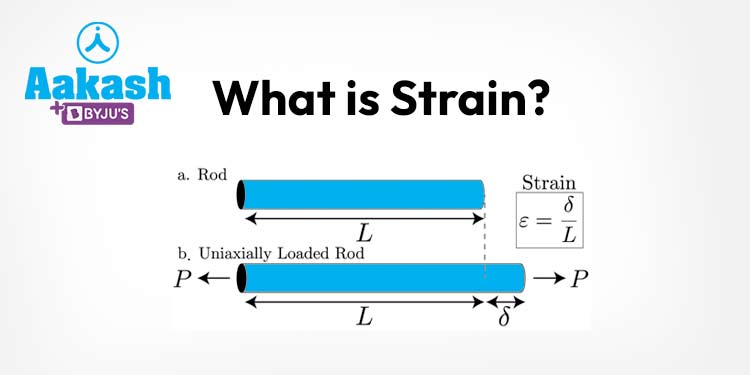

In the world of physics, various terms and concepts help us comprehend the behavior and properties of materials. One such fundamental concept is strain. Strain plays a crucial role in understanding the deformation of objects and how they respond to external forces. Whether you’re a student delving into the realm of physics or simply curious about the topic, this blog will provide you with a comprehensive understanding of strain.
Defining Strain
Strain, in physics, refers to the measure of the deformation or change in shape experienced by a material when subjected to external forces. It quantifies the relative change in size or shape of an object in response to applied stress. Strain is expressed as a dimensionless quantity and is typically represented by the Greek letter epsilon (ε).
Types of Strain
There are two main types of strain: linear strain and shear strain.
Linear Strain:
Linear strain, also known as normal strain or tensile strain, measures the change in length of an object along a specific direction. It is calculated by dividing the change in length (∆L) by the original length (L₀) of the object:
Linear Strain (ε) = (∆L / L₀)
Linear strain can be positive for elongation or negative for compression, depending on whether the object is stretched or compressed.
Shear Strain:
Shear strain measures the change in the shape of an object without a change in volume. It occurs when forces act parallel to each other but in opposite directions. Shear strain is denoted by the Greek letter gamma (γ) and is calculated by dividing the change in the angle (∆θ) by the original angle (θ₀):
Shear Strain (γ) = (∆θ / θ₀)
Shear strain is responsible for the distortion or slippage between adjacent layers of material.
Relationship between Strain and Stress
Strain and stress are interconnected concepts. Stress refers to the internal resistance of a material to deformation, while strain measures the resulting deformation itself. Stress is typically denoted by the Greek letter sigma (σ) and is defined as the force (F) applied per unit area (A):
Stress (σ) = (F / A)
The relationship between stress and strain is governed by the material’s elastic properties, described by a physical property known as Young’s modulus (E). Young’s modulus relates to stress and strain through the equation:
Stress (σ) = Young’s Modulus (E) × Strain (ε)
This equation implies that for a given material, the amount of strain-induced is proportional to the stress applied. Young’s modulus is a material property that characterizes its stiffness or elasticity.
Applications of Strain
Understanding strain is vital in various fields, including materials science, engineering, and construction. It helps engineers and designers evaluate the behavior and durability of materials under different conditions. Strain measurements are crucial in designing structures to ensure their integrity, stability, and safety. By analyzing the strain response of materials, scientists can predict and prevent potential failures and accidents.
Conclusion
Strain is a fundamental concept in physics that quantifies the deformation of materials when subjected to external forces. By measuring the change in size or shape of an object, scientists and engineers can analyze the response of materials under stress. Understanding strain allows us to design and construct structures that are efficient, safe, and reliable. The relationship between strain and stress, as described by Young’s modulus, helps us predict and evaluate the behavior of materials in real-world applications. With a deeper comprehension of strain, we gain valuable insights into the intricate mechanics of the physical world.