
Semiconductors are materials with electrical conductivity between that of conductors (like metals) and insulators (like rubber). This unique property makes them vital in electronics, from computers to smartphones. Unlike conductors, which allow free movement of electrons, and insulators, which restrict it, semiconductors control electron flow in specific conditions. This controlled conductivity is essential for creating electronic components such as diodes, transistors, and integrated circuits. This article discusses details on what semiconductors are, their types, properties, working principles, uses in modern technology, and key differences from conductors and insulators, providing a comprehensive understanding for those interested in physics and electronics.
What is a Semiconductor?
A semiconductor is a material that has an electrical conductivity level between that of a conductor and an insulator. Unlike conductors, such as copper, which easily allow electric current to pass through, or insulators, like glass, which block the flow of electricity, semiconductors can control electrical flow in a unique way. This special property makes them crucial in the world of electronics. The conductivity of a semiconductor can be changed by adding specific impurities through a process called doping. This process introduces extra electrons or creates “holes” where electrons can move, thereby altering how well the material conducts electricity. Additionally, the conductivity of semiconductors can be influenced by external factors such as temperature and electric fields. For example, raising the temperature can increase the number of charge carriers (electrons and holes), thus improving conductivity.
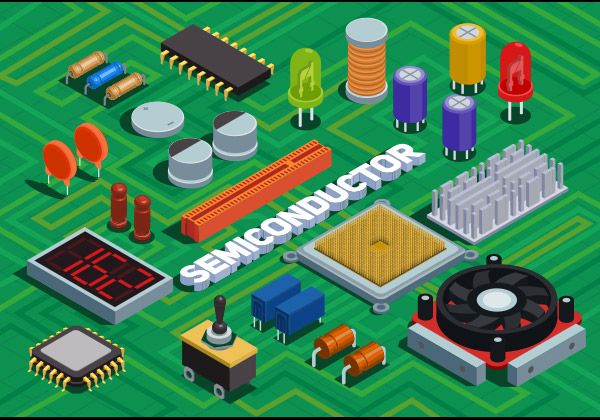
Semiconductors are the building blocks of many modern electronic devices, including computers, smartphones, and solar panels. Their ability to control electrical currents with precision makes them essential for creating various electronic components like transistors, diodes, and integrated circuits. This versatility and control are why semiconductors are fundamental to modern technology.
Types of Semiconductors
Semiconductors are divided into two main types: intrinsic and extrinsic.
Intrinsic Semiconductors
Intrinsic Semiconductors are pure materials with no added impurities. The most common examples are silicon (Si) and germanium (Ge). These materials have a specific level of electrical conductivity on their own. Their ability to conduct electricity changes with temperature. As the temperature increases, more electrons gain enough energy to move from the valence band to the conduction band, which enhances the material’s conductivity.
Extrinsic Semiconductors
Extrinsic Semiconductors are created by adding impurities to the intrinsic semiconductors. This process is known as doping and changes their electrical properties. Extrinsic semiconductors are classified into two types:
- n-type Semiconductors: These are doped with elements that add extra electrons to the material. These additional electrons act as negative charge carriers. For example, adding phosphorus to silicon creates an n-type semiconductor. The extra electrons improve the material’s conductivity.
- p-type Semiconductors: These are doped with elements that create “holes” where electrons are missing, which act as positive charge carriers. An example is boron-doped silicon. The holes enhance conductivity by allowing positive charge to move through the material.
Both types of semiconductors are essential for creating various electronic devices and components.
Properties of Semiconductors
Semiconductors are distinguished by a few key properties that make them essential in electronics:
Variable Conductivity
One of the most important properties of semiconductors is their ability to change how well they conduct electricity. Their conductivity can be increased by raising the temperature or by introducing impurities through doping. As the temperature goes up, more electrons gain enough energy to move from the valence band to the conduction band, enhancing conductivity. Doping introduces extra charge carriers, either electrons or holes, which also increases conductivity.
Energy Band Gap
Semiconductors have an energy band gap, which is the energy difference between the valence band (where electrons are usually found) and the conduction band (where electrons move to conduct electricity). This gap is smaller than in insulators, which have a large energy band gap, but larger than in conductors, which have overlapping bands. The size of this band gap determines how easily electrons can move and thus how well the semiconductor can conduct electricity.
Carrier Movement
In semiconductors, electrical current is carried by both electrons and “holes” (vacancies where an electron is missing). When an electric field is applied, electrons move towards the positive side, and holes move towards the negative side. This movement of charge carriers allows electric current to flow through the semiconductor material.
How Semiconductors Work?
Semiconductors control the flow of electric current in a precise manner. Here’s how they operate:
- Application of Voltage: When a voltage is applied to a semiconductor, it provides energy to the electrons in the material. This energy helps the electrons move from the valence band (where they are normally bound) to the conduction band (where they can freely move).
- Creation of Holes: As electrons jump to the conduction band, they leave behind “holes” in the valence band. These holes act as positive charge carriers, creating spaces where electrons can move into.
- Movement of Charge Carriers: In the presence of an electric field, electrons in the conduction band move towards the positive terminal, while holes move towards the negative terminal. This movement of both electrons and holes constitutes an electric current.
- Effect of Doping: By adding impurities (doping) to the semiconductor, the number of charge carriers can be increased. For n-type semiconductors, extra electrons are added, while for p-type semiconductors, holes are created. This manipulation enhances the material’s conductivity.
- Device Functionality: These principles are used to create various electronic devices. For example, in diodes, semiconductors allow current to flow in one direction only, while in transistors, they can amplify or switch electronic signals.
This controlled flow of current is fundamental to the operation of modern electronics.
Uses of Semiconductors in Technology
Semiconductors are crucial in nearly all modern electronic devices due to their unique properties. Here’s how they are used:
- Transistors: These are essential components in electronic circuits. Transistors act as switches or amplifiers. As switches, they control the flow of electrical signals, turning them on or off. As amplifiers, they boost weak electrical signals to stronger ones. This function is fundamental in devices like computers, radios, and televisions.
- Diodes: Diodes allow electric current to flow in only one direction. This property is important in converting alternating current (AC) to direct current (DC) in rectifiers. Diodes are also used in signal demodulators to extract signals from a carrier wave, which is crucial in communication systems like radio and television.
- Integrated Circuits (ICs): ICs are compact assemblies of multiple semiconductor devices, such as transistors and diodes, on a single chip. They are used in almost all electronic devices, including computers, smartphones, and tablets. ICs help reduce the size and cost of electronic devices while increasing their functionality and reliability.
- Solar Cells: Solar cells use semiconductor materials, like silicon, to convert sunlight into electrical energy. When light strikes the semiconductor, it creates electron-hole pairs, generating an electric current. This technology is used in solar panels to produce renewable energy for homes and businesses.
These applications highlight how semiconductors enable the functionality of everyday electronic devices and contribute to advancements in technology and energy.
Key Differences Between Conductors, Insulators, and Semiconductors
Here’s a comparison of conductors, insulators, and semiconductors based on their key properties:
| Property | Conductors | Insulators | Semiconductors |
| Conductivity | High | Low | Moderate, varies with conditions |
| Examples | Copper, Silver, Aluminum | Rubber, Glass, Plastic | Silicon, Germanium, Gallium Arsenide |
| Temperature Effect | Conductivity decreases with temperature | No significant effect | Conductivity increases with temperature |
| Energy Band Gap | No gap (overlapping bands) | Large gap | Small gap |
Explanation
- Conductors: Materials like copper and aluminum are good conductors of electricity because they have high conductivity. This means they allow electric current to flow easily. However, their conductivity decreases as the temperature rises due to increased resistance.
- Insulators: Materials such as rubber, glass, and plastic have low conductivity, meaning they do not allow electric current to flow easily. The conductivity of insulators is not significantly affected by temperature, and they have a large energy band gap, which prevents electrons from moving easily.
- Semiconductors: Materials like silicon and germanium have moderate conductivity, which can change under different conditions. Their conductivity increases with temperature as more electrons gain enough energy to move. Semiconductors have a small energy band gap, which allows them to control the flow of electricity effectively.
This comparison helps in understanding how different materials behave in electrical applications and their suitability for various uses in electronics.
Key Differences Between Intrinsic and Extrinsic Semiconductors
Intrinsic and extrinsic semiconductors are two fundamental types with distinct characteristics. Here’s a comparison to highlight their key differences:
| Aspect | Intrinsic Semiconductors | Extrinsic Semiconductors |
| Purity | Pure materials with no added impurities. | Doped with specific impurities to alter properties. |
| Examples | Silicon (Si), Germanium (Ge) | Phosphorus-doped Silicon (n-type), Boron-doped Silicon (p-type) |
| Conductivity | Conductivity is relatively low and depends on temperature. | Conductivity is higher and controlled by the type and amount of doping. |
| Charge Carriers | Generates electron-hole pairs naturally. | Contains extra electrons (n-type) or holes (p-type) due to doping. |
| Effect of Doping | No doping involved; conductivity changes with temperature. | Doping introduces either excess electrons or holes to enhance conductivity. |
| Temperature Dependence | Conductivity increases with temperature as more electrons move to the conduction band. | Conductivity is less affected by temperature and more by the type of doping. |
Intrinsic Semiconductors are pure materials like silicon and germanium. Their conductivity is relatively low and changes with temperature. They generate charge carriers naturally without additional help.
Extrinsic Semiconductors are modified with impurities (doping) to improve their conductivity. They can be n-type, with extra electrons, or p-type, with extra holes. This doping allows for more control over their electrical properties, making them crucial for creating various electronic components.
Common Examples of Semiconductor Materials
Semiconductors are used in many electronic devices, and different materials are chosen based on their specific properties. Here are some common semiconductor materials:
| Material | Description | Common Uses |
| Silicon (Si) | The most widely used semiconductor material. It has a moderate energy band gap and is found in most electronic devices. | Computer processors, memory chips, solar cells |
| Germanium (Ge) | Known for its high electron mobility and efficiency at high frequencies. It has a smaller band gap compared to silicon. | High-speed electronic devices, infrared detectors |
| Gallium Arsenide (GaAs) | Offers high electron mobility and is efficient for high-frequency applications. It has a larger band gap than silicon. | Microwave and satellite communications, LED lights |
| Silicon Carbide (SiC) | Known for its ability to withstand high temperatures and voltages. It has a wide band gap and is very durable. | Power electronics, electric vehicle components |
| Gallium Nitride (GaN) | Has a wide band gap and is known for its high efficiency and thermal stability. It is excellent for high-power applications. | High-efficiency LEDs, power amplifiers, RF devices |
These materials are chosen based on their electrical properties, such as band gap and mobility, which make them suitable for various electronic applications.
The Future of Semiconductor Technology in Electronics
The future of semiconductor technology holds exciting possibilities that will shape the electronics industry. Here’s what to expect:
- Smaller and More Powerful Devices: As technology advances, semiconductors will become even smaller and more efficient. This means that electronic devices, like smartphones and computers, will continue to become more powerful while remaining compact. Enhanced semiconductor materials and designs will enable faster processing speeds and lower power consumption.
- Advanced Materials: Researchers are exploring new materials beyond silicon, such as graphene and gallium nitride. These materials could lead to semiconductors that perform better at higher speeds and temperatures, and are more energy-efficient.
- Flexible Electronics: The development of flexible semiconductors will enable new types of electronics that can bend and stretch. This could lead to innovative products like foldable screens, wearable electronics, and flexible solar panels.
- Quantum Computing: Semiconductors are crucial for the development of quantum computers, which use quantum bits or qubits to perform complex calculations much faster than traditional computers. This could revolutionize fields like cryptography, materials science, and artificial intelligence.
- Improved Energy Efficiency: Future semiconductor technology will focus on reducing energy consumption and improving efficiency. This is important for both consumer electronics and large data centers, helping to lower electricity use and reduce environmental impact.
Overall, advancements in semiconductor technology will drive progress in electronics, making devices faster, more flexible, and energy-efficient, while opening doors to new technological innovations.
What is Semiconductor in Physics? FAQs
Q1. What is a semiconductor in physics?
A semiconductor is a material with electrical conductivity between conductors and insulators. It can conduct electricity under certain conditions, such as when doped with impurities or exposed to temperature changes. This controlled conductivity is crucial for electronic devices like transistors and diodes.
Q2. How do semiconductors work?
Semiconductors work by allowing controlled electrical current flow. When voltage is applied, electrons move from the valence band to the conduction band, creating holes. This movement of electrons and holes allows the semiconductor to conduct electricity, making it essential for electronic components like transistors and diodes.
Q3. What are the types of semiconductors?
Semiconductors are mainly classified into intrinsic and extrinsic types. Intrinsic semiconductors are pure materials like silicon and germanium. Extrinsic semiconductors are doped with impurities to enhance conductivity, and are further divided into n-type (extra electrons) and p-type (holes).
Q4. Why are semiconductors important in electronics?
Semiconductors are vital in electronics because they can control electrical current flow with precision. They are used in devices like transistors, diodes, and integrated circuits, which are fundamental to modern electronics, including computers, smartphones, and solar panels.
Q5. What future advancements are expected in semiconductor technology?
Future advancements in semiconductor technology include the development of smaller, more powerful devices, new materials like graphene, flexible electronics, and quantum computing. These innovations will enhance performance, energy efficiency, and open new possibilities for technology and electronics.