If you ever open a radio, amplifier, or many kinds of digital devices, you will see small black parts with three legs—these are transistors. In the world of electronics, transistors are considered the heart of almost every electronic circuit.
One important type is the PNP transistor. What does it do, how does it work, and where is it used? This blog will explain everything you need to know about a PNP transistor in clear and simple English, so anyone can understand—even if you’re just starting out in electronics.
What Is a Transistor?
A transistor is a semiconductor device used in almost all modern electronics to switch, amplify, or regulate electrical signals. It usually has three key parts, called terminals:
- Emitter (E)
- Base (B)
- Collector ©
There are two main types of transistors:
- Bipolar Junction Transistors (BJTs)
- Field Effect Transistors (FETs)
Our main focus here is the BJT, and specifically, the PNP type.
What Is a PNP Transistor?
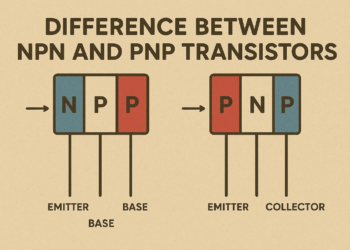
A PNP transistor is a type of Bipolar Junction Transistor. The name comes from its structure:
- “P” stands for a region made of p-type semiconductor (positive, with extra “holes” or absence of electrons).
- “N” is a region made of n-type semiconductor (negative, with extra electrons).
- The letters show how the three layers are arranged: P-type, N-type, and P-type again (P-N-P).
So, a PNP transistor consists of a thin N-type layer sandwiched between two thicker P-type layers. This structure gives it special properties and allows current to flow in a certain way.
Parts of a PNP Transistor
Let’s look at each part:
1. Emitter (E)
- Supplies the main charge carriers (for PNP, these are holes).
- Heavily “doped,” which means it has a lot of charge carriers (holes).
- Always forward-biased (positively charged) with respect to the base, so it easily sends charge carriers into the base.
2. Base (B)
- Very thin and lightly doped layer.
- Acts as the gate of the transistor: it controls how many charge carriers move from emitter to collector.
- In a PNP transistor, this is made from N-type semiconductor, so there are not as many electrons.
3. Collector (C)
- Collects the charge carriers (holes) that pass through the base.
- Also heavily doped and larger than the emitter, but not as heavily as the emitter.
- Usually reverse-biased (negatively charged) with respect to the base, so it has a strong attraction for the charge carriers.
The Symbol of a PNP Transistor
The symbol for a PNP transistor shows an arrow on the emitter leg, pointing into the base. This arrow shows the direction of “conventional” current (from positive to negative), which for a PNP transistor is from emitter to base.
How Does a PNP Transistor Work?
The PNP transistor works by using small changes in the base current to control a much larger current that flows from emitter to collector.
Basic Principle
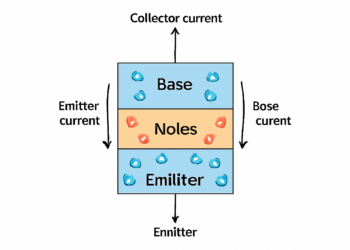
- Forward Bias: The emitter-base junction is connected so that the emitter is positive compared to the base.
- Reverse Bias: The base-collector junction is connected so that the collector is negative compared to the base.
- When a small current flows out of the base (from base to ground), it allows a much larger current to flow from the emitter to the collector.
Detailed Step-by-Step Working
Applying Voltage
- The positive terminal of the power supply is connected to the emitter.
- The negative terminal of the power supply is connected to the base.
- This creates a forward bias at the emitter-base junction.
Charge Carrier Movement
- The forward bias causes the emitter to inject holes (majority carriers in PNP) into the base.
- The base is thin and has few electrons. Most “holes” do not recombine in the base; instead, they keep moving into the collector layer.
Collector Action
- The collector, being reverse biased, attracts these holes.
- So, a large current flows from emitter → base → collector.
Current Flow: Usually, the collector current is the largest part; the base current is a tiny fraction.
Amplification
- Because a small change in base current controls a much larger collector current, the transistor amplifies signals.
Direction of Current in a PNP Transistor
- Conventional Current: Flows from emitter to collector. This is opposite to the flow in an NPN transistor (which flows from collector to emitter).
- Base Current: In PNP, the base current flows out of the base (from base to ground).
Construction of a PNP Transistor
- The base (N-type) is very thin and lightly doped.
- The emitter and collector (P-type) are heavily doped with more holes, so they can supply and collect more charge carriers.
- The depletion region between the emitter and base is very narrow (because it’s forward biased), while the collector-base junction has a wider depletion region (because it’s reverse biased).
Characteristics of PNP Transistors
- Current direction: From emitter (P-type) to collector (P-type) through the thin base layer (N-type).
- On-State: The PNP transistor is ON when no current flows into the base (instead, current must flow out of the base). This is the opposite of NPN, which is ON when a current flows into the base.
- Amplifies or switches signals: Small base current controls large collector-emitter current, so it works as an amplifier or as a switch.
- Majority Charge Carrier: Holes are the main charge carriers for PNP.
PNP vs NPN Transistor: What’s the Difference?
| Feature | NPN Transistor | PNP Transistor |
| Layers | N-P-N | P-N-P |
| Main charge carrier | Electrons | Holes |
| Current direction | Collector → Emitter | Emitter → Collector |
| Powering “ON” | Current into base | No current into base (current out) |
| Symbol arrow | Points out of the emitter | Points into the emitter |
| Common use | More common for most applications | Used when negative voltage needs switching |
Types of PNP Transistors
PNP transistors come in different types based on application:
- Small-signal PNP: used in low-power signal amplification.
- Power PNP: designed for switching and controlling larger currents.
- Darlington PNP: two transistors combined for extra amplification.
- Schottky PNP: for high-speed applications.
Key Properties and Parameters
When you pick a PNP transistor for your circuit, you should consider:
- Voltage rating: Maximum voltage it can handle between collector and emitter.
- Current rating: Max collector current.
- Gain (β): How much amplification: typically between 20 and 200 or more.
- Power Dissipation: Maximum heat it can handle, beyond which it can be damaged.
- Frequency Response: How well it works at different speeds (frequencies).
- Saturation/Cut-off: Whether it is fully ON or OFF, it is important for switching applications.
How to Use a PNP Transistor?
As a Switch
- When used as a switch, the PNP transistor turns ON when a low signal (relative to the emitter) is applied to the base.
- It can control devices like LEDs, motors, and relays.
- Its OFF-state is when there’s no voltage difference between emitter and base; the ON-state is when the base is at a lower voltage.
As an Amplifier
- Used to boost weak audio, radio, or sensor signals.
- Common in audio amplifiers and signal processing circuits.
- The PNP transistor can be set up in different “configurations” (common-emitter, common-base, common-collector), depending on the wanted amplification type.
Application Circuits Examples
- LED Switching: Turning ON/OFF an LED based on a signal.
- Motor Control: Switching a DC motor using a small control signal.
- Audio Amplification: Making weak microphone signals strong enough to power a speaker.
- Voltage Regulators: Keeping output voltage steady in power supplies.
- Oscillators: Creating repeating signals for timers and alarms.
Advantages of PNP Transistors
- Complements NPN transistors for full circuit designs (push-pull stages, H-bridges).
- Often used when the positive voltage supply is the reference or the ground for the control circuit is not convenient.
- Good for high-side switching.
- Effective in circuits where the load must be connected to ground, and the switch connects to the positive supply.
Disadvantages of PNP Transistors
- Less commonly used than NPN transistors in some circuits (especially logic circuits).
- Slightly more susceptible to temperature changes than NPN counterparts.
- Sometimes more limiting in switching speed due to “hole” movement being slower than electron movement.
- May require different drive circuitry than NPN transistors when used in microprocessor-based designs.
PNP Transistor in Everyday Life
You don’t need to look far to find PNP transistors at work. Some real-world uses include:
- In old radios and amplifiers, both NPN and PNP types are paired to create clearer sound.
- Used in the power supply section of appliances to ensure stable voltage.
- As switches in home automation systems—like automatic fans, alarm systems, and lighting.
How to Identify a PNP Transistor?
- Check the part number (like BC558, 2N3906—these are common PNP types).
- Circuit symbol arrow points into the base.
- If testing with a multimeter (diode test mode), you’ll notice one pin (emitter) allows “current” only when the positive probe is on the emitter and the negative probe is on the base—the reverse of NPN.
FAQs
Q1: What are the three terminals of a PNP transistor?
A: A PNP transistor has three terminals: the Emitter, which emits holes; the Base, which controls current; and the Collector, which collects the charge carriers flowing through.
Q2: In which direction does current flow in a PNP transistor?
A: In a PNP transistor, current flows from the Emitter to the Collector, as holes (positive charge carriers) move through the transistor when the Base is more negative.
Q3: What is the typical use of a PNP transistor?
A: PNP transistors are mainly used for amplifying electrical signals or as electronic switches, turning devices ON or OFF in various analog and digital circuits, especially in negative power configurations.
Q4: Which type provides the majority charge carriers in PNP?
A: In a PNP transistor, holes are the majority charge carriers, meaning they are responsible for current conduction, unlike electrons which dominate in NPN transistors.
Q5: Are PNP transistors used in digital ICs?
A: While NPN transistors are more commonly used, PNP transistors are still important in complementary logic and analog circuit designs, helping create push-pull amplifier stages or symmetrical responses.
Conclusion
A PNP transistor is a small, but powerful, electronic device. When you understand how it works, you can build and repair many kinds of circuits, from amplifiers to switches and even parts of computers. By being able to control large currents with a tiny signal, the PNP transistor remains one of the pillars of modern electronics.
Whether you’re just learning or designing advanced circuits, understanding the PNP transistor will form the foundation for more complex electronics knowledge in your future.
Also Read
Difference Between NPN and PNP Transistors
PNP Transistor
NPN Transistor
What is a Transistor
What is Fet?
Bipolar Junction Transistor (BJT)
Characteristics of a Transistor
Uses of Transistors
Also Read
Difference Between NPN and PNP Transistors
PNP Transistor
NPN Transistor
What is a Transistor
What is Fet?
Bipolar Junction Transistor (BJT)
Characteristics of a Transistor
Uses of Transistors