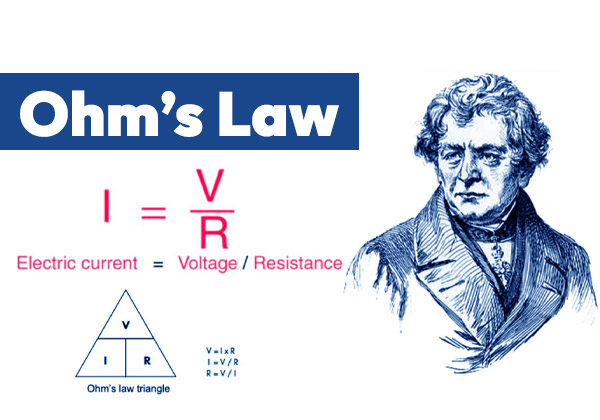

Ohm’s Law is a fundamental principle in physics that describes the relationship between voltage, current, and resistance in an electrical circuit. It is named after the German physicist Georg Simon Ohm, who first formulated the law in the early 19th century. Understanding Ohm’s Law is essential for anyone studying electronics or electrical engineering, as it forms the basis for analyzing and designing electrical circuits. This article explores the definition of Ohm’s Law, its mathematical representation, practical applications, and key concepts.
What is Ohm’s Law?
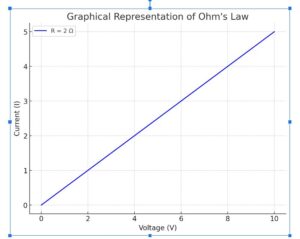
Ohm’s Law is a basic rule in physics that explains how voltage, current, and resistance are connected in an electrical circuit. It was discovered by a German scientist named Georg Simon Ohm in the 1820s. The law states that the current flowing through a conductor between two points is directly proportional to the voltage across those points and inversely proportional to the resistance.
This means that if you increase the voltage, the current will increase too, as long as the resistance stays the same. On the other hand, if you increase the resistance, the current will decrease if the voltage remains constant. The formula for Ohm’s Law is written as V=IRV = IRV=IR, where V stands for voltage, I for current, and R for resistance. This law is important because it helps us understand how electrical circuits work, making it easier to design and troubleshoot them.
The Mathematical Expression of Ohm’s Law
The mathematical expression of Ohm’s Law is a simple formula that helps us understand how voltage, current, and resistance are related in an electrical circuit. The formula is written as, V stands for voltage, I for current, and R for resistance.
This means that the voltage across a conductor (like a wire) is equal to the current flowing through it multiplied by its resistance. If you know any two of these values, you can easily calculate the third one using this formula. For example, if you know the voltage and resistance, you can find the current by rearranging the formula to
This expression is fundamental in electrical engineering and physics because it helps us design circuits, understand how they work, and solve problems related to electricity.
Fundamentals of Ohm’s Law
Definition: Ohm’s Law is a basic principle in electrical engineering and physics that describes the relationship between voltage, current, and resistance in a circuit.
Key Components:
- Voltage (V): This is the electrical potential difference between two points in a circuit. It’s like the “push” that makes electric charges move through a conductor. Voltage is measured in volts (V).
- Current (I): This is the flow of electric charge through a conductor, like water flowing through a pipe. It’s measured in amperes (A), often just called “amps.”
- Resistance (R): This is the opposition to the flow of current in a conductor. It’s like friction that slows down the flow of electric charges. Resistance is measured in ohms (Ω).
- Voltage is equal to the current multiplied by the resistance.
- If voltage increases and resistance stays the same, the current will also increase.
- If resistance increases and voltage stays the same, the current will decrease.
Application:
- Circuit Design: Engineers use Ohm’s Law to design circuits by choosing the right components that will produce the desired current and voltage.
- Problem Solving: It helps in calculating unknown values in a circuit when two of the three components are known.
Limitations: Ohm’s Law applies only to ohmic materials, where the resistance remains constant regardless of the voltage or current. In materials where resistance changes, Ohm’s Law doesn’t apply straightforwardly.
Derivation and Proof of Ohm’s Law
The derivation and proof of Ohm’s Law start with understanding how electric current flows through a conductor. When a voltage is applied across a conductor, it creates an electric field that pushes charged particles, usually electrons, to move. This movement of charges is what we call an electric current.
Ohm’s Law is derived from the observation that the current flowing through a conductor is directly proportional to the voltage applied across it and inversely proportional to the resistance of the conductor.
Here’s a step-by-step explanation:
- Proportional Relationship: Experimentally, it was observed that if you increase the voltage applied to a conductor, the current increases proportionally. Mathematically, this can be expressed as , where I is the current and V is the voltage.
- Introduction of Resistance: The constant of proportionality in this relationship is the resistance RRR of the conductor. Resistance depends on factors like the material, length, and cross-sectional area of the conductor.
- Formulation of the Law: Combining the proportional relationship with resistance, we get the equation V=IR. This means the voltage across a conductor is equal to the product of the current flowing through it and its resistance.
- Proof: Ohm’s Law has been verified through numerous experiments with various materials and circuits, consistently showing that the law holds true for ohmic materials, where resistance remains constant regardless of voltage and current.
Thus, Ohm’s Law is both a theoretical and experimentally proven principle that is foundational in understanding electrical circuits.
Practical Applications of Ohm’s Law
Ohm’s Law is essential in electrical engineering and everyday life, offering practical applications like circuit design, troubleshooting, and ensuring the safe operation of electronic devices and systems.
Circuit Design: Engineers use Ohm’s Law to design electrical circuits by calculating the right values of voltage, current, and resistance. This ensures that circuits function safely and efficiently.
Determining Resistor Values: Ohm’s Law helps in selecting the correct resistor values in a circuit. By knowing the desired current and voltage, you can calculate the necessary resistance using R=V/I
Troubleshooting Electrical Problems: When there is a malfunction in an electrical circuit, Ohm’s Law can be used to identify the issue. By measuring the voltage and current, the resistance can be calculated and compared to expected values to find faults.
Battery Life Estimation: Ohm’s Law helps in estimating how long a battery will last in a device. By knowing the voltage of the battery and the resistance of the device, the current draw can be calculated, which helps in estimating battery life.
Understanding Power Consumption: The law is used to calculate the power consumption of electrical devices. Since power P=VI , knowing the current and voltage allows you to calculate how much power a device uses.
Designing Home Electrical Systems: In household electrical systems, Ohm’s Law helps in choosing the right wire sizes and circuit breakers. This ensures that wires don’t overheat and circuits are protected from overload.
Creating Safe Electronic Devices: Manufacturers apply Ohm’s Law to design electronic devices that operate within safe voltage and current limits, preventing overheating and ensuring user safety.
Graphical Representation of Ohm’s Law
Limitations of Ohm’s Law In Physics
Non-Ohmic Materials: Ohm’s Law applies only to ohmic materials where the resistance remains constant, regardless of the voltage or current. Non-ohmic materials, like diodes or transistors, do not follow Ohm’s Law because their resistance changes with voltage and current.
Temperature Dependence: Ohm’s Law assumes that the resistance of a material remains constant, but in reality, resistance can change with temperature. For example, as the temperature of a conductor increases, its resistance usually increases, causing deviations from Ohm’s Law.
High-Frequency Circuits: In high-frequency AC circuits, Ohm’s Law may not apply accurately due to the effects of inductance and capacitance, which cause the impedance (a combination of resistance, inductance, and capacitance) to vary with frequency.
Electrolytes and Gasses: Ohm’s Law does not hold for electrolytes and gasses, where the relationship between voltage and current is not linear. In these cases, the current might vary in a non-linear fashion with applied voltage.
Strong Electric Fields: In cases where very strong electric fields are applied, the material’s properties can change, leading to a breakdown or a nonlinear relationship between voltage and current, thus violating Ohm’s Law.
Quantum Effects: At the quantum scale or in superconductors, where resistance can be zero or very small, Ohm’s Law does not apply as expected, requiring more advanced theories to describe the behavior of current and voltage.
Examples and Problems Based on Ohm’s Law
Simple Circuit:
Description: A basic circuit has a resistor with a resistance of 10 ohms and a voltage supply of 20 volts. Using Ohm’s Law (V = IR), the current flowing through the resistor can be calculated as
Calculating Resistance:
Description: If a circuit has a current of 5 amperes and the voltage is 15 volts, the resistance can be found using
Voltage Drop Across a Resistor:
Description: In a series circuit with a total resistance of 4 ohms and a current of 3 amperes, the voltage drop across the resistor is calculated as
Ohm’s Law in Series and Parallel Circuits
1. Ohm’s Law in Series Circuits:
In a series circuit, the components are connected end-to-end, so the same current flows through all components, but the voltage is divided among them.
- Total Resistance: The total resistance in a series circuit is the sum of the individual resistances.
- Total Voltage: The total voltage across the series circuit is the sum of the voltage drops across each resistor.
- Current (III): The current is the same through each resistor and can be calculated using Ohm’s Law:
Example:
2. Ohm’s Law in Parallel Circuits:
In a parallel circuit, the components are connected across the same voltage source, so the voltage is the same across each component, but the current is divided among them.
- Total Resistance: The total resistance in a parallel circuit is given by:
- Total Voltage: The voltage across each resistor is the same and equal to the source voltage.
- Total Current: The total current is the sum of the currents through each resistor.
Example:
- Given:
- Total Resistance:
- Current through
- Current through
- Total Current:
Understanding Ohm’s Law in series and parallel circuits is crucial for analyzing and designing electrical circuits efficiently.
What is Ohm’s Law? – FAQs
Q1. What is Ohm's Law?
Ohm's Law is a fundamental principle in physics that relates the voltage (V), current (I), and resistance (R) in an electrical circuit. It states that the current flowing through a conductor between two points is directly proportional to the voltage across the two points and inversely proportional to the resistance. The formula is V=IR.
Q2. How do you apply Ohm's Law to find the current?
To find the current using Ohm's Law, use the formula I=V/R . Here, I is the current, V is the voltage across the resistor, and R is the resistance. Simply divide the voltage by the resistance to determine the current.
Q3. Can Ohm's Law be used for both AC and DC circuits?
Yes, Ohm's Law applies to both alternating current (AC) and direct current (DC) circuits. However, in AC circuits, impedance (which combines resistance and reactance) replaces resistance in the formula. For DC circuits, the formula V=IR is straightforward, as resistance is the only factor affecting the current.
Q4. What are the limitations of Ohm's Law?
Ohm's Law does not apply to non-ohmic materials, where resistance changes with voltage or current. Examples include semiconductors and components like diodes and transistors. Ohm’s Law also assumes constant temperature and material properties, which might not hold true in all practical scenarios.
Q5. What are the applications of Ohm’s Law?
Ohm’s Law is used to design and analyze electrical circuits, determine current, voltage, and resistance, and ensure safe operation of devices in household electronics, power systems, and electrical engineering.