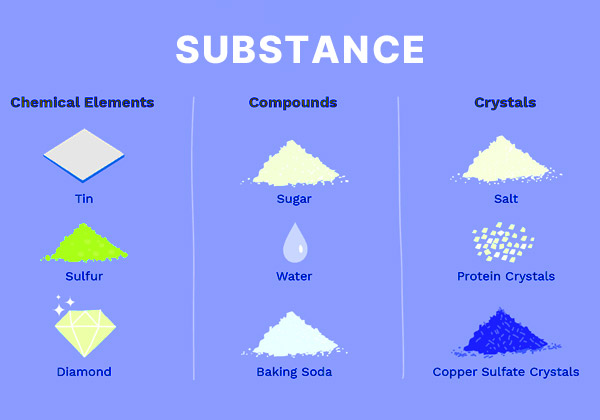

In scientific terminology, a “substance” refers to any form of matter with a specific composition and distinct properties. The concept of a substance is fundamental in chemistry and other scientific disciplines, as it helps in classifying and understanding different forms of matter. Substances are broadly categorized into elements, compounds, and mixtures, each with unique characteristics and roles.
- Elements are pure substances consisting of only one type of atom. They are the simplest form of matter and serve as the basic building blocks for more complex substances. Examples include hydrogen, oxygen, and gold.
- Compounds are substances formed when two or more elements chemically combine in fixed ratios. These compounds have unique properties that are distinct from those of their constituent elements. Water (H₂O) and carbon dioxide (CO₂) are common examples.
- Mixtures consist of two or more substances that are not chemically bonded. They can be homogeneous, where the composition is uniform throughout (like saltwater), or heterogeneous, where different components are visible (like a salad).
Understanding substances is crucial for various applications, from scientific research and industrial processes to medical treatments and environmental management. The study of substances helps us grasp their behaviors, interactions, and impacts, facilitating advancements in technology, health, and safety.
Types of Substances
| Type of Substance | Description | Examples | Characteristics |
| Elements | Pure substances consisting of only one type of atom. | Hydrogen, Oxygen, Gold | Building blocks of all matter; cannot be broken down further by chemical means. |
| Compounds | Substances formed by the chemical combination of two or more elements in fixed proportions. | Water (H₂O), Carbon Dioxide (CO₂) | Have unique properties different from their constituent elements; can be decomposed into elements by chemical reactions. |
| Mixtures | Combinations of two or more substances that are not chemically bonded. | Saltwater, Salad | Can be homogeneous (uniform composition) or heterogeneous (distinct, separate components); can be physically separated. |
Functions of Substances
Substances play essential roles in various functions, including:
- Chemical Reactions: Substances react with each other to form new products, driving processes in both nature and industry. For example, photosynthesis in plants converts carbon dioxide and water into glucose and oxygen.
- Material Properties: The physical and chemical properties of substances determine their usability. For instance, metals like steel are used in construction due to their strength, while plastics are used for their flexibility and durability.
- Biological Processes: In biology, substances such as enzymes and hormones are crucial for regulating bodily functions. Enzymes catalyze biochemical reactions, while hormones regulate growth and metabolism.
Importance of Substances
Understanding substances is fundamental for several reasons:
- Scientific Research: Knowledge of substances and their interactions is vital for advancing scientific research and developing new technologies.
- Medicine: Pharmaceuticals and medical treatments rely on the specific properties of substances to diagnose and treat diseases effectively.
- Environmental Protection: Understanding substances helps in addressing environmental issues, such as pollution and waste management, by identifying harmful chemicals and finding sustainable alternatives.
Uses and Effects of Substances
- Industrial Uses: Substances are used in manufacturing, from creating everyday products like detergents and plastics to specialized materials like semiconductors.
- Consumer Products: Substances are integral to consumer goods, including food, cosmetics, and cleaning agents.
- Health and Safety: The effects of substances on health and the environment are studied to ensure safety and prevent harm. For instance, regulations are in place to control the use of hazardous chemicals in products.
In summary, substances are fundamental to our understanding of the material world. Their types, functions, importance, uses, and effects are integral to scientific advancements, industrial processes, and everyday life. Understanding these aspects helps us harness their potential while mitigating any negative impacts.
FAQs: Substances – Types, Functions, Importance, Uses, and Effects
Q1. What is a substance in chemistry?
Answer: In chemistry, a substance is a form of matter with a specific composition and distinct properties. Substances can be pure elements, compounds, or mixtures. Elements consist of only one type of atom, compounds are made up of two or more elements chemically combined, and mixtures contain multiple substances that are not chemically bonded.
Q2. What are the different types of substances?
Answer: The main types of substances are:
Elements: Pure substances consisting of one type of atom (e.g., oxygen, gold).
Compounds: Substances formed from two or more elements chemically combined in fixed ratios (e.g., water, carbon dioxide).
Mixtures: Combinations of two or more substances that are not chemically bonded, which can be either homogeneous (uniform composition) or heterogeneous (distinct components).
Q3. Why is understanding substances important?
Answer: Understanding substances is crucial for various reasons, including scientific research, industrial applications, and medical treatments. It helps in developing new technologies, creating effective pharmaceuticals, and addressing environmental issues.
Q4. How are substances used in everyday life?
Answer: Substances are used in a wide range of everyday products and processes. For example, metals and plastics are used in manufacturing, while substances like salt and sugar are used in food. Additionally, substances are key in medical treatments, environmental protection, and consumer goods.
Q5. What effects do substances have on health and the environment?
Answer: The effects of substances on health and the environment can be significant. Harmful substances can cause health issues or environmental damage if not properly managed. For example, certain chemicals can be toxic or pollute water sources. Understanding these effects helps in developing safety regulations and finding sustainable alternatives.
What is Meant by a Substance Class 6, 7, 8, 9, and 11
| Class/Level | Topic | Description |
|---|---|---|
| Class 9 | What is meant by a substance | A substance is a form of matter that has constant chemical composition and characteristic properties. It cannot be separated into components by physical separation methods. |
| Class 6 | What is meant by a substance | A substance is a type of matter with a uniform and definite composition. All samples of a substance have the same properties. |
| Class 7 | What is meant by a substance | A substance is a material with consistent properties and composition throughout. It is either an element or a compound. |
| Chemistry | What is meant by a substance in chemistry | In chemistry, a substance refers to a matter with a specific composition and distinct chemical properties. Substances can be pure (elements or compounds) or mixtures. |
| Class 11 | What is meant by a substance | A substance is matter that has a specific composition and specific properties. It can be classified into elements and compounds. |
| Class 9 | Points of differences between homogeneous and heterogeneous mixtures | Homogeneous Mixture: Uniform composition, single phase, e.g., saltwater. Heterogeneous Mixture: Non-uniform composition, multiple phases, e.g., salad. |
| Science | Substance meaning in Science | In science, a substance is a form of matter that has a uniform and unchanging composition. |
| Science | What is meant by a pure substance | A pure substance is a material that has a constant composition and has consistent properties throughout the sample. It can be an element or a compound. |