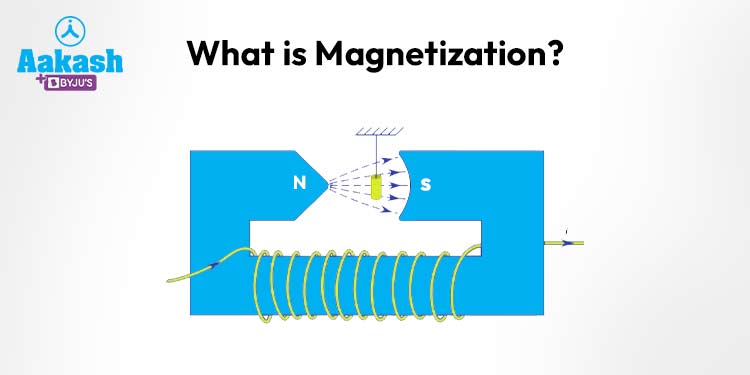

Magnetization is a fascinating and fundamental phenomenon in the realm of physics that underlies the behavior of magnets and magnetic materials. At its core, magnetization refers to the process by which a material becomes magnetized, acquiring the ability to attract or repel other materials with magnetic properties. This phenomenon plays a crucial role in various scientific, technological, and everyday applications, ranging from medical imaging to transportation and power generation.
Understanding Magnetism: A Brief Overview
Magnetism, one of the four fundamental forces of nature, arises from the intrinsic magnetic moments of elementary particles, such as electrons and protons, as well as the collective behavior of these moments in larger structures. These magnetic moments originate from the spinning and orbital motion of charged particles within atoms. When these moments align in a particular way, they create a magnetic field.
Magnetization occurs when a material’s magnetic domains, which are regions within the material where magnetic moments are aligned, become more coordinated. In a non-magnetized state, these domains point in random directions, resulting in a cancellation of their magnetic effects on a larger scale. However, when the domains align, the material becomes magnetized and exhibits magnetic properties.
Types of Magnetization
There are several ways in which magnetization can be achieved:
Ferromagnetism: In ferromagnetic materials, like iron, cobalt, and nickel, the magnetic moments of atoms spontaneously align due to strong interactions between neighboring moments. This leads to the creation of permanent magnets, capable of retaining their magnetization even after the external magnetic field is removed.
Paramagnetism: Paramagnetic materials, such as aluminum and oxygen, possess magnetic moments that align with an external magnetic field but do not maintain their magnetization once the field is removed. These materials are only weakly attracted to magnetic fields and are often used in applications like magnetic resonance imaging (MRI).
Diamagnetism: Diamagnetic materials, like copper and water, exhibit weak magnetic properties and oppose the creation of an external magnetic field. When placed in a magnetic field, the material’s magnetic moments align in the opposite direction, resulting in a temporary reduction of the external field’s effect.
Antiferromagnetism and Ferrimagnetism: These are intermediate cases between ferromagnetism and paramagnetism. In antiferromagnetic materials, neighboring magnetic moments align in opposite directions, cancelling each other out on a larger scale. In ferrimagnetic materials, moments are aligned, but the cancellation is incomplete, resulting in a net magnetic moment.
Applications of Magnetization
The concept of magnetization has far-reaching applications across various fields:
Electromagnetic Devices: Magnetization is essential in the creation of motors, generators, transformers, and other electromagnetic devices. These devices utilize the interactions between magnetic fields and electric currents to produce motion, generate power, and convert energy.
Magnetic Data Storage: Hard drives and magnetic tapes rely on magnetization to store and retrieve digital information. Binary data is encoded as patterns of magnetization on the storage medium’s surface.
Medical Imaging: Magnetic resonance imaging (MRI) utilizes the magnetic properties of atoms in the body to create detailed images of internal structures. Magnetization plays a crucial role in the functioning of MRI machines.
Navigation and Compasses: Magnetization has been used for centuries in navigation, as compass needles align with Earth’s magnetic field, allowing for accurate orientation.
Material Testing and Analysis: Magnetization is employed in non-destructive testing methods, such as magnetic particle testing and eddy current testing, to detect defects and flaws in materials.
In conclusion, magnetization is a captivating phenomenon that arises from the intrinsic properties of matter at the atomic and molecular levels. Its impact extends from our understanding of the fundamental forces governing the universe to the practical applications that shape our modern world. As we continue to explore and harness the power of magnetization, we unveil new possibilities for technological innovation and scientific discovery.
FAQs About Magnetization
1. What is magnetization, and how does it occur?
Magnetization is the process by which a material becomes magnetized, acquiring the ability to attract or repel other materials with magnetic properties. It occurs when the magnetic moments within a material’s atoms or molecules align in a coordinated manner, creating a net magnetic field.
2. What are magnetic domains, and how do they relate to magnetization?
Magnetic domains are regions within a material where the magnetic moments of atoms or molecules are aligned. In a non-magnetized state, these domains point in random directions, resulting in a minimal overall magnetic effect. Magnetization involves aligning these domains to produce a stronger, more coherent magnetic field.
3. Can all materials be magnetized?
No, not all materials can be easily magnetized. Only materials that contain atoms or molecules with unpaired electrons and exhibit a degree of magnetic ordering can be magnetized. Ferromagnetic materials, such as iron and nickel, are highly magnetizable, while materials like copper and aluminum are weakly magnetic or non-magnetic.
4. What is the difference between ferromagnetism and paramagnetism?
Ferromagnetism involves the spontaneous alignment of magnetic moments in a material, leading to the creation of permanent magnets. Paramagnetism, on the other hand, occurs when magnetic moments align with an external magnetic field but do not maintain their alignment once the field is removed. Paramagnetic materials are weakly attracted to magnetic fields.
5. How is magnetization used in everyday life and technology?
Magnetization has a wide range of applications. It is essential for creating electromagnetic devices like motors and generators, as well as in magnetic data storage technologies like hard drives. Medical imaging techniques like MRI rely on the magnetic properties of atoms in the body. Magnetization is also used in navigation (compasses), material testing, and various industrial processes, showcasing its significance in both scientific research and practical advancements.