
Angles are fundamental concepts in geometry, playing a crucial role in understanding shapes, structures, and various mathematical principles. Whether in basic geometry or advanced applications, a thorough understanding of angles and their types is essential. This article explores the concept of angles, their types, and their practical significance.
What is an Angle?
An angle is formed when two rays or lines meet at a common point called the vertex. The rays are referred to as the sides of the angle. Angles are measured in degrees (°), which quantifies the amount of rotation or turn between the two rays. The basic concept of an angle involves understanding how two lines intersect and the space they enclose.
Basic Components of an Angle
Angles are fundamental geometric concepts that help us understand how shapes and figures are formed and interact. The basic components of an angle include the vertex, where the two lines or rays meet, and the sides, which are the lines or rays that form the angle. Understanding these components is crucial for grasping how angles function and are measured, providing the foundation for more complex geometric concepts.
- Vertex: The common point where the two rays meet.
- Sides: The rays or lines that form the angle.
- Measurement: The angle is measured in degrees or radians, indicating the size of the turn between the two rays.
Types of Angles
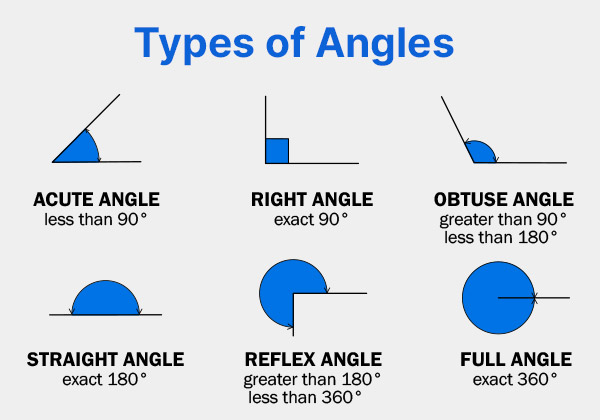
Angles can be categorized into several distinct types based on their measurements. These include acute angles, which are less than 90 degrees; right angles, which are exactly 90 degrees; obtuse angles, which exceed 90 degrees but are less than 180 degrees; and straight angles, which measure exactly 180 degrees. Each type of angle has unique properties and plays a specific role in geometric configurations and calculations.
1. Acute Angle
An acute angle is one that measures less than 90 degrees. It is the sharpest type of angle and appears frequently in various geometric shapes.
| Angle Type | Measurement | Description |
|---|---|---|
| Acute Angle | < 90° | Sharp, less than a right angle |
2. Right Angle
A right angle measures exactly 90 degrees. It forms a perfect corner and is commonly seen in squares and rectangles.
| Angle Type | Measurement | Description |
|---|---|---|
| Right Angle | 90° | Forms a perfect corner or square corner |
3. Obtuse Angle
An obtuse angle measures more than 90 degrees but less than 180 degrees. It appears larger than a right angle and is often seen in various polygon shapes.
| Angle Type | Measurement | Description |
|---|---|---|
| Obtuse Angle | > 90° and < 180° | Larger than a right angle |
4. Straight Angle
A straight angle measures exactly 180 degrees. It forms a straight line, representing a complete turn.
| Angle Type | Measurement | Description |
|---|---|---|
| Straight Angle | 180° | Forms a straight line |
5. Reflex Angle
A reflex angle measures more than 180 degrees but less than 360 degrees. It is the larger angle formed when a straight angle is divided.
| Angle Type | Measurement | Description |
|---|---|---|
| Reflex Angle | > 180° and < 360° | Larger angle, beyond a straight line |
6. Full Angle
A full angle measures exactly 360 degrees. It represents a complete rotation around a point.
| Angle Type | Measurement | Description |
|---|---|---|
| Full Angle | 360° | Represents a complete rotation |
Types of Angles Based on Their Position
Angles can also be classified based on their positional relationships to one another. This classification includes complementary angles, which add up to 90 degrees; supplementary angles, which sum to 180 degrees; adjacent angles, which share a common side and vertex; and vertical angles, which are opposite each other when two lines intersect. Understanding these positional relationships helps in solving geometric problems and analyzing various angle configurations.
1. Complementary Angles
Complementary angles are two angles whose measures add up to 90 degrees. Each angle is called the complement of the other.
| Angle Type | Measurement | Description |
|---|---|---|
| Complementary Angles | Sum = 90° | Two angles that together form a right angle |
2. Supplementary Angles
Supplementary angles are two angles whose measures add up to 180 degrees. Each angle is called the supplement of the other.
| Angle Type | Measurement | Description |
|---|---|---|
| Supplementary Angles | Sum = 180° | Two angles that together form a straight angle |
3. Adjacent Angles
Adjacent angles are two angles that share a common side and vertex but do not overlap. They are next to each other and can be part of a larger geometric figure.
| Angle Type | Measurement | Description |
|---|---|---|
| Adjacent Angles | Varied | Share a common side and vertex |
4. Vertical Angles
Vertical angles are the angles opposite each other when two lines intersect. They are equal in measure and form a pair of congruent angles.
| Angle Type | Measurement | Description |
|---|---|---|
| Vertical Angles | Equal | Opposite angles formed by intersecting lines |
5. Alternate Angles
Alternate angles are formed when a transversal intersects two parallel lines. They come in two types: alternate interior and alternate exterior angles.
| Angle Type | Measurement | Description |
|---|---|---|
| Alternate Interior Angles | Equal | Formed inside the parallel lines |
| Alternate Exterior Angles | Equal | Formed outside the parallel lines |
6. Corresponding Angles
Corresponding angles are formed when a transversal intersects two parallel lines. They are located in the same relative position at each intersection and are equal.
| Angle Type | Measurement | Description |
|---|---|---|
| Corresponding Angles | Equal | Located in the same position at each intersection |
Practical Applications of Angles
The study of angles extends beyond theoretical mathematics into practical applications across multiple fields. In engineering and architecture, angles are essential for designing stable structures and ensuring proper alignment. Artists and designers use angles to create perspective and symmetry in their work, while navigation and sports rely on angles for accurate direction and technique. Understanding the practical uses of angles enhances problem-solving skills and provides insights into real-world applications.
- Engineering and Architecture: Angles are fundamental in designing structures, ensuring stability and proper alignment.
- Art and Design: Artists use angles to create perspective and symmetry in their work.
- Navigation and Mapping: Angles are used to determine directions and locations in navigation.
- Sports: Angles play a role in strategies and techniques in sports like soccer, basketball, and golf.
The concept of angles is a cornerstone of geometry and mathematics, with applications extending into many areas of daily life and professional fields. Understanding the different types of angles, their measurements, and their properties provides a solid foundation for solving geometric problems and appreciating the role of angles in various contexts. Whether you’re analyzing a geometric shape, designing a structure, or simply observing the world around you, a grasp of angles enhances your mathematical skills and spatial awareness.
By familiarizing yourself with these concepts, you gain valuable insights into the world of geometry and its practical uses, contributing to a deeper understanding of both mathematical theory and real-world applications.
FAQs on Angles and Their Types
Q1. What are the basic components of an angle?
Ans: The basic components of an angle include the vertex, which is the point where the two rays or lines meet, and the sides, which are the rays or lines that form the angle. The angle is measured by the amount of rotation or turn between these two sides, quantified in degrees.
Q2. What is the difference between acute, right, and obtuse angles?
Ans: An acute angle measures less than 90 degrees, appearing sharp and narrow. A right angle measures exactly 90 degrees and forms a perfect corner. An obtuse angle measures more than 90 degrees but less than 180 degrees, appearing wider and more open than a right angle.
Q3. How do complementary and supplementary angles differ?
Ans: Complementary angles are two angles whose measures add up to 90 degrees. Supplementary angles are two angles whose measures add up to 180 degrees. Complementary angles often form a right angle when combined, while supplementary angles form a straight line.
Q4. What are vertical angles and how are they related?
Ans: Vertical angles are the pairs of angles formed when two lines intersect. They are located opposite each other and are equal in measure. Vertical angles are congruent, meaning they have the same angle measurement.
Q5. How are angles used in practical applications?
Ans: Angles have various practical applications, such as in engineering and architecture for designing and constructing buildings, in art and design for creating perspective and symmetry, and in navigation and sports for determining directions and optimizing techniques. Understanding angles helps in solving real-world problems and enhances accuracy in these fields.