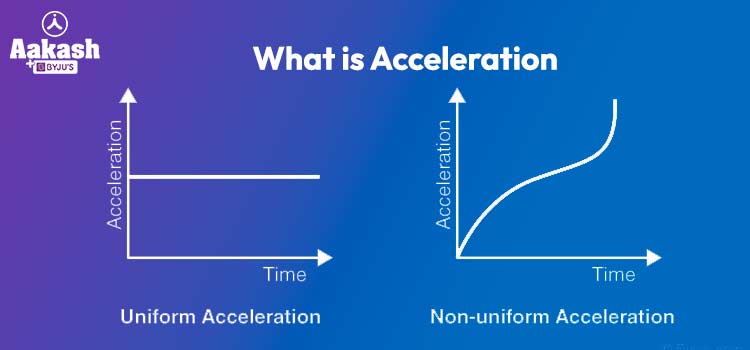

Acceleration, a fundamental concept in physics, holds the key to understanding how objects change their state of motion. We witness acceleration every day, whether it’s a car speeding up on the highway or a ball falling freely toward the ground. In this blog, we will delve into the captivating world of acceleration, exploring its definition, characteristics, equations, and real-world applications that make it a powerful force in the study of motion and the laws of nature.
Defining Acceleration
Acceleration is the rate at which an object’s velocity changes with time. In simpler terms, it measures how quickly an object’s speed or direction of motion changes. When an object speeds up, slows down, or changes direction, it experiences acceleration.
Characteristics of Acceleration
Positive and Negative Acceleration:
Positive acceleration occurs when an object’s speed increases with time. In contrast, a negative acceleration, also known as deceleration or retardation, happens when an object’s speed decreases with time.
The direction of Acceleration:
Acceleration can occur in the same direction as an object’s velocity (speeding up) or in the opposite direction (slowing down).
Constant Acceleration:
When an object’s acceleration remains the same throughout its motion, it experiences constant acceleration. A classic example of constant acceleration is an object in free fall due to gravity.
Equations of Acceleration
Average Acceleration:
Average acceleration (a_avg) is calculated using the following formula:
a_avg = (change in velocity) / (time taken for change)
Instantaneous Acceleration:
Instantaneous acceleration is the acceleration of an object at a specific moment in time. It can be determined by taking the derivative of the object’s velocity with respect to time.
a = dv/dt
Where “a” is the instantaneous acceleration, “dv” is the change in velocity, and “dt” is the change in time.
Applications of Acceleration
Acceleration plays a crucial role in various real-world scenarios and applications:
Automotive Industry:
In the automotive industry, understanding acceleration is vital for designing safe and efficient vehicles. Engineers use acceleration data to develop advanced braking systems and optimize engine performance.
Sports and Athletics:
In sports, acceleration is essential for athletes to achieve maximum speed and agility. Sprinters, for example, work on improving their acceleration to gain a competitive edge.
Space Exploration:
In space missions, acceleration is a critical factor in rocket propulsion. The precise control of acceleration is necessary to launch spacecraft and navigate through space.
Physics Experiments:
Acceleration is often measured in physics experiments to study the behavior of objects under the influence of forces and gravity.
Conclusion
Acceleration is a remarkable force that governs changes in an object’s motion. Its presence is felt in every aspect of our lives, from the motion of vehicles on the road to the behavior of celestial bodies in space. By understanding the principles and equations of acceleration, we gain valuable insights into the forces that shape the motion of objects in our universe. As we continue to unravel the mystery of acceleration, we unlock the secrets of changing motion, allowing us to explore the world of physics and engineering with a new perspective and appreciation for the laws of nature.
FAQs
What is acceleration?
Acceleration is the rate at which an object's velocity changes with time. It measures how quickly an object's speed or direction of motion changes.
How is acceleration different from velocity?
Velocity represents an object's speed and direction of motion, while acceleration measures how quickly the velocity is changing. An object can have a constant velocity but experience acceleration if its speed or direction changes.
What are the units of acceleration?
The units of acceleration depend on the system of measurement used. In the International System of Units (SI), acceleration is measured in meters per second squared (m/s²).
What is positive acceleration?
Positive acceleration occurs when an object's speed increases with time. It is often associated with speeding up.
What is negative acceleration?
Negative acceleration, also known as deceleration or retardation, happens when an object's speed decreases with time. It is associated with slowing down.
What is constant acceleration?
Constant acceleration occurs when an object's acceleration remains the same throughout its motion. An example is an object in free fall due to gravity.
What is instantaneous acceleration?
Instantaneous acceleration is the acceleration of an object at a specific moment in time. It is determined by taking the derivative of the object's velocity with respect to time.
What are some real-world applications of acceleration?
Acceleration has various applications, including designing safe and efficient vehicles in the automotive industry, optimizing athletic performance in sports, controlling rocket propulsion in space exploration, and conducting physics experiments to study the behavior of objects under forces and gravity.
How does acceleration relate to Newton's laws of motion?
Acceleration is directly related to Newton's Second Law of Motion, which states that the acceleration of an object is directly proportional to the net force acting on it and inversely proportional to its mass (a = F / m). Newton's First Law of Motion, the Law of Inertia, also ties into acceleration, as it explains how objects maintain their state of motion or rest unless acted upon by an external force.