
Transistor is a tiny electronic device that dictates the flow of the current on the circuits. It is used as a switch or amplifier and it is a strongly employed component in current electronic gadgets such as computers, radios, and smartphones.
Transistors are made from semiconductor materials and come in different types, such as NPN and PNP. They play a major role in processing signals and building logic gates in electronics.
In this blog, we will explore what a transistor is, its functions, types, structure, working, and various uses of transistor in the field of electronics.
What is a Transistor?
A transistor is a semiconductor with three or more terminals (usually labeled emitter, base and collector) that is used to switch electric current or power. Electronically speaking, mundanely, a transistor is a tiny signal at the base that can switch a much bigger current between the emitter and collector.
This causes the transistor to be useful in switching (turning circuits on and off) and amplification (strengthening weak signals). The definition of a transistor implies that it is a device in which one of the terminals regulates the resistance between the other two (this is the explanation of why it is named trans-istor).
In physics, a transistor exploits p‑type and n‑type semiconductor layers and p‑n junctions. It can act as a switch or amplifier depending on how it is biased.
History of Transistor
John Bardeen, Walter Brattain and William Shockley invented the transistor in 1947 at the Bell Labs. The first one was the point-contact transistor, succeeded by the better version of the bipolar junction transistor (BJT) in 1948. They substituted vacuum tubes that were bulky in radios and computers.
- The first use of transistors included radios and early computing machines.
- Through the 1950s and 1960s, grown-junction transistors, alloy-junction transistors, and later MOSFETs emerged.
- MOSFETs—field-effect transistors—became dominant in digital electronics.
- Since the early days, NPN BJTs have been widely used for switching and amplification in many types of circuits.
Over time, transistor count in integrated circuits exploded—today’s chips have billions or trillions of tiny MOSFETs, powering modern computing and mobile devices.
Structure and Operation of Transistor
Transistors are tiny devices with three layers and three terminals that control how electricity flows in electronic circuits. Understanding the structure and how it works is important for using them correctly in devices.
Structure of a Transistor
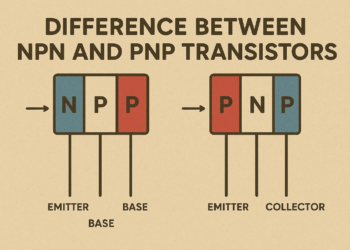
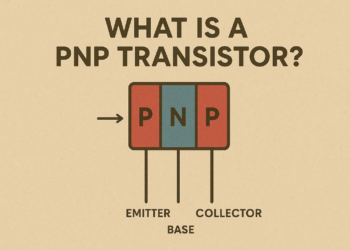
A transistor is made from semiconductor material like silicon. It has three layers: either NPN or PNP type. The three terminals are
- Emitter (E): Sends current out.
- Base (B): Controls the transistor’s activity.
- Collector (C): Collects the current from the emitter.
Operation of a Transistor
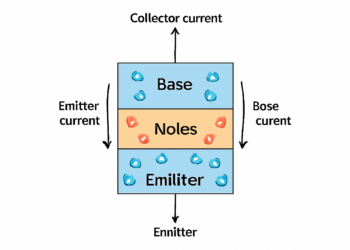
The base acts as a control between the collector and the emitter. A small current at the base incorporates a higher current to the collector-emitter. It functions as a switch or amplifier, which depends on the usage of the gadget.
Biasing the transistor assists in the establishment of the right level of current and voltage. Applied as a switch, it is either completely on (saturation) or completely off (cutoff).
Types of Transistor
Transistors fall into two general categories: the Bipolar Junction Transistors (BJT) and the Field Effect Transistors (FET). Each of them has certain properties upon which they are used in different electronic circuits.
Bipolar Junction Transistor (BJT):
- Has three parts: Emitter, Base, and Collector
- Comes in two types: NPN and PNP
- Uses both electrons and holes for current flow
- Commonly used for amplification and switching
Field Effect Transistor (FET):
- Has three parts: Source, Gate, and Drain
- Includes types like MOSFET and JFET
- Works with only one type of charge carrier
These types are selected on the basis of speed, size, power and the necessary application.
Every type of transistor requires appropriate transistor biasing and structures such as Q‑point, load line, beta and saturation are differently applicable to different types.
Uses of a Transistor
Transistors are everywhere in modern electronics. They serve two major roles:
- Amplification: In audio systems, radios, and sensors, transistors amplify weak signals. A tiny input at the base/gate can control a large output between the collector-emitter (BJT) or drain-source (FET). Amplifiers rely on β (beta or hFE) to determine gain.
- Switching: In digital logic—computers, memory, mobile processors—transistors switch circuits on and off rapidly. When fully saturated, a transistor acts like a closed switch. In cut‑off, it acts like an open switch. Engineers use load line analysis and set a stable Q‑point through transistor biasing to ensure reliable switching.
Other uses of transistor include voltage regulation, buffer stages, modulators, timers, and logic gates like TTL using multiple-emitter transistors. In integrated circuits, billions of MOSFETs achieve complex logic with minimal power.
Transistor Biasing Techniques
When we use a transistor in a circuit, we need to set the correct current and voltage at its three parts—base, emitter, and collector. This setting is called transistor biasing. It ensures the transistor works without distortion and gives stable output.
Types of Transistor Biasing
There are three main types of transistor biasing techniques:
| Type of Biasing | Description |
| Fixed Bias | A resistor is connected to the base. It is simple but unstable with temperature. |
| Collector-to-Base Bias | A resistor is connected from collector to base. It improves stability slightly. |
| Voltage-Divider Bias | Two resistors divide the voltage at the base. This is the most stable method. |
Transistor Parameters
The parameters of the transistor give us an idea about the way the transistor operates in the circuit. Others of them are quite crucial, including beta, hFE and gain. The values indicate the maximum current that can be switched or amplified following the transistor.
Beta in Transistor
Beta (B) is defined as the ratio of collector current to base current of a Bipolar Junction Transistor (BJT). When beta is equal to 100, it will indicate that when the base current is 1 mA, the collector current is 100 mA. This is the indication of transistor capability in signal amplification.
hFE in Transistor
Beta can also be referred to as hFE. It is normally printed on transistor datasheets. It is an abbreviation of DC current gain, which informs us as to how powerful the transistor becomes in terms of amplifying capacity. e.g., when hFE is said to be 200, the transistor has a 200x amplification of the base current.
Real-Life Applications of Transistors
Almost all the electronic devices that we see around us use transistors. They are important in the simple toys and advanced medical equipment. Some of the major industries with the usage of transistors include:
Consumer Electronics
Transistors are the heart of devices like
- Mobile phones
- Televisions
- Computers
- Calculators
They work as amplifiers in speakers and as switches in processors.
Automotive Sector
Modern vehicles use transistors in:
- Sensors (like speed and temperature sensors)
- Control units (engine control, ABS)
- Lighting systems (LED drivers)
- Power control (battery management)
They help improve safety, control, and fuel efficiency.
Telecommunication
In phones and communication towers, transistors are used for
- Signal amplification
- Switching signals
- Frequency conversion
Without transistors, mobile communication would not be possible.
Medical Devices
Transistors are used in life-saving equipment like
- ECG machines
- Hearing aids
- Blood pressure monitors
- Pacemakers
They ensure these devices work reliably and respond quickly.
Renewable Energy
Inverters and power control systems in:
- Solar panels
- Wind turbines
- Battery storage systems
FAQs
Q1. What is a transistor in electronics?
A transistor appears in an electronic circuit as a switch or amplifier. It controls the current flow, buffers it and powers appliances, including computers, radios, TV sets and mobile phones.
Q2. What are the main types of transistors?
There are different forms of transistors and they can be at best categorized into two groups which are Bipolar Junction Transistors (BJT) and Field Effect Transistors (FET). They are both used according to the demands of velocity, amplification and power control.
Q3. What impacts does transistor biasing have on performance?
Transistor biasing adjusts the appropriate voltage and currents. Comprehensive biasing allows good steady operation, avoids distortion of the signal, and can reliably keep the transistor functioning within its desired region.
Q4. What is beta (β) in a transistor?
Beta (β) is the current gain of a transistor. It shows how much the base current is amplified to produce collector current in bipolar junction transistors (BJTs).
Q5. What are the real-life uses of transistors?
Signal processing, switching and amplification of transistors are daily applications in computers, mobile phones, TVs, medical equipment, cars, solar inverters, and industrial machines.
Sources :
Also Read
Difference Between NPN and PNP Transistors
PNP Transistor
NPN Transistor
What is a Transistor
What is Fet?
Bipolar Junction Transistor (BJT)
Characteristics of a Transistor
Uses of Transistors