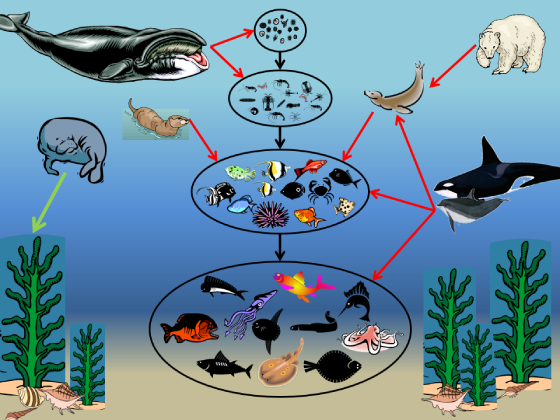

What is a Food Web?
A food web is a complex network of feeding relationships among organisms in an ecosystem. Unlike a food chain, which shows a linear sequence of who eats whom, a food web illustrates how multiple food chains interconnect, revealing a more realistic picture of energy flow and predator-prey interactions in nature.
The Basics of Food Webs
In an ecosystem, energy is transferred from one organism to another through feeding relationships. These relationships can be simple, forming a linear food chain, or complex, forming a food web. A food web is a more accurate representation because it includes multiple interlinked food chains and illustrates the various paths through which energy flows in an ecosystem.
Components of a Food Web
- Producers: These are typically plants and algae that produce energy through photosynthesis.
- Consumers: Organisms that consume other organisms for energy. They can be further categorized as:
- Primary Consumers: Herbivores that eat producers.
- Secondary Consumers: Carnivores that eat herbivores.
- Tertiary Consumers: Top predators that eat other carnivores.
- Decomposers: Organisms such as bacteria and fungi that break down dead matter, returning nutrients to the soil.
Structure of a Food Web
A food web consists of multiple trophic levels:
- First Trophic Level: Producers
- Second Trophic Level: Primary Consumers (Herbivores)
- Third Trophic Level: Secondary Consumers (Carnivores)
- Fourth Trophic Level: Tertiary Consumers (Top Predators)
- Decomposers: These organisms function across all trophic levels, recycling nutrients back into the ecosystem.
Example of a Food Web
To illustrate, consider a simplified forest ecosystem:
| Trophic Level | Organisms |
| Producers | Trees, shrubs, grass |
| Primary Consumers | Deer, rabbits, insects |
| Secondary Consumers | Foxes, birds, small mammals |
| Tertiary Consumers | Eagles, wolves, large carnivores |
| Decomposers | Fungi, bacteria, earthworms |
Importance of Food Webs
Food webs are essential for maintaining ecological balance. They illustrate how different species are interconnected and depend on one another for survival. Understanding food webs helps ecologists identify the impact of changes in the ecosystem, such as the removal of a species or the introduction of a new one.
Energy Transfer in Food Webs
Energy enters the food web through producers, which convert sunlight into chemical energy via photosynthesis. This energy is then transferred to primary consumers and subsequently to higher trophic levels. However, not all energy is efficiently transferred. Typically, only about 10% of the energy at one trophic level is passed on to the next level, with the rest lost as heat through metabolic processes.
Energy Pyramid
The concept of an energy pyramid helps visualize the energy loss at each trophic level:
| Trophic Level | Energy (kcal/m²/year) | Example Organisms |
| Tertiary Consumers | 10 | Eagles, wolves |
| Secondary Consumers | 100 | Foxes, birds |
| Primary Consumers | 1,000 | Deer, rabbits |
| Producers | 10,000 | Trees, shrubs, grass |
Types of Food Webs
Terrestrial Food Webs
Terrestrial food webs occur on land. They include ecosystems like forests, grasslands, and deserts. These food webs are primarily driven by producers like trees, grasses, and shrubs.
Aquatic Food Webs
Aquatic food webs exist in water environments, including freshwater and marine ecosystems. In these webs, algae and phytoplankton are the primary producers. Aquatic food webs can be even more complex due to the vast diversity of aquatic organisms and the different layers of the water column.
Detrital Food Webs
Detrital food webs focus on the decomposition process. These webs highlight the role of decomposers and detritivores (organisms that feed on dead organic matter) in recycling nutrients back into the ecosystem.
Human Impact on Food Webs
Human activities significantly impact food webs. Pollution, habitat destruction, overfishing, and climate change can disrupt these intricate networks, leading to the loss of biodiversity and ecosystem services.
Case Study: Impact of Overfishing
Overfishing can remove key species from marine food webs, causing cascading effects throughout the ecosystem. For example, the removal of large predatory fish can lead to an increase in smaller fish and invertebrates, which in turn can deplete algae and other primary producers, disrupting the entire aquatic food web.
Conservation and Management
Protecting Keystone Species
Keystone species play a crucial role in maintaining the structure of a food web. Their removal can lead to significant changes in the ecosystem. Conservation efforts often focus on protecting these vital species to preserve ecological balance.
Restoring Degraded Ecosystems
Restoration projects aim to reintroduce native species and rebuild food webs that have been disrupted. This can involve activities such as planting native vegetation, reintroducing apex predators, and reducing pollution.
Food webs are fundamental to understanding the intricate relationships and energy flows within ecosystems. They provide a comprehensive view of how organisms interact and depend on one another. By studying food webs, ecologists can better predict the impacts of environmental changes and develop strategies to conserve biodiversity and maintain ecological balance.
Understanding and protecting food webs is essential for sustaining healthy ecosystems, which in turn support human life and the planet’s overall well-being.
Food Webs FAQ
Q1. What is the difference between a food chain and a food web?
Ans - A food chain is a linear sequence of organisms where each is eaten by the next one in the chain. In contrast, a food web is a complex network of multiple food chains that are interconnected, showing the various paths through which energy flows in an ecosystem.
What are the primary components of a food web?
The primary components of a food web include producers (plants and algae), primary consumers (herbivores), secondary consumers (carnivores that eat herbivores), tertiary consumers (top predators), and decomposers (bacteria and fungi that break down dead matter).
Why are food webs important for ecological balance?
Food webs are crucial for maintaining ecological balance because they illustrate the interconnectedness and dependency of various species on one another for survival. They help ecologists understand the impact of changes within the ecosystem, such as the introduction or removal of species.
How does energy flow through a food web?
Energy flows through a food web starting with producers, which convert sunlight into chemical energy via photosynthesis. This energy is transferred to primary consumers and then to higher trophic levels. However, only about 10% of the energy at each trophic level is passed on to the next level, with the rest lost as heat through metabolic processes.
How do human activities impact food webs?
Human activities such as pollution, habitat destruction, overfishing, and climate change can disrupt food webs, leading to the loss of biodiversity and ecosystem services. For example, overfishing can remove key species from marine food webs, causing cascading effects that disrupt the entire aquatic ecosystem.