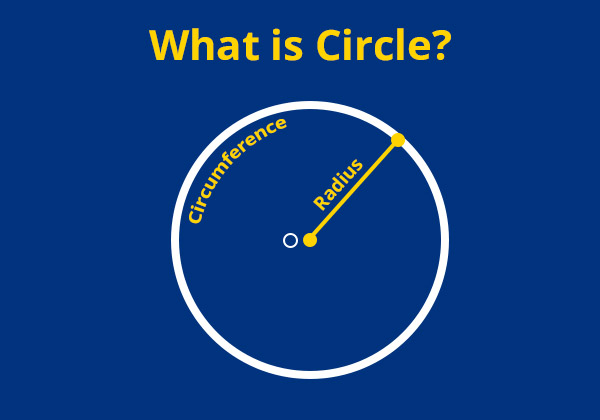

A circle is a basic shape in geometry, defined by a smooth, round line where every point is the same distance from a fixed point called the center. This constant distance is known as the radius. Circles have a unique, symmetrical shape with no corners.
To understand circles better, we look at their definition, different types (such as concentric and tangent circles), key properties, and important formulas like those for calculating the circumference and area. This article also explores how circles are used in everyday life, from wheels to sports equipment, showing their importance and practical applications.
What is a Circle?
A circle is a basic and important shape in geometry. It’s defined as a set of points that are all the same distance from a central point, which is called the center of the circle. The distance from the center to any point on the circle is known as the radius. A circle doesn’t have any corners or edges, which makes it different from other shapes like squares or triangles. Everything about a circle is smooth and continuous. The longest distance across the circle, passing through the center, is called the diameter, and it’s twice as long as the radius. Circles are everywhere in our daily lives, from wheels and clocks to round tables and pizza, showing their wide range of practical uses and importance.
Parts of a Circle
Understanding the parts of a circle is key to grasping its geometry. Each component, from the center and radius to the circumference and arcs, plays a crucial role in defining the circle’s shape and properties. Here’s a closer look.
1. Center
The center is the point from which every point on the circle is equidistant. It’s the middle point around which the circle is evenly shaped. If you draw a line from the center to any point on the edge, you’ll get the radius.
2. Radius
The radius is the distance from the center to any point on the circumference (the edge of the circle). It’s a straight line and is always the same length throughout the circle. For example, if the radius of a circle is 5 units, every point on the edge is 5 units away from the center.
3. Diameter
The diameter is the longest distance you can measure across the circle, passing through the center. It’s twice the length of the radius. So, if the radius is 5 units, the diameter will be 10 units. The diameter divides the circle into two equal halves.
4. Circumference
The circumference is the total distance around the edge of the circle. It’s similar to the perimeter of other shapes. To find the circumference, you use the formula is approximately 3.14159. If the radius is 5 units, the circumference will be about 31.4 units.
5. Chord
A chord is a straight line segment that connects any two points on the edge of the circle. It does not necessarily pass through the center. The longest chord of a circle is the diameter. For instance, if you connect two points on the edge without passing through the center, that line is a chord.
6. Arc
An arc is a part of the circle’s circumference. It’s a curved line segment between two points on the circle. The length of an arc depends on how large the angle is at the center that subtends it. If you imagine cutting a small slice from the circle, the curved edge of that slice is the arc.
7. Sector
A sector is a region enclosed by two radii and the arc between them. It looks like a slice of pie or a wedge. To find the area of a sector, you use the formula
is the central angle in radians.
For example, if the central angle is 90 degrees, which is radians, and the radius is 5 units, the area of the sector would be about 19.6 square units.
8. Segment
A segment is the area between a chord and the arc above it. Imagine slicing off a small piece of a circle, including the space between a chord and the curved edge. This area is called a segment. It’s different from a sector because it doesn’t include the entire area up to the center; it’s just the part between the chord and the arc.
These parts of the circle are fundamental for understanding its properties and for solving geometric problems involving circles.
Important Circle Formulas
Understanding the formulas related to circles helps us measure and work with this fundamental shape in geometry. Here’s a detailed look at each key formula:
1. Circumference Formula
Explanation:
The circumference is the total distance around the edge of the circle. To calculate it, you need the radius of the circle, which is the distance from the center to any point on the edge.
Steps to Use the Formula:
- Identify the Radius (rrr): Measure or obtain the radius of the circle.
- Multiply by 2: Double the radius to get the diameter (2r2r2r).
- Multiply by Pi (π\piπ): Multiply the diameter by π\piπ (approximately 3.14159).
2. Area Formula
Explanation:
The area of a circle represents the space enclosed within its circumference. To find it, you need to square the radius and then multiply by π\piπ.
Steps to Use the Formula:
- Identify the Radius (rrr): Measure or obtain the radius.
- Square the Radius: Multiply the radius by itself (r2r^2r2).
- Multiply by Pi (π\piπ): Multiply the squared radius by π\piπ (approximately 3.14159).
3. Diameter Formula
Explanation:
The diameter is the longest distance across the circle, passing through the center. It is simply twice the length of the radius.
Steps to Use the Formula:
- Identify the Radius (rrr): Measure or obtain the radius.
- Multiply by 2: Multiply the radius by 2 to get the diameter.
4. Radius Formula from Circumference
Explanation:
If you know the circumference and need to find the radius, you can rearrange the circumference formula to solve for the radius.
Steps to Use the Formula:
- Identify the Circumference (CCC): Measure or obtain the circumference.
- Divide by 2π: Divide the circumference by 2π2\pi2π to get the radius.
5. Radius Formula from Area
Explanation:
To find the radius when you know the area, rearrange the area formula to solve for the radius.
- Steps to Use the Formula:
- Identify the Area (AAA): Measure or obtain the area.
- Divide by π: Divide the area by π\piπ to get the squared radius.
- Take the Square Root: Take the square root of the result to find the radius.
Types of Circles
Circles come in different types based on their relationships and positions relative to each other. Each type has unique characteristics, from circles sharing the same center to those that touch or intersect. Some of these types are:
1. Concentric Circles
Definition: Concentric circles are circles that share the same center but have different radii. This means that the circles are centered at the same point, but each circle has a different size.
Appearance:
- Visual Description: Imagine a target board with multiple rings. Each ring is a circle centered at the same point, and they increase in size as you move outward from the center. The circles do not overlap; instead, they are nested within one another.
- Spacing: The distance between adjacent circles is uniform around the center, depending on the difference in their radii. This results in a pattern where the circles appear like layers or rings.
2. Tangent Circles
Definition: Tangent circles are circles that touch each other at exactly one point. This single point where they touch is called the point of tangency.
Appearance:
Externally Tangent Circles:
- Visual Description: Two circles touch each other from the outside. The point where they touch is the only contact point, and the circles do not overlap. Example: Think of two coins placed next to each other just touching at one point.
Internally Tangent Circles:
- Visual Description: One circle is entirely inside the other, touching it at exactly one point from within. The smaller circle is within the larger circle, and the point of tangency is where they meet. Example: A small circle drawn inside a larger circle, like a dot on the inside edge of a ring.
3. Intersecting Circles
Definition: Intersecting circles are circles that cross each other at exactly two points. This happens when two circles overlap in such a way that they share two common points of intersection.
Appearance:
- Visual Description: Two circles that intersect will overlap, creating a lens-shaped or almond-shaped region in between them. The intersection occurs at two distinct points where the circles cross.
- Example: Imagine drawing two circles on a piece of paper so that they overlap. The area where they cross forms a shape similar to the letter “V.”
4. Eccentric Circles
Definition: Eccentric circles are circles that do not share the same center. Unlike concentric circles, each eccentric circle has a different central point.
Appearance:
- Visual Description: If you draw two circles with different centers, they will not be aligned. They might be close to each other, overlap, or be completely separate, but they do not share a common center.
- Example: Think of drawing a circle and then drawing another circle that is slightly off to the side or elsewhere on the page.
Properties of Circles
Circles have several key properties that make them unique and important in geometry. Here’s a look at some of their fundamental characteristics:
- Symmetry: A circle is perfectly symmetrical around its center. This means if you draw a line through the center, the circle will look the same on both sides of that line. This symmetry applies in every direction from the center.
- Radius and Diameter: The radius is the distance from the center of the circle to any point on its edge. The diameter is the longest distance across the circle, passing through the center. It is always twice as long as the radius. For instance, if the radius is 5 units, the diameter will be 10 units.
- Circumference: This is the distance around the edge of the circle. It can be calculated using the formula C=2πrC = 2\pi rC=2πr, where rrr is the radius and π\piπ (pi) is approximately 3.14159. The circumference is proportional to the diameter and depends directly on the radius.
- Area: The area is the space enclosed by the circle. It is calculated using the formula A=πr2A = \pi r^2A=πr2, where rrr is the radius. This formula shows how the area grows with the square of the radius, meaning that even small changes in radius can significantly affect the area.
- Chord: A chord is a line segment connecting two points on the circle. The diameter is the longest chord. Every chord divides the circle into two segments.
- Arc: An arc is a part of the circle’s circumference. It’s the curved segment between two points on the circle. The length of an arc depends on the size of the circle and the angle between the two points.
- Sector: A sector is like a slice of the circle, created by two radii and the arc between them. The area of a sector depends on the angle of the slice and the radius of the circle.
- Segment: A segment is the area enclosed between a chord and the arc above it. It’s a portion of the circle cut off by a chord.
- Central Angle: This is the angle formed by two radii of the circle. The size of this angle determines the length of the arc and the area of the sector.
- Inscribed Angle: An inscribed angle is formed by two chords in the circle. The vertex of this angle is on the circumference of the circle. The size of an inscribed angle is half the measure of the arc it intercepts.
- Tangent Line: A tangent line touches the circle at exactly one point and is perpendicular to the radius at that point. It helps to define the circle’s boundary and has a unique geometric relationship with the circle.
Circles in Everyday Life
Circles are everywhere in our daily lives. Here’s how you can see them around you:
| Category | Example | Description |
| Transportation | Wheels | Car, bicycle, and motorcycle wheels are round for smooth rolling. |
| Timekeeping | Clocks and Watches | The circular face helps evenly display time. |
| Food | Pizzas and Pancakes | Circular shape aids in even cooking and easy serving. |
| Currency | Coins | Circular coins are easy to stack and handle. |
| Toys | Hula Hoops | Spinning in a circle around the body. |
| Optics | Lenses | Round lenses focus light accurately. |
| Traffic Design | Roundabouts | Circular intersections help manage vehicle flow. |
| Snacks | Doughnuts | Circular with a hole, ideal for frying. |
| Sports Equipment | Basketballs, Soccer Balls | Round shape facilitates rolling and bouncing. |
| Architecture | Domes, Arches | Circular designs used for both aesthetics and stability. |
| Art | Circular Frames | Round frames used in artwork for visual appeal. |
| Games | Board Games (e.g., Roulette) | Circular boards and wheels in games for movement and chance. |
| Containers | Jars and Lids | Circular shape for sealing and storage efficiency. |
| Decor | Circular Rugs | Round rugs used for aesthetic and practical purposes. |
| Household Items | Table Tops | Circular tables provide even surface for dining. |
This table highlights how the simple shape of a circle is utilized in diverse aspects of everyday life, from practical uses to aesthetic designs.
How to Draw a Circle?
Drawing a circle is a simple task that can be done with various tools. Here’s a step-by-step guide to help you draw a perfect circle easily and accurately.
- Gather Your Tools: You’ll need a pencil, a piece of paper, and a tool to make the circle. You can use a compass, a round object like a cup or lid, or even a string.
- Choose Your Center: Decide where you want the center of the circle to be on your paper. This will be the point from which the circle’s radius will be measured.
- Using a Compass: Place the point of the compass on the center point you chose. Adjust the compass to the desired radius by setting the distance between the point and the pencil. Keep the point in place and rotate the compass 360 degrees to draw the circle.
- Using a Round Object: Place the round object (like a cup or lid) on the paper with the center where you want your circle to be. Hold the object steady and trace around it with your pencil.
- Using a String: Tie a piece of string to a pencil and hold the other end at the center point. Keep the string taut and draw a circle by moving the pencil around the center.
- Check Your Work: Make sure the circle is even and the edges are smooth. Adjust if necessary.
- Erase Any Extra Marks: If you made any extra lines or marks outside the circle, erase them gently.
That’s it! You’ve drawn a circle. The key is to keep your tool steady and maintain an even distance from the center.
FAQs
Q1. What is a simple definition of a circle?
A circle is a shape where all points are the same distance from a central point. This central point is called the center, and the distance from the center to any point on the circle is known as the radius.
Q2. What is called a circle?
A circle is defined as a two-dimensional geometric figure consisting of all points in a plane that are at a fixed distance, called the radius, from a central point. It is a continuous curve with no edges or corners.
Q3. How are circles defined?
Circles are defined by their central point and radius. In geometry, a circle is the set of all points that are equidistant from a fixed point (the center). This definition helps in calculating other properties like circumference and area.
Q4. What is a concentric circle?
Concentric circles are two or more circles that share the same center but have different radii. The circles are nested within each other, and the space between them can be referred to as an annular region.
Q5. How are circles used in real life?
Circles are used in various real-life applications, including:
Wheels and gears in machinery and vehicles.
Design elements in art and architecture.
Circular tracks in sports and racing.
Optical lenses and mirrors.
Various everyday objects such as clocks and plates.