The transistor is one of the greatest components in modern electronics. Be it computer or phone, radio or a small electronic toy, it seems transistors dwell all over the place. They are commonly known to seal electronic circuits as the blocks of a building owing to their ability to regulate current and voltage. Learning about transistors is not only learning what they are but also learning how they are symbolized on circuit diagrams. In this situation, the symbol of the transistor is critical during this stage of the pi.
In this blog, we are going to consider what a transistor symbol is, what its constituents are, the different types of transistor symbols, and how to read them in electric circuits.
Introduction to Transistor
Before comprehension of the symbol, it is noteworthy to get to know what a transistor really is. A transistor is an electronics component able to either amplify a signal or act as a switch. The invention took place in 1947 and totally transformed the electronic world.
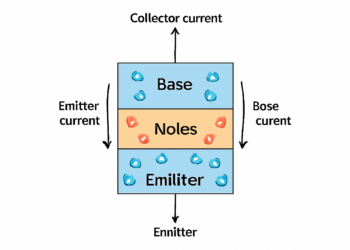
There are three main parts to a transistor. A transistor has three main parts:
- Emitter (E): The area that does provide charge carriers.
- Magnetic base (B)—A thin layer that dictates the number of carriers that are moved.
- Collector (C)—The compartment that picks up the carriers.
The transistor controls a small base current in order to flow a large current between the emitter and collector. What this accomplishes is making it very helpful in regulating signals and driving circuits.
What is a Symbol in Electronics?
Electronics A symbol is a graphical mark, or symbol, that is used to represent a circuit component. As an example, a battery will have a different symbol than a resistor and a transistor a different one indeed.
Circuit diagrams (schematics) use signs and symbols so that engineers, students, and technicians can better interpret and design circuits.
Rather than calling a real-life picture of a transistor, the simplification in the form of a symbol is applied because it is clean, easy and universally acceptable.
The Symbol of a Transistor
The transistor symbol is a graphical way to represent how the transistor functions in a circuit. As mentioned earlier, a transistor has three main terminals: emitter, base, and collector. These are always represented in the symbol.
The most important feature of a transistor symbol is the arrow. The arrow shows the direction of current flow in the emitter leg.
There are two major types of transistors:
- Bipolar Junction Transistor (BJT)
- Field Effect Transistor (FET)
Both have different symbols because they work differently. Let us first look at the BJT.
Bipolar Junction Transistor (BJT) Symbol
A BJT is the most common type of transistor. It has three terminals: emitter, base, and collector. The symbol of a BJT shows a straight line for the base, a diagonal line for the collector, and another diagonal line for the emitter.
There are two types of BJTs:
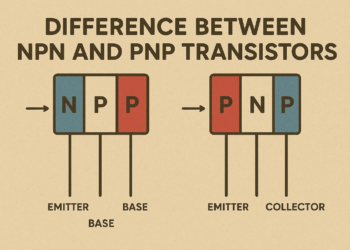
1. NPN Transistor Symbol
- In this symbol, the arrow on the emitter points outward.
- It means the current flows from the base into the emitter.
- NPN transistors are the most commonly used because they are efficient and have faster response times.
Key features in the symbol:
- The base line is drawn vertically.
- The collector and emitter are connected diagonally.
- The arrow on the emitter points out.
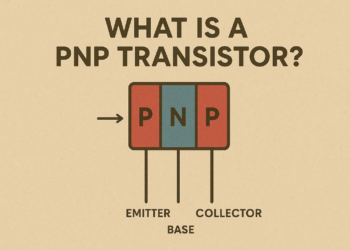
2. PNP Transistor Symbol
- In this symbol, the arrow on the emitter points inward.
- It means the current flows from the emitter into the base.
- PNP transistors are also used, but they are less common compared to NPN.
Key features in the symbol:
- Similar to NPN, but the arrow direction changes.
- The arrow points towards the base.
Easy Way to Remember BJT Symbols
A simple trick is:
- NPN → “Not Pointing iN” (arrow points out).
- PNP → “Pointing iN Proudly” (arrow points in).
This makes it easy for students and beginners to remember which way the arrow goes in circuit diagrams.
Field Effect Transistor (FET) Symbol
Another widely used transistor is the Field Effect Transistor (FET). Unlike BJT, it works using voltage rather than current at the base. FETs are popular in integrated circuits, amplifiers, and switching devices.
The FET has three terminals:
- Source (S)—Similar to emitter.
- Gate (G)—Similar to base.
- Drain (D)—Similar to collector.
There are different types of FETs, so their symbols also vary.
1. JFET (Junction Field Effect Transistor)
- N-Channel JFET: The arrow points inward toward the gate.
- P-Channel JFET: The arrow points outward from the gate.
2. MOSFET (Metal-Oxide-Semiconductor FET)
MOSFETs are very common in modern electronics. They come in two types:
- Enhancement Mode MOSFET
- Depletion Mode MOSFET
Each type has its own symbol, showing the gate, source, drain, and sometimes a substrate line. The arrows again show the direction of current flow.
Importance of the Arrow in Transistor Symbol
The arrow is the heart of the transistor symbol. It tells you:
- The direction of current flow.
- Whether it is NPN/PNP or N-channel/P-channel.
- How the transistor will behave in a circuit.
If you understand the arrow, you can easily identify the type of transistor and its function without memorizing too much.
Comparison Table of Transistor Symbols
| Transistor Type | Symbol Feature | Arrow Direction | Terminals | Use Case |
| NPN BJT | Arrow on emitter | Outward | E, B, C | Switching, amplification |
| PNP BJT | Arrow on emitter | Inward | E, B, C | Amplification, current control |
| N-Channel JFET | Arrow on gate | Inward | S, G, D | Signal processing |
| P-Channel JFET | Arrow on gate | Outward | S, G, D | Low-noise circuits |
| N-Channel MOSFET | Arrow on source | Outward | S, G, D | Power electronics |
| P-Channel MOSFET | Arrow on source | Inward | S, G, D | Voltage control |
How to Read a Circuit with Transistor Symbols?
When encountering a transistor symbol in a circuit diagram, do the following:
- You can also determine which type of transistor is used (NPN, PNP, MOSFET, and a few others) by examining the arrow.
- The names of the terminals are emitter, base and collector (or source, gate and drain).
- Know how it works: Is it a switch or is it an amplifier?
- Ring: What circuitry is connected on each terminal?
With these steps one can read and comprehend electronic circuits.
Applications of Transistors (and Their Symbols)
These practices are assisted by knowing the transistor symbol that will help one determine where it can be applied in a circuit. Some typically used apps are
- Amplifiers: These are used in radios, speakers and audio systems.
- Application uses: Used in smartphone applications, computers and digital logic circuits.
- Oscillators: In use in communication devices.
- Power control: Ultimately applied in power supplies and chargers.
- Applied to TVs, sensors and microchips.
Conclusion
The diagram of a transistor is not simply a diagram but a guide on how the component functions and how it happens to integrate with the rest of the electronics. It is very simple to know the type of transistor being used on the circuit, the purpose, and by just taking a look at the direction of the arrow, the positioning of the legs, and other characteristics surrounding the transistor.
FAQs
What is the symbol of a transistor in circuit diagrams?
The symbol of a transistor consists of three lines to represent the base line, collector line and the emitter line. The emitter is marked with an arrow to indicate the direction of the flow of current and what side (NPN or PNP) is marked.
How can you identify NPN and PNP transistor symbols?
In an NPN symbol, the emitter arrow points away from the base. For a PNP, the arrow points toward the base, helping recognize the transistor type instantly in diagrams.
Why is the arrow direction important in transistor symbols?
The arrow in a transistor symbol indicates current flow direction. In NPN, it points outward; in PNP, inward. This helps determine electrical behavior and proper circuit configuration.
What are the main terminals shown in a transistor symbol?
A transistor symbol always includes three terminals: base (B), collector (C), and emitter (E). Each terminal plays a specific role in controlling and conducting current within circuits.
Do MOSFET and phototransistor symbols differ from regular transistor symbols?
Yes, MOSFETs show separate gate, source, and drain, while phototransistors add two arrows for light. Each symbol style helps quickly identify functions and usage in circuit diagrams.
Also Read
Difference Between NPN and PNP Transistors
PNP Transistor
NPN Transistor
What is a Transistor
What is Fet?
Bipolar Junction Transistor (BJT)
Characteristics of a Transistor
Uses of Transistors