
“How many government MBBS seats in India are actually available?” Isn’t that a question of almost every NEET aspirant? The fact holds great importance in terms of their preparation framework.
Government medical colleges offer quality education, experienced faculty, massive clinical exposure, and most importantly, subsidised fees. That combination makes them the most competitive seats in the country.
If you’re preparing for NEET 2026, here’s a clear, realistic picture of the total government MBBS seats in India, how they’re distributed, and what that means for your chances.
Total MBBS Seats in India: The Big Picture
As per the latest data released by the National Medical Commission (NMC):
- Total MBBS seats in India (2025-26): ~1,37,600
- Total medical colleges: 817
- Seats filled through NEET UG: 100%
Out of these, government medical colleges account for nearly 60,000+ MBBS seats, making them the most sought-after chunk of the pie.
That means roughly 1 out of every 2 MBBS seats in India is a government seat. Sounds promising. Until you factor in competition.
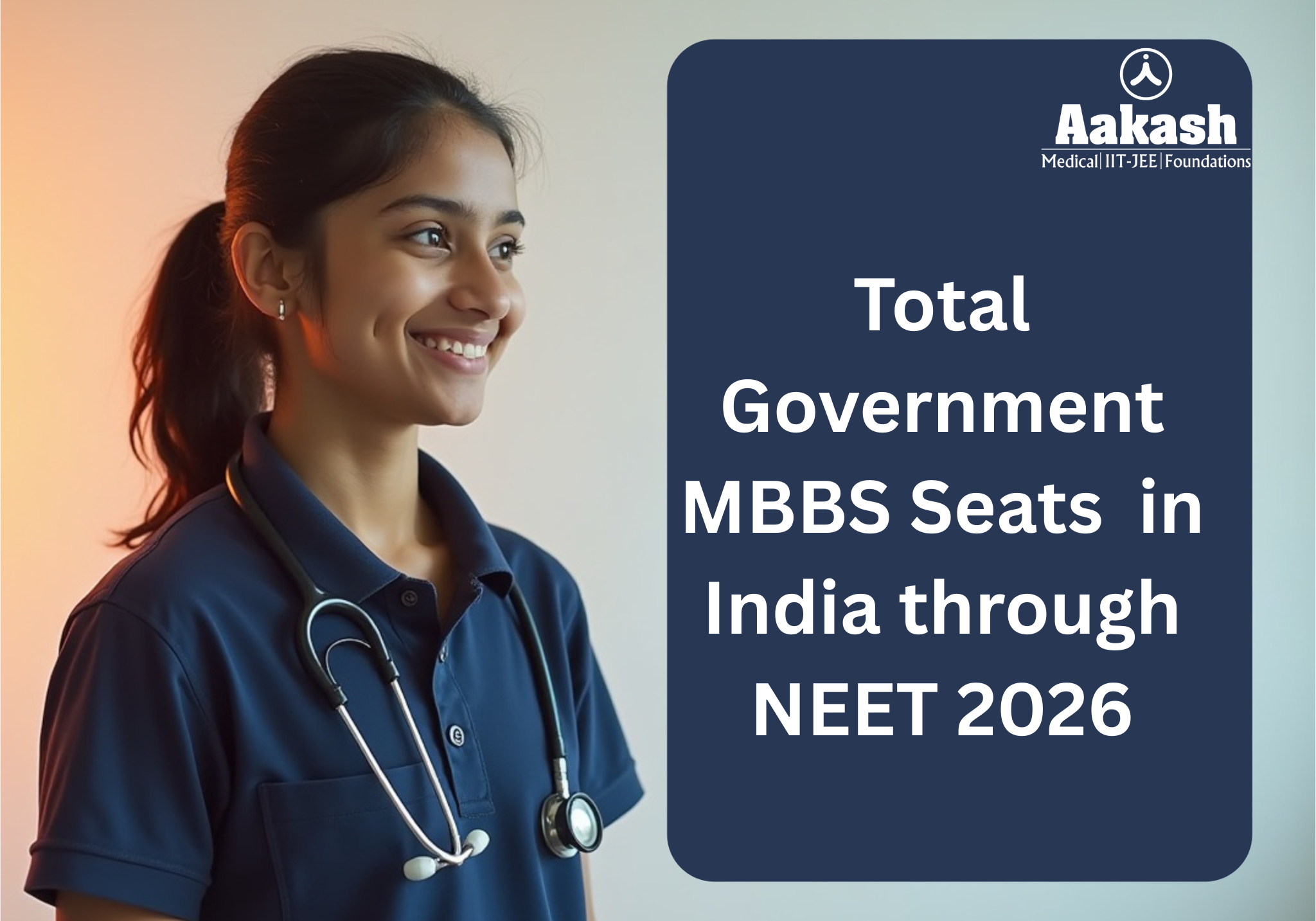
Total Government MBBS Seats in India Through NEET 2026
For NEET 2026, the seat matrix is expected to remain similar, with marginal additions due to new colleges.
Estimated total govt MBBS seats in India 2026: ~60,000 to 62,000 seats
These include seats from:
- Central government colleges (AIIMS, JIPMER, AFMC*)
- State government medical colleges
- ESIC and municipal colleges
*AFMC has separate eligibility conditions.
Why Government MBBS Seats Are So Competitive
Every year, 23-24 lakh students appear for NEET. And fewer than 3% secure a government MBBS seat.
Why the obsession?
- Annual fees as low as ₹10,000-₹50,000
- High patient inflow = real clinical exposure
- Strong academic ecosystem
- Better PG entrance performance historically
Naturally, aspirants aim here first.
Category-Wise Reservation in Government MBBS Seats
The Government of India follows a fixed reservation structure for MBBS admissions through NEET.
| Category | Reservation Percentage |
| General | No reservation |
| OBC (Non-Creamy Layer) | 27% |
| SC | 15% |
| ST | 7.5% |
| EWS | 10% |
| PwD (horizontal) | 5% |
So when students ask about total government MBBS seats in India for general category, the answer depends on:
- Total seats in that state/college
- Reservation breakup
- AIQ vs State quota
All India Quota (AIQ) vs State Quota: Know the Split
Every government medical college contributes seats under two pools:
1. All India Quota (AIQ)
- 15% of total seats
- Open to candidates from all states
- Counselling conducted by MCC
2. State Quota
- 85% of total seats
- Reserved for domicile candidates
- Counselling conducted by state authorities
AIIMS, JIPMER, and central universities participate 100% in AIQ.
State-Wise Government MBBS Seats: Where Are Most Seats?
Some states consistently dominate the seat count. States with the highest government MBBS seats:
- Tamil Nadu
- Maharashtra
- Uttar Pradesh
- Karnataka
- Rajasthan
- West Bengal
Tamil Nadu alone has multiple colleges with 250 seats each, giving it a clear edge in availability. This is why state-wise strategy matters as much as score.
Does More Seats Mean Lower Cutoffs? Not Always.
A common myth. Even states with more seats see high NEET cutoffs, because:
- More aspirants per seat
- Strong local competition
- Better awareness and preparation ecosystem
Seat availability helps. But rank decides everything.
Government MBBS Seats for General Category: Reality Check
Let’s be honest. Even though ~60,000 government MBBS seats exist:
- Only ~25,000-28,000 seats are effectively open to the general category
- That includes AIQ + state quota general seats
For general category students, a safe NEET score usually means:
- 650+ for top states
- 610-630 for mid-range states
- Borderline chances below that, depending on domicile
This is why preparation cannot be casual.
What This Means for NEET 2026 Aspirants
Understanding seat numbers is not about fear. It is about clarity. If you know:
- Total government MBBS seats in India
- Category-wise distribution
- State-wise trends
You stop chasing vague targets. You prepare with intent.
At Aakash, preparation is built around rank-oriented planning, not just qualifying marks, because seats don’t go to qualifiers. They go to the rank holders.
State-Wise Cutoff Insights for Government MBBS Seats (NEET 2026)
Knowing the number of government MBBS seats is only half the story. The real game begins when you understand state-wise cutoffs.
Because in NEET, 650 marks in one state can mean certainty, while the same score in another can still feel uncertain.
Here’s how cutoffs usually behave across states—based on seat density, competition, and historical admission data.
High-Cutoff States (Very Competitive)
These states have strong academic ecosystems and intense competition.
Examples:
- Delhi
- Rajasthan
- Haryana
- Uttar Pradesh
- Bihar
General category cutoff trend: 660–680+ marks
Why so high?
- Limited seats compared to applicant volume
- High-performing aspirant pool
- Strong coaching penetration
In these states, even a single mark drop can shift ranks significantly.
Moderate-Cutoff States (Balanced Competition)
These states offer a healthier seat-to-student ratio.
Examples:
- Maharashtra
- Karnataka
- Gujarat
- Tamil Nadu
- West Bengal
General category cutoff trend: 620–650 marks
Tamil Nadu is a special case. Despite high seat numbers, competition remains strong due to:
- Multiple high-capacity colleges
- Large number of serious aspirants
Still, for well-prepared students, these states often offer better conversion chances.
Relatively Lower-Cutoff States (Opportunity Zones)
These states usually have fewer applicants per seat.
Examples:
- Assam
- Chhattisgarh
- Himachal Pradesh
- Uttarakhand
- Some North-Eastern states
General category cutoff trend: 590–620 marks
For domicile students, this can be a strategic advantage—especially during state quota counselling.
AIQ Cutoffs: One Number, Nationwide Pressure
For the 15% All India Quota, competition is pan-India.
- AIQ general category cutoff: usually 640–670+
- AIIMS and top central institutes push cutoffs even higher
This is where rank inflation hits hardest.
Why Cutoffs Fluctuate Every Year
Cutoffs don’t rise randomly. They change due to:
- Paper difficulty
- Number of test-takers
- Score clustering at the top
- Seat additions or redistributions
That’s why Aakash prepares students for a safe-score buffer, not a risky cutoff chase. So,
- Don’t prepare for “just clearing the cutoff”
- Prepare for rank safety
- State awareness + score buffer = confidence during counselling
Because when counselling starts, clarity beats panic.
Conclusion
Government MBBS seats in India are limited. Demand is massive. Competition is unforgiving. But the system is transparent.
For NEET 2026:
- Around 60,000 government MBBS seats will be available
- Allocation will depend on rank, category, and counselling choices
- Knowing the numbers early helps you prepare smarter, not harder
NEET is not about luck. It is about informed preparation, and that starts with understanding the seat matrix.
FAQs
Q1. How many government MBBS seats are there in India through NEET 2026?
Approximately 60,000-62,000 seats, based on NMC data and expected additions.
Q2. Are AIIMS seats included in government MBBS seats?
Yes. All AIIMS MBBS seats are government seats and filled through NEET.
Q3. How many government MBBS seats are available for general category students?
Roughly 40-45% of total seats, varying by state and AIQ distribution.
Q4. Does a higher number of seats in a state mean easier admission?
Not necessarily. Cutoffs depend on competition, not just seat count.
Q5. Can I predict my chances based on seats alone?
Seats give context. Rank decides admission. Always prepare with a buffer above expected cutoffs.