
Hello, future scientists and curious minds! Have you ever been playing outside on a bright, sunny day when suddenly, the sky starts to get dark, as if evening has arrived early? This amazing event is called a solar eclipse, and it’s one of the most breathtaking shows that nature puts on for us.
At Aakash Institute, we believe that understanding such magnificent events is the first step towards falling in love with science. Whether you are in Class 1 just starting to gaze at the sky or in Class 12 preparing for competitive exams, this guide will take you on a journey to discover everything about a solar eclipse. We’ll explore the science behind it, its different types, how to safely watch it, and its significance in science and culture. Let’s embark on this astronomical adventure!
What is a Solar Eclipse?
In the simplest terms, a solar eclipse occurs when the Moon moves between the Sun and the Earth. This blocks the Sun’s light from reaching certain parts of the Earth, casting a shadow on our planet. Imagine you have a bright torch (the Sun), and you use a ball (the Moon) to block its light from reaching a wall (the Earth). That’s exactly what happens during a solar eclipse!
It’s a fantastic cosmic coincidence that the Sun and the Moon appear to be the same size in our sky. The Sun is about 400 times larger than the Moon, but it’s also about 400 times farther away. This perfect match is what allows the Moon to cover the Sun so precisely.
How Does a Solar Eclipse Happen?
To understand a solar eclipse, we need to understand the movements of the Earth and the Moon.
-
The Sun: The star at the center of our solar system, providing us with light and heat.
-
The Earth: Our home planet, which orbits (revolves around) the Sun once every year.
-
The Moon: Earth’s only natural satellite, which orbits the Earth once every 27.3 days.
For a solar eclipse to happen, two things must occur at the same time:
-
The Moon must be in its New Moon phase. This is when the Moon is positioned between the Earth and the Sun.
-
The Moon must be crossing the plane of Earth’s orbit around the Sun. This specific point is called a node.
When these two conditions are met, the alignment is just right for the Moon’s shadow to fall on the Earth, causing a solar eclipse. It’s a precise and beautiful alignment, which is why eclipses don’t happen every month.
Types of Solar Eclipses
Did you know that not all solar eclipses look the same? Depending on the distances and alignment, we get to see different types. Let’s learn about them:
1. Total Solar Eclipse
This is the most dramatic and rarest type. It happens when the Moon completely covers the Sun. For a few precious minutes, day turns into night.
-
What you see: The Sun’s bright face is completely blocked, revealing its outer atmosphere, called the corona. The corona appears as a beautiful, pearly-white halo around the black disk of the Moon.
-
Path of Totality: A total eclipse is only visible from a narrow track on Earth’s surface, called the path of totality. Outside this path, people see only a partial eclipse.
2. Partial Solar Eclipse
This is the most common type. It occurs when the Sun, Moon, and Earth are not perfectly aligned. So, the Moon only covers a part of the Sun.
-
What you see: The Sun looks like a cookie with a bite taken out of it. The size of the “bite” depends on your location.
3. Annular Solar Eclipse
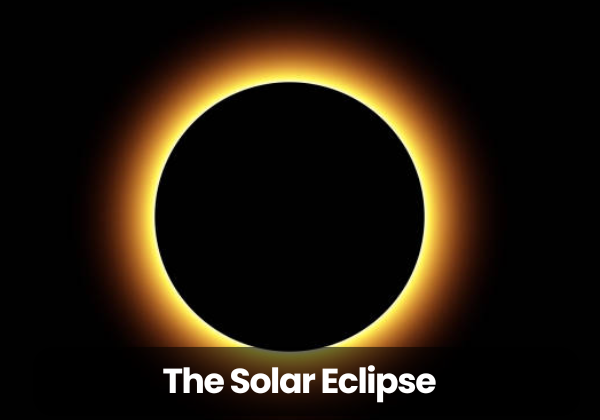
“Annular” comes from the Latin word “annulus,” which means ring. This eclipse happens when the Moon is farthest from the Earth in its orbit (at its apogee). At this distance, the Moon appears slightly smaller than the Sun and cannot cover it completely.
-
What you see: A spectacular “ring of fire” appears in the sky. The Moon covers the Sun’s center, leaving the outer rim visible as a bright, shining ring.
4. Hybrid Solar Eclipse
This is the rarest of all! A hybrid eclipse shifts between a total and an annular eclipse. It appears as a total eclipse from some locations on Earth and an annular eclipse from others. It’s a true astronomical marvel.
The Science Behind the Shadow: Umbra, Penumbra, and Antumbra
The Moon casts two main types of shadows on Earth during an eclipse. Understanding these will help you visualize the different types of eclipses, especially for Class 10-12 students.
-
Umbra: This is the central, darkest part of the shadow. If you are standing in the Moon’s umbra, you will see a total solar eclipse.
-
Penumbra: This is the lighter, outer part of the shadow. If you are standing in the Moon’s penumbra, you will see a partial solar eclipse.
-
Antumbra: This is the shadow that begins where the umbra ends. If you are standing in the Moon’s antumbra, you will see an annular solar eclipse.
How to Safely Watch a Solar Eclipse?
This is the most important section. NEVER, EVER look directly at the Sun, even during a partial or annular eclipse. The Sun’s powerful rays can severely damage your eyes in seconds, causing permanent blindness.
Here are the only safe ways to view a solar eclipse:
-
ISO-Certified Solar Viewing Glasses: These are special-purpose glasses that block out the harmful solar radiation. Ensure they have the ISO 12312-2 certification mark. Do not use regular sunglasses.
-
Pinhole Projector: This is a fun and safe DIY method. Take two sheets of white cardstock. Make a small pinhole in one. With your back to the Sun, let the sunlight pass through the pinhole and project an image of the eclipsed Sun onto the second card. You are not looking at the Sun, but at its projection.
-
Welder’s Glass: Shade number 14 welder’s glass is safe for direct solar viewing.
-
Live Streams: Many science museums and space agencies like NASA provide live streams of eclipses. This is a guaranteed safe and clear view!
History and Mythology of Solar Eclipses
Long before we understood the science, solar eclipses were mysterious and often frightening events. Different cultures had fascinating stories to explain them.
-
Ancient China: People believed a dragon was eating the Sun. They would make loud noises by banging pots and drums to scare the dragon away.
-
Hindu Mythology: It is believed that the demon Rahu’s head chases and occasionally swallows the Sun, causing an eclipse. This is why in some traditions, people take a bath after an eclipse.
-
Vikings: They thought two sky wolves were chasing the Sun and Moon.
-
Scientific Milestone: The total solar eclipse of 1919 provided one of the first key proofs for Einstein’s Theory of General Relativity, as it showed that the Sun’s gravity could bend the light from distant stars.
Why are Solar Eclipses Important for Science?
Solar eclipses are not just beautiful; they are incredibly valuable for scientific research.
-
Studying the Corona: The Sun’s corona is millions of degrees hotter than its surface, which is a major mystery in solar physics. During a total eclipse, when the main disk is blocked, scientists can study the corona in detail.
-
Helioseismology: Eclipses help scientists study the interior structure of the Sun.
-
Atmospheric Studies: The sudden drop in sunlight and temperature during an eclipse allows scientists to study how Earth’s atmosphere responds.
Solar Eclipse vs Lunar Eclipse
This is a common question in exams! Here’s a quick table to remember the key differences:
| Feature | Solar Eclipse | Lunar Eclipse |
|---|---|---|
| Alignment | Sun – Moon – Earth | Sun – Earth – Moon |
| Moon’s Phase | New Moon | Full Moon |
| Visibility | From a small area on Earth | From the entire night-side of Earth |
| Duration | A few minutes | A few hours |
| Safety | Not safe to look with naked eyes | Perfectly safe to look with naked eyes |
Upcoming Solar Eclipses to Mark on Your Calendar
Get ready to witness these future events!
-
Annular Solar Eclipse: October 2, 2024 (Visible from South America)
-
Total Solar Eclipse: August 12, 2026 (Visible from the Arctic, Greenland, Iceland, Spain)
-
Total Solar Eclipse: August 2, 2027 (Visible from North Africa, the Middle East, and Central Asia)
Safety Measures During a Solar Eclipse
Looking directly at the Sun without protection can cause permanent eye damage. Students should follow these safety tips:
-
Always use ISO-certified solar eclipse glasses.
-
Avoid using regular sunglasses or cameras without filters.
-
Indirect viewing methods like pinhole projectors are safe.
Solar Eclipse Projects for School Students
-
For Classes 1-5: Create an eclipse model using balls and a torch. Draw and color the different types of eclipses.
-
For Classes 6-8: Build your own pinhole projector. Write a short story or a poem from the perspective of someone seeing an eclipse for the first time in ancient times.
-
For Classes 9-12: Calculate the scale of the solar system to understand the alignment. Follow NASA’s eclipse webinars and analyze data from recent eclipses.
The solar eclipse is a powerful reminder of the beauty, precision, and wonder of our universe. It connects us to the cosmos and to generations of humans who have looked up at the sky in awe. At Aakash Institute, we encourage you to stay curious, ask questions, and explore the mysteries of science. The next time a solar eclipse is visible from India, we hope you’ll use this knowledge to safely enjoy one of nature’s greatest performances.
Solar Eclipse FAQs
1. What is a solar eclipse?
Answer: A solar eclipse occurs when the Moon passes between the Sun and the Earth, blocking all or part of the Sun’s light. It happens only during the New Moon phase when the Sun, Moon, and Earth align perfectly. Solar eclipses can be total, partial, or annular depending on how much of the Sun is covered.
2. What are the types of solar eclipses?
Answer: There are three main types of solar eclipses:
-
Total Solar Eclipse: The Moon completely covers the Sun, and the Sun’s corona becomes visible.
-
Partial Solar Eclipse: Only a part of the Sun is obscured by the Moon.
-
Annular Solar Eclipse: The Moon appears smaller than the Sun, creating a visible ring of fire around it.
3. How often do solar eclipses occur?
Answer: Solar eclipses happen 2 to 5 times a year globally. However, a total solar eclipse at any specific location is rare, occurring roughly once every 375 years. The frequency depends on the Moon’s orbit, Earth’s rotation, and the alignment of the Sun, Moon, and Earth.
4. Is it safe to look at a solar eclipse?
Answer: No, looking directly at the Sun during a solar eclipse can cause permanent eye damage or blindness. Safe ways to observe include:
-
Solar viewing glasses
-
Pinhole projectors
-
Indirect projection methods
Never use regular sunglasses, binoculars, or cameras without proper solar filters.
5. Why are solar eclipses scientifically important?
Answer: Solar eclipses allow scientists to study parts of the Sun that are otherwise invisible, like the corona. They also help in:
-
Measuring distances between celestial bodies
-
Studying gravitational effects
-
Confirming astronomical theories, such as Einstein’s Theory of General Relativity