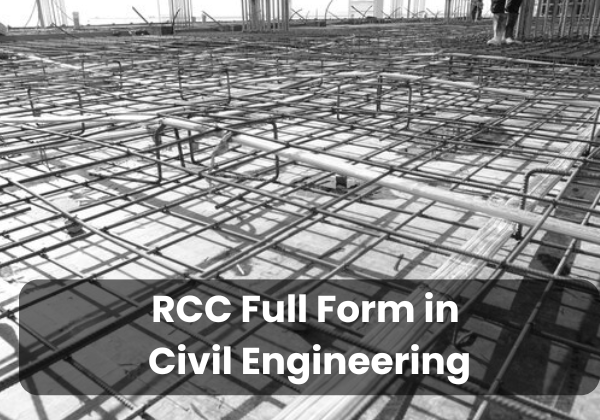

Full Form of RCC in Civil Engineering: Civil engineering forms the backbone of infrastructure development, and one of its most essential components is RCC, which stands for Reinforced Cement Concrete. In 2025, as construction practices become more advanced and quality-focused, understanding RCC’s full form, meaning, and practical application becomes vital for both students and professionals in the field.
What is RCC in Civil Engineering?
RCC (Reinforced Cement Concrete) is a composite material made by combining concrete (a mix of cement, sand, aggregates, and water) with reinforcing steel bars (rebars). This combination significantly improves the strength of the concrete, allowing it to bear both compression and tension forces.
Concrete alone is strong in compression but weak in tension. By embedding steel bars, which are strong in tension, RCC becomes a robust and versatile construction material capable of supporting heavy loads in buildings, bridges, dams, and other civil structures.
Components of RCC
RCC is made of two major components:
-
Concrete:
-
Cement (typically OPC)
-
Fine aggregates (sand)
-
Coarse aggregates (gravel or crushed stone)
-
Water
-
-
Reinforcement:
-
Steel bars (TMT bars or mild steel bars)
-
Mesh or wire reinforcements in some cases
-
The steel reinforcement is placed according to the structural design, and concrete is poured over it to form a strong bond after curing.
Applications of RCC in Civil Engineering
RCC is extensively used in almost every modern structure. Below are key areas where RCC is applied:
-
Residential and commercial buildings (columns, beams, slabs, and foundations)
-
Bridges and flyovers
-
Water tanks and retaining walls
-
Dams and canals
-
Road pavements and airport runways
-
Multi-storey parking lots and industrial structures
RCC’s adaptability makes it a preferred choice for constructing load-bearing structures that require durability and resilience.
Advantages of RCC
Reinforced Cement Concrete offers multiple benefits, making it a staple material in construction:
| Advantage | Explanation |
|---|---|
| High Strength | RCC can handle both compressive and tensile loads. |
| Fire & Weather Resistant | It performs well in diverse environmental conditions. |
| Durable & Long-Lasting | RCC structures, when built properly, can last for decades with minimal upkeep. |
| Moldable | It can be shaped into different structural forms and sizes. |
| Cost-effective | Widely available materials make it economical for mass construction. |
RCC vs PCC in Civil Engineering
While discussing RCC, it’s also essential to differentiate it from PCC (Plain Cement Concrete):
| Feature | RCC (Reinforced Cement Concrete) | PCC (Plain Cement Concrete) |
|---|---|---|
| Reinforcement | Contains steel reinforcement | No steel reinforcement |
| Strength | Handles both tension and compression | Handles compression only |
| Usage | Structural components | Non-structural elements (flooring, base layers) |
Future of RCC in 2025
In 2025, the construction industry is increasingly incorporating precast RCC elements, fiber-reinforced concrete, and eco-friendly alternatives like green concrete to meet sustainability goals. Innovations in RCC composition and design standards have improved earthquake resistance, load-bearing efficiency, and structural longevity.
For civil engineering students, a solid grasp of RCC principles and practical implementation is crucial for academic and career success.
Conclusion
The RCC full form in civil engineering — Reinforced Cement Concrete — represents the foundation of modern construction. Its ability to provide strength, durability, and versatility makes it indispensable in structural engineering. As urbanization and infrastructure development continue to rise in 2025, knowledge of RCC is not just beneficial but essential for every aspiring civil engineer.
RCC Full Form in Civil Engineering FAQs
Q1. What is the full form of RCC in civil engineering?
Answer: RCC stands for Reinforced Cement Concrete. It is a composite material where concrete is combined with steel reinforcement (rebar) to improve its strength, particularly in handling tension and compression forces in structural applications.
Q2. Where is RCC used in civil construction?
Answer: RCC is widely used in construction of buildings, bridges, dams, flyovers, water tanks, retaining walls, and road pavements. It is essential in structural elements like slabs, beams, columns, and foundations because of its load-bearing capacity and durability.
Q3. How is RCC different from PCC?
Answer: The key difference is that RCC contains steel reinforcement, while PCC (Plain Cement Concrete) does not. RCC can handle both tension and compression, making it suitable for structural purposes, whereas PCC is mostly used for non-structural work like flooring and base concrete layers.
Q4. What are the main advantages of using RCC in construction?
Answer: RCC offers several advantages:
-
High strength in both compression and tension
-
Durability and long service life
-
Resistance to fire and environmental conditions
-
Moldability into various structural forms
-
Cost-effectiveness for large-scale construction projects