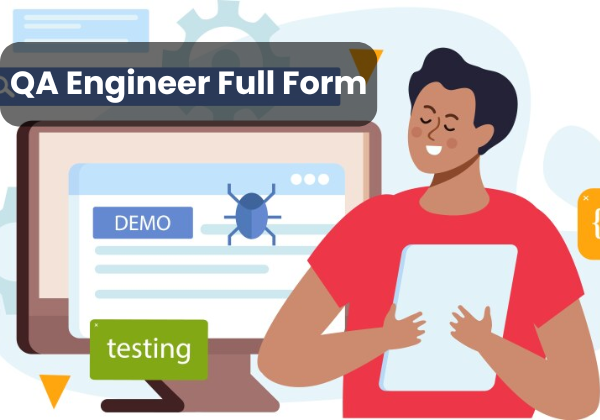

Full Form of QA Engineer: In the fast-evolving tech world of 2025, careers in software and product development are booming. Among the most critical roles in this space is that of a QA Engineer. But what does QA Engineer actually stand for? Let’s decode the full form of QA Engineer, explore their role, responsibilities, and how students can pursue a career in this domain.
What is the Full Form of QA Engineer?
QA Engineer Full Form: QA stands for Quality Assurance, so a QA Engineer is a Quality Assurance Engineer.
A Quality Assurance Engineer ensures that the software or product meets all the required quality standards before it reaches the end user. They focus on identifying bugs, errors, and inconsistencies in a product so that the final release is flawless and user-friendly.
Who is a QA Engineer?
A QA Engineer is a professional responsible for monitoring every phase of the development process to ensure that the design and software adhere to the company’s standards. They play a crucial role in the software development life cycle (SDLC).
While developers write code, QA Engineers test that code in various ways — manual and automated — to identify performance issues, crashes, and unexpected behaviors.
Roles and Responsibilities of a QA Engineer
In 2025-26, the role of a QA Engineer is more dynamic than ever due to advancements in AI, cloud platforms, and automation testing tools.
Here are some common tasks a QA Engineer handles:
-
Reviewing Software Requirements: Understanding what the product is supposed to do and how it should behave.
-
Creating Test Plans & Cases: Developing test strategies and scenarios to check product performance.
-
Executing Manual and Automated Tests: Running manual checks and using automation tools like Selenium, TestNG, or JUnit.
-
Bug Reporting: Identifying, documenting, and tracking bugs to ensure developers fix them.
-
Regression Testing: Ensuring new code changes don’t disrupt existing functionalities.
-
Collaborating with Developers & Product Managers: To ensure proper quality is maintained throughout the process.
-
Performance & Security Testing: Verifying product strength under heavy loads and security vulnerabilities.
Skills Required to Become a QA Engineer in 2025-26
If you’re planning a future in this field, here are the must-have skills:
| Technical Skills | Soft Skills |
|---|---|
| Automation Testing (Selenium, etc.) | Attention to Detail |
| Programming Basics (Java, Python) | Problem-Solving |
| SQL & Database Knowledge | Analytical Thinking |
| Bug Tracking Tools (JIRA, Bugzilla) | Communication |
| CI/CD Tools (Jenkins, GitLab) | Team Collaboration |
QA Engineers with knowledge of AI-driven testing and cloud-based testing platforms are in high demand!
QA Engineer Eligibility and Educational Background
To become a QA Engineer, here’s what your academic background should look like:
-
Class 10 & 12: Focus on Science and Mathematics.
-
Undergraduate Degree: B.Tech/B.E. in Computer Science, IT, or related fields.
-
Certifications (Optional but Valuable):
-
ISTQB (International Software Testing Qualifications Board)
-
Certified Tester Foundation Level (CTFL)
-
Automation Testing Certifications (Selenium, QTP, etc.)
-
For school students interested in pursuing this path, early focus on coding (Python/Java) and logical reasoning is highly recommended.
Career Path of a QA Engineer
Here’s how a typical career progression may look in the QA field:
-
QA Intern
-
QA Analyst
-
QA Engineer
-
Senior QA Engineer
-
QA Lead
-
Test Architect / QA Manager
-
Head of Quality / Director QA
In 2025-26, QA Engineers are not just testers — they are deeply involved in product design, automation strategies, AI-testing frameworks, and more. This makes their career scope broader and more lucrative.
Average Salary of a QA Engineer in India (2025-26)
| Experience Level | Average Salary (per annum) |
|---|---|
| Entry-level (0–2 years) | ₹4 – ₹6 LPA |
| Mid-level (3–6 years) | ₹7 – ₹12 LPA |
| Senior Level (7+ years) | ₹15 – ₹25 LPA or higher |
Top companies like TCS, Infosys, Accenture, Amazon, Google, and Microsoft hire QA Engineers regularly with attractive packages.
Difference Between QA and Software Testing
A common confusion among aspirants is the difference between QA (Quality Assurance) and Testing. Here’s a quick breakdown:
| QA (Quality Assurance) | Software Testing |
|---|---|
| Prevents defects | Detects defects |
| Process-oriented | Product-oriented |
| Involves planning & audits | Involves execution of test cases |
| Proactive approach | Reactive approach |
QA is a broader role that includes testing as a part of its process.
Why Choose QA Engineering in 2025-26?
-
High Demand – Every company launching a digital product needs quality assurance.
-
Job Stability – QA is critical and cannot be overlooked in development cycles.
-
Tech Involvement – You’ll be exposed to automation, tools, cloud platforms, and AI in testing.
-
Career Growth – Fast track promotions for skilled QA Engineers with certifications.
Conclusion
In the competitive digital landscape of 2025–26, QA Engineers are the backbone of product reliability and customer trust. With the rise of automation, cloud computing, and AI, the field of Quality Assurance Engineering is evolving rapidly, offering great opportunities for those passionate about software, logic, and perfection.
Whether you’re a student planning your future or a fresher exploring job roles, becoming a QA Engineer is a smart, future-proof career choice.
QA Engineer Full Form
Q1. What is the full form of QA Engineer?
A: QA stands for Quality Assurance, so QA Engineer = Quality Assurance Engineer.
Q2. What does a QA Engineer do?
A: They test software for bugs and ensure the product meets quality standards before launch.
Q3. Is coding required for QA Engineers?
A: Yes, basic programming is useful, especially for automation testing.
Q4. Can a non-engineer become a QA Engineer?
A: Yes, with the right certifications and skills, even non-engineers can enter the field.
Q5. What tools do QA Engineers use?
A: Selenium, JIRA, TestNG, Jenkins, Postman, among others.
Q6. Which companies hire QA Engineers?
A: Google, TCS, Infosys, Amazon, Cognizant, Wipro, Microsoft, etc.
Q7. Is QA Engineering a good career in 2025?
A: Absolutely. The demand is high and continues to grow with digital transformation.
Q8. How can students start preparing for this field?
A: Learn coding basics, understand testing concepts, and take up online certifications.
Q9. What’s the difference between QA and Testing?
A: QA is about preventing bugs (process-oriented), while testing is about finding bugs (execution-oriented).