
The human body is a complex machine made up of various parts that work together to keep us alive and functioning. These parts are organized into groups called organ systems. Each organ system has a specific job and plays a crucial role in maintaining our health. This blog gives you detailed information on the major organ systems in the human body, their functions, and how they interact with each other.
Composition of a Human Body
The human body is composed of various elements and compounds that work together to sustain life. Here’s a brief overview of the main components:
- Water: Comprising about 60-70% of body weight, water is essential for regulating body temperature, transporting nutrients, and eliminating waste.
- Proteins: Making up approximately 15-20% of body weight, proteins are vital for building tissues, producing enzymes, and supporting immune function.
- Fats (Lipids): Accounting for about 15-25% of body weight, fats provide energy, insulation, and protect organs.
- Carbohydrates: Comprising about 1-3% of body weight, carbohydrates are a primary energy source.
- Minerals: Making up 4-5% of body weight, minerals like calcium and iron are essential for bone health and oxygen transport.
- Vitamins and Nucleic Acids: While present in smaller amounts, vitamins support metabolic processes, and nucleic acids (DNA and RNA) are crucial for genetic information and protein synthesis
12 Types of Organ Systems In the Human Body
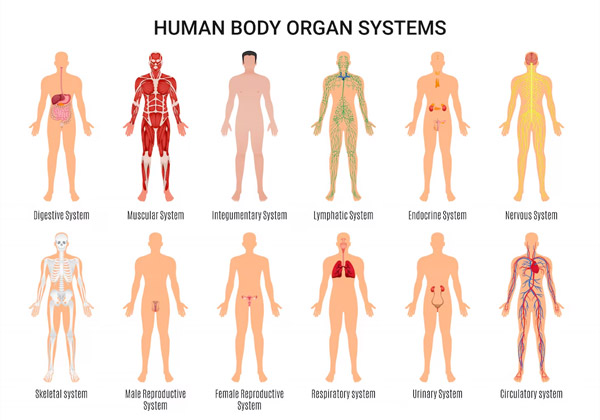
The human body is organized into various organ systems, each with specific functions that work together to maintain health and support life. Here are 12 types of organ systems in the human body:
Digestive System
- Mouth: Begins mechanical digestion with chewing and chemical digestion with saliva.
- Esophagus: Tube that transports food to the stomach.
- Stomach: Secretes acid and enzymes to break down food.
- Small Intestine: Absorbs nutrients and minerals from food.
- Large Intestine: Absorbs water and forms waste products (feces).
- Liver: Produces bile to digest fats.
- Pancreas: Secretes digestive enzymes and insulin.
- Gallbladder: Stores bile.
Functions
- Digestion: Breaks down food into nutrients.
- Absorption: Transfers nutrients into the bloodstream.
- Excretion: Removes undigested food and waste products.
Key Points
- Enzymes play a critical role in breaking down carbohydrates, proteins, and fats.
- The liver is also involved in detoxification and metabolism.
Endocrine System
- Hypothalamus: Regulates the pituitary gland.
- Pituitary Gland: The “master gland” that controls other endocrine glands.
- Thyroid and Parathyroid Glands: Regulate metabolism and calcium levels.
- Adrenal Glands: Produce hormones like cortisol and adrenaline.
- Pancreas: Secretes insulin and glucagon to regulate blood sugar levels.
- Gonads (Ovaries and Testes): Produce sex hormones.
Functions
- Hormone Secretion: Releases hormones that regulate various bodily functions.
- Metabolism: Controls the rate of metabolic processes.
- Growth and Development: Influences growth, development, and reproductive processes.
Key Points
- Hormones act as messengers to regulate physiological activities.
- The endocrine system works closely with the nervous system to maintain homeostasis.
Exocrine System
- Salivary Glands: Produce saliva to aid in digestion and oral health.
- Sweat Glands: Secrete sweat to regulate body temperature and excrete waste.
- Sebaceous Glands: Produce sebum (oil) to lubricate and protect the skin.
- Mammary Glands: Secrete milk for nourishment of infants.
- Digestive Glands: Include the pancreas (produces digestive enzymes) and liver (produces bile), both essential for digestion.
Functions
- Secretion: Releases substances such as enzymes, hormones, or fluids to specific sites within the body or to the exterior.
- Digestion: Produces enzymes and bile that aid in the breakdown of food and absorption of nutrients.
- Temperature Regulation: Secretes sweat to help cool the body through evaporation.
- Protection: Produces substances like sebum that protect and moisturize the skin.
Key Points
- Ducts: Exocrine glands release their secretions through ducts directly to the site of action, unlike endocrine glands, which release hormones directly into the bloodstream.
- Variety of Secretions: The exocrine system encompasses various glands with diverse functions, including digestive, protective, and regulatory roles.
- Feedback Mechanisms: Many exocrine functions are regulated by feedback mechanisms to maintain homeostasis.
Cardiovascular System
- Heart: The central pump that circulates blood.
- Blood Vessels: Arteries, veins, and capillaries that transport blood throughout the body.
- Blood: The fluid that carries oxygen, nutrients, hormones, and waste products.
Functions
- Transportation: Delivers oxygen and nutrients to cells, and removes carbon dioxide and waste products.
- Regulation: Maintains body temperature and pH balance.
- Protection: Contains white blood cells and antibodies that fight infections.
Key Points
- The heart pumps oxygenated blood through the arteries to various tissues and returns deoxygenated blood to the lungs via veins.
- The exchange of gasses, nutrients, and waste products occurs in the capillaries.
Integumentary System
- Skin: The largest organ, protects internal structures.
- Hair and Nails: Provide protection and sensory functions.
- Sweat and Sebaceous Glands: Regulate temperature and secrete oils.
Functions
- Protection: Shields against physical damage, pathogens, and dehydration.
- Regulation: Controls body temperature through sweat and blood flow.
- Sensation: Detects touch, pain, and temperature changes.
Key Points
- The skin consists of three layers: epidermis, dermis, and subcutaneous tissue.
- Melanin in the skin protects against UV radiation.
Immune System
- Lymphoid Organs: Lymph nodes, spleen, thymus, and bone marrow.
- White Blood Cells: Leukocytes that fight infections.
- Antibodies: Proteins that neutralize pathogens.
- Complement System: Proteins that enhance immune response.
Functions
- Defense: Protects against pathogens like bacteria, viruses, and fungi.
- Surveillance: Identifies and destroys abnormal cells.
- Memory: Remembers previous infections to mount a faster response in the future.
Key Points
- The immune system includes both innate (nonspecific) and adaptive (specific) defenses.
- Vaccines help the immune system recognize and combat pathogens.
Muscular System
- Skeletal Muscles: Muscles attached to bones that facilitate voluntary movements such as walking, running, and lifting.
- Smooth Muscles: Involuntary muscles found in the walls of internal organs like the stomach, intestines, and blood vessels, controlling movements such as digestion and blood flow.
- Cardiac Muscle: Specialized muscle found only in the heart, responsible for pumping blood throughout the body.
- Tendons: Connective tissues that attach muscles to bones, enabling force transfer during muscle contraction.
Functions
- Movement: Facilitates body movement by contracting and relaxing skeletal muscles.
- Posture: Maintains body posture and stability through continuous muscle contractions.
- Heat Production: Generates heat through muscle contractions, helping to maintain body temperature.
- Circulation: Assists in moving blood through veins and lymph through lymphatic vessels via muscle contractions.
Key Points
- Voluntary Control: Skeletal muscles are under conscious control, allowing for deliberate movements.
- Involuntary Control: Smooth and cardiac muscles operate automatically without conscious effort.
- Muscle Fibers: Composed of myofibrils that contain actin and myosin, proteins essential for muscle contraction.
Nervous System
- Brain: The central control center responsible for processing sensory information, regulating bodily functions, and facilitating cognition and emotion.
- Spinal Cord: A long, thin bundle of nerves that transmits signals between the brain and the rest of the body.
- Nerves: Peripheral nerves that conduct electrical impulses to and from various body parts.
- Sensory Organs: Eyes, ears, nose, tongue, and skin, which detect and relay sensory information to the brain.
Functions
- Control: Regulates bodily functions, including voluntary actions (like movement) and involuntary actions (such as heartbeat and digestion).
- Coordination: Integrates and processes sensory information from the environment and the body to produce appropriate responses.
- Communication: Transmits signals between different parts of the body, ensuring a coordinated response to internal and external stimuli.
Key Points
- Central Nervous System (CNS): Consists of the brain and spinal cord, responsible for processing information and generating responses.
- Peripheral Nervous System (PNS): Includes all other neural elements, such as sensory and motor nerves, connecting the CNS to limbs and organs.
- Neurons: Specialized cells that transmit nerve impulses through electrical and chemical signals.
- Neurotransmitters: Chemicals that facilitate communication between neurons at synapses.
Reproductive System
- Male: Testes, vas deferens, prostate, seminal vesicles, penis.
- Female: Ovaries, fallopian tubes, uterus, cervix, vagina.
Functions
- Reproduction: Produces gametes (sperm and eggs) and facilitates fertilization.
- Hormone Production: Secretes sex hormones (e.g., testosterone, estrogen) that influence secondary sexual characteristics and reproductive functions.
Key Points
- The reproductive system is essential for producing offspring and ensuring the continuation of the species.
- Hormonal cycles regulate reproductive processes.
Respiratory System
- Nose and Nasal Cavity: Filters, warms, and moistens air.
- Pharynx and Larynx: Pathways for air to enter the lungs; the larynx also houses the vocal cords.
- Trachea: Windpipe that connects the larynx to the bronchi.
- Bronchi and Bronchioles: Air passages that lead to the lungs.
- Lungs: Organs where gas exchange occurs.
- Diaphragm: Muscle that aids in breathing.
Functions
- Gas Exchange: Provides oxygen to the blood and removes carbon dioxide.
- Voice Production: Vocal cords in the larynx produce sound.
Key Points
- The process of breathing involves inhalation (bringing in oxygen) and exhalation (expelling carbon dioxide).
- Gas exchange takes place in the alveoli, tiny air sacs in the lungs.
Skeleton System
- Bones: Rigid structures that form the framework of the body, providing support and protection for internal organs.
- Cartilage: Flexible connective tissue found in joints, ear, nose, and intervertebral discs, providing cushioning and reducing friction.
- Ligaments: Strong, fibrous tissues that connect bones to other bones, stabilizing joints and preventing excessive movement.
- Joints: Articulations where two or more bones meet, allowing for varying degrees of movement.
Functions
- Support: Provides structural support for the body, maintaining its shape and form.
- Protection: Shields vital organs, such as the brain (skull), heart, and lungs (ribcage).
- Movement: Works in conjunction with the muscular system to facilitate movement by serving as attachment points for muscles.
- Mineral Storage: Stores essential minerals like calcium and phosphorus, releasing them into the bloodstream as needed.
- Blood Cell Production: Contains bone marrow, which produces red blood cells, white blood cells, and platelets.
Key Points
- Bone Remodeling: A dynamic process where old bone tissue is replaced with new bone tissue, maintaining bone strength and integrity.
- Types of Bones: Long bones (e.g., femur), short bones (e.g., carpals), flat bones (e.g., sternum), and irregular bones (e.g., vertebrae).
Urinary System
- Kidneys: Bean-shaped organs that filter blood to remove waste products and excess substances, forming urine.
- Ureters: Tubes that transport urine from the kidneys to the bladder.
- Bladder: A muscular sac that stores urine until it is ready to be expelled from the body.
- Urethra: The duct through which urine is expelled from the bladder to the outside of the body.
Functions
- Filtration: Removes waste products and excess fluids from the blood to form urine.
- Excretion: Eliminates waste and excess substances from the body through urine.
- Regulation: Maintains fluid and electrolyte balance, as well as acid-base homeostasis.
- Blood Pressure Regulation: Helps regulate blood pressure by adjusting the volume of blood and the concentration of electrolytes.
Key Points
- Urine Formation: Involves filtration (in the kidneys), reabsorption (of water and nutrients back into the blood), and secretion (of additional waste into the urine).
- Homeostasis: The urinary system plays a crucial role in maintaining the body’s internal environment, including electrolyte levels and pH balance.
- Urinology: The study of urinary system functions and disorders, including conditions such as urinary tract infections (UTIs) and kidney stones.
Organ Systems In the Human Body FAQs
Q1. What is the primary function of the circulatory system?
Answer: The primary function of the circulatory system is to transport blood, oxygen, nutrients, hormones, and waste products throughout the body. It also helps regulate body temperature and pH balance.
Q2. What functions does the immune system perform?
Answer: The immune system protects the body from pathogens (e.g., bacteria, viruses) and foreign substances. It also plays a role in recognizing and destroying abnormal or damaged cells.
Q3. What happens if one organ system fails?
Answer: If one organ system fails, it can disrupt the function of other systems and lead to health issues or diseases. For instance, kidney failure can result in the accumulation of toxins and affect the cardiovascular system.
Q4. How many organ systems are there in the human body?
Answer: There are 12 major organ systems in the human body:
Circulatory System
Respiratory System
Digestive System
Nervous System
Endocrine System
Exocrine System
Muscular System
Skeletal System
Immune System
Integumentary System
Reproductive System
Urinary System