
This is a national-level entrance for Class 11 and 12 students interested in chemistry. It acts as a gateway to the Indian National Chemistry Olympiad and, therefore, is an important hallmark event for those pursuing excellence in the subject. Only the top 1 percent of the more than 30,000 who take the exam each year are able to proceed to the INChO level. NSEC 2024, to be held on November 24, 2024, from 11:30 AM to 1:30 PM, will provide the perfect setting to display your chemistry skills. It is essential to know about this highly competitive exam’s pattern, curriculum emphasis, and preparation methodology in order to succeed in it. In detail, this post is devoted to every aspect of the NSEC 2024–25 exam, so you can study and perform to the best of your abilities.
NSEC 2024 Exam Overview
This evaluation primarily tests the student’s knowledge related to chemistry concepts, with the intense focus being given to the Class 11 syllabus, integrated with the advanced topics of Class 12. The exam is the first stepping stone toward the Indian National Chemistry Olympiad (INChO) and hence a very significant avenue for those who are serious about a future in chemistry.
| Category | Details |
| Organization |
IAPT (Indian Association of Physics Teachers) in collaboration with HBCSE (Homi Bhabha Centre for Science Education)
|
| Exam Name |
National Standard Examination in Chemistry (NSEC 2024-25)
|
|
NSEC 2024-25 Exam Date
|
24th November 2024 (11:30 AM to 1:30 PM)
|
| Mode of Exam |
Pen and Paper Mode
|
|
Duration of NSEC Exam
|
2 Hours |
|
Type of Questions
|
Multiple Choice Questions
|
| Official Website |
NSEC 2024 Exam Pattern
Understanding the exam pattern is critical for a strong performance in any competitive exam. The NSEC exam 2024 will follow the structure outlined below:
- Total Number of Questions: 60
- Total Marks: 216 Marks
- Question Type: Multiple Choice Questions (MCQs)
- Marking Scheme:
- +3 marks for a correct answer
- -1 mark for an incorrect answer
- 0 marks for unattempted questions
The questions in NSEC 2024 will be divided into two sets:
- Set A: Contains 48 questions
- Set B: Contains 12 questions
Detailed Breakdown of Set A and Set B:
| Set | No. of Questions | Marks per Correct Answer | Marks per Incorrect Answer |
|---|---|---|---|
| Set A | 48 | +3 | -1 |
| Set B | 12 | +6 | 0 |
Those questions of Set A carry a weightage of 3 marks each and will carry a penalty of 1 mark for every wrong answer attempted. In case of Set B, the questions carry higher values of marks with 6 marks being awarded for every correct answer given. However, the trend of marking wrong answers does not operate in this set.
Important Topics for NSEC 2024
Since the NSEC examination follows the CBSE Class 12 syllabus for Chemistry, it is crucial to focus on the core topics of chemistry that are necessarily covered in Class 11. Some of the most important areas to focus on include:
- Physical Chemistry:
- Atomic Structure
- Thermodynamics
- Chemical Kinetics
- Surface Chemistry
- States of Matter
- Inorganic Chemistry:
- Classification of Elements and Periodicity in Properties
- Chemical Bonding and Molecular Structure
- p-Block Elements
- d-Block Elements and Coordination Compounds
- Organic Chemistry:
- General Organic Chemistry
- Hydrocarbons
- Organic Compounds Containing Nitrogen
- Biomolecules
- Polymers
- Environmental Chemistry:
- Environmental Pollution
- Green Chemistry
It’s important to have a strong grasp of these subjects and be prepared to tackle a variety of questions related to each. Practicing problem-solving and developing a deeper understanding of chemical concepts will be key to success in the exam.
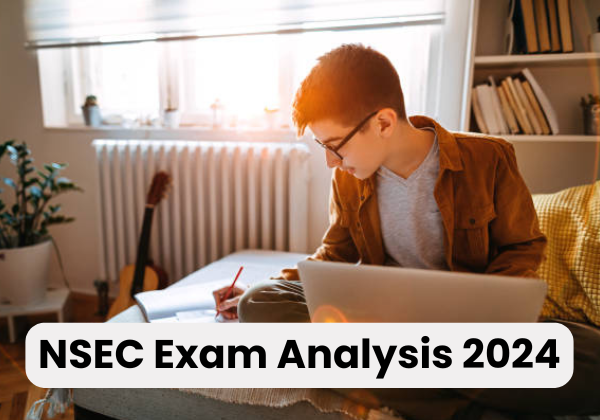
NSEC Exam Analysis 2024 (Detailed)
The NSEC Exam Analysis 2024 would provide in-depth review of the exam, giving students valuable insights into its structure, question types, and overall difficulty level. This analysis would be crucial for any student getting ready to sit for the National Standard Examination in Chemistry someday soon as it breaks down how the exam is organized, what kind of questions might be expected, and how to approach each one effectively. Clearly, knowing the format of the test is going to make a good difference in the preparation process of students for the much-needed NSEC before the Indian National Chemistry Olympiad (INChO) gets qualified.
This analysis takes a comprehensive look into various areas related to the NSEC 2024 exam, including how questions are divided, the marking scheme, and the most important topics that typically appear on the exam. Being a first-time candidate or upgrading your performance is what this analysis will provide you with.
The National Standard Examination in Chemistry (NSEC) conducted on 24th November 2024 had a very carefully thought out and quite challenging question paper. This year’s Chemistry Examination was spread over the most diverse set of topics from Classes XI and XII, with an observable bias towards Class XII. Given below is the detailed analysis of the problem distribution pattern, difficulty levels, and the overall paper structure.
Distribution of Questions by Class
Class XI Contribution
Approximately one-third of the questions came from the Class XI syllabus. Among these:
- Physical Chemistry dominated, accounting for 65% of the Class XI section. Topics like thermodynamics, chemical equilibrium, and mole concept were prominent, often requiring strong conceptual knowledge and numerical problem-solving skills.
- Organic Chemistry contributed 20%, focusing on foundational topics such as nomenclature, basic reaction mechanisms, and hydrocarbon reactions.
- Inorganic Chemistry constituted the remaining 15%, placing emphasis on periodic properties, chemical bonding, and basic properties of group elements
Class XII Contribution
- Class XII syllabus contributed two-thirds of the entire number, with Organic Chemistry in an overt lead Constituted 40 per cent, comprising advanced reaction mechanisms, biomolecules, and named reactions. These questions required deep understanding and strong application skills.
- Areas such as electrochemistry, chemical kinetics, and solutions, with a focus on analytical and problem-solving competencies, comprised 25% from Physical Chemistry.
- Inorganic Chemistry comprised 35%, covering the ground under coordination compounds, qualitative analysis, and chemistry of transition elements.
NSEC Exam Difficulty Level
It becomes easy for the candidates to prepare suitably by directing their attention toward studying those topics that are considered to have the greatest challenge.
In preparation for the NSEC 2024-25, this page will give us glimpses into the nature of questions that have been presented in the NSEC Exam conducted on 24 November 2024:
Difficulty Level Analysis
The paper consisted of an equally balanced proportion of questions that were divided into three categories with regard to their difficulty levels:
Difficulty Level % of Questions Characteristics
- Easy. 18%. Straightforward, concept-based questions with minimal arithmetic.
- Medium. 58%. Moderately challenging, often requiring the combination of multiple concepts or experimental data to be analyzed.
- Difficult. 24%. Complex questions that test deep understanding, requiring intricate problem solving or advanced reasoning.
Examples of Questions by Level
- Easy: Numerical mole-based problems or direct periodic trend questions.
- Medium: Organic Chemistry mechanism reaction problems or thermodynamic calculation questions.
- Difficult: Kinetics multi-step problems or synthesis organic chemistry-based questions
General NSEC Paper Difficulty
The NSEC 2024 paper can be considered moderate to challenging, skewed towards analytical and application-based questions.
- Organic Chemistry was the Star of the Show: Organic Chemistry took center stage in the Class XII section, primarily focusing on reaction mechanisms, stereochemistry, and functional group transformations. Knowledge of these areas had to be strong for a smooth performance.
- Heavy on Numbers in Physical Chemistry: Numerical problems were a quintessential feature in both Class XI and XII sections. These require accuracy, speed, and an excellent knowledge of the formulas.
- Conceptual Depth in Inorganic Chemistry: The type of questions asked in Inorganic Chemistry needed a strong concept understanding of bonding theories, periodic trends, and qualitative analysis. Some demanded interpretation of experimental results, making them uniquely challenging.
Balanced Difficulty Levels
While easy and medium-level questions offered scoring opportunities, the difficult questions helped distinguish top-performing students. The inclusion of experimental data and application-based problems made the paper fair but demanding.
NSEC 2024 exam certainly opens doors to a great number of students who love chemistry: taking the first step towards a promising career in science. Once the question paper pattern is understood, concentration will be focused on key topics, and preparation tips followed, all this is enough to make you qualify for the Indian National Chemistry Olympiad and beyond. Just stay focused, practice regularly, and approach the exam without any sort of fear or nervousness. Good luck with your preparation!
NSEC Exam Analysis 2024-25 FAQs
1. What is the NSEC Exam Analysis 2024?
Answer: The NSEC Exam Analysis 2024 is a detailed breakdown of the exam pattern, difficulty level, and marking scheme of the National Standard Examination in Chemistry (NSEC). It will provide students with insights into the types of questions asked, important topics, and strategies for effective exam preparation. The analysis will help students understand how to approach the exam and maximize their scores.
2. When will the NSEC Exam Analysis 2024 be available?
Answer: The NSEC Exam Analysis 2024 will be available shortly after the exam, with updates to follow as soon as the exam is conducted. The analysis will include a comprehensive review of the exam and its components, helping students gain a better understanding of what to expect and how to improve their performance for future exams.
3. How can the NSEC Exam Analysis help me with my preparation?
Answer: The NSEC Exam Analysis provides an in-depth look at the exam’s format, question distribution, and typical difficulty levels. By studying this analysis, students can gain insights into the areas that are commonly tested and use this information to tailor their preparation. It also offers tips on time management and approaches to answering multiple-choice questions effectively.
4. What are the main components covered in the NSEC Exam Analysis?
Answer: The NSEC Exam Analysis covers various aspects of the exam, including the total number of questions, marking schemes, difficulty level, and frequently tested topics in the Chemistry syllabus. It will also highlight the structure of the questions and provide strategies for improving accuracy in answering them. The analysis aims to help students understand how to approach each section of the exam confidently.
5. Can the NSEC Exam Analysis improve my chances of qualifying for the Indian National Chemistry Olympiad?
Answer: Yes, the NSEC Exam Analysis is designed to provide students with a deeper understanding of the exam, making it easier for them to focus their efforts on areas that matter most. By using the analysis to identify strengths and weaknesses, students can improve their performance and increase their chances of qualifying for the Indian National Chemistry Olympiad (INChO).