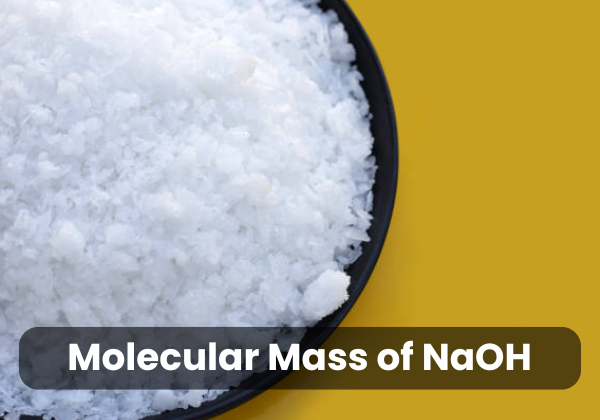

Understanding the molecular mass of NaOH (Sodium Hydroxide) is essential for students preparing for competitive exams such as NEET, JEE, and board examinations. In Chemistry, molecular mass plays a key role in stoichiometry, chemical reactions, and mole concept calculations. In this article, we will discuss what NaOH is, how to calculate its molecular mass, and why it is important for students to master this concept in 2025 and beyond.
What is NaOH?
NaOH stands for Sodium Hydroxide, a strong base commonly used in laboratories and industries. It is an ionic compound composed of:
-
Sodium (Na) – a metal from group 1 of the periodic table
-
Oxygen (O) – a non-metal
-
Hydrogen (H) – also a non-metal
It appears as a white crystalline solid and is highly soluble in water. When dissolved, it forms hydroxide ions (OH⁻), making it a powerful alkali. Sodium hydroxide is used in making soaps, detergents, paper, and various chemicals, making its study significant at both academic and practical levels.
Chemical Formula of Sodium Hydroxide (NaOH)
The molecular formula of sodium hydroxide is:
NaOH
This formula indicates that one molecule of NaOH contains:
-
1 atom of Sodium (Na)
-
1 atom of Oxygen (O)
-
1 atom of Hydrogen (H)
How to Calculate the Molecular Mass of NaOH
To calculate the molecular mass of NaOH, you need to sum up the atomic masses of all the atoms present in one molecule of sodium hydroxide. The standard atomic masses (approximate values) are:
-
Sodium (Na) = 22.99 g/mol
-
Oxygen (O) = 16.00 g/mol
-
Hydrogen (H) = 1.008 g/mol
Molecular Mass Calculation of NaOH:
Molecular Mass Calculation of NaOH:
Molecular Mass of NaOH = (1×22.99)+(1×16.00)+(1×1.008) = 22.99+16.00+1.008 = 39.998
So, the molecular mass of NaOH is 39.998 g/mol.
Why is Molecular Mass of NaOH Important?
Knowing the molecular mass of sodium hydroxide is important in various Chemistry topics, including:
-
Mole concept: Used to convert between mass and number of moles
-
Stoichiometry: Helps balance chemical equations and determine reactant-product relationships
-
Solution preparation: Essential for calculating molarity and normality in titrations
-
Industrial applications: Determines chemical requirements in large-scale manufacturing
In 2025, when curriculum and competitive exams like NEET and JEE are becoming more application-oriented, conceptual clarity on such topics gives students an edge.
Application in Reactions
Here’s a simple example of how molecular mass is used in reactions:
NaOH + HCl → NaCl + H₂O
To neutralize 1 mole (39.998 g) of NaOH, you need 1 mole (36.46 g) of HCl. The calculation of required amounts for such reactions becomes easier when molecular mass is known.
Conclusion
The molecular mass of NaOH is 39.998 g/mol, and it forms a fundamental part of Chemistry learning at school and competitive exam levels. A strong grip on this concept can significantly enhance a student’s performance in exams and practicals. At Aakash Institute, students are guided step-by-step through such calculations, ensuring both theoretical clarity and real-world application.
Molecular Mass of NaOH FAQs
Q1. What is the molecular mass of NaOH and how is it calculated?
Answer: The molecular mass of NaOH (Sodium Hydroxide) is 39.998 g/mol. It is calculated by summing the atomic masses of its constituent elements:
-
Sodium (Na) = 22.99 g/mol
-
Oxygen (O) = 16.00 g/mol
-
Hydrogen (H) = 1.008 g/mol
Thus,
Molecular Mass of NaOH = 22.99 + 16.00 + 1.008 = 39.998 g/mol
Q2. Why is it important to know the molecular mass of NaOH?
Answer: Knowing the molecular mass of NaOH is essential for solving problems in stoichiometry, molarity, and chemical reactions. It helps in converting between grams and moles, preparing solutions for titrations, and balancing chemical equations accurately.
Q3. Where is NaOH used in real-life applications?
Answer: NaOH is widely used in soap manufacturing, chemical processing, water treatment, and laboratories. Its molecular mass is often used in calculations while preparing chemical solutions for industrial and academic purposes.
Q4. Is molecular mass the same as molar mass for NaOH?
Answer: Yes, for practical purposes, molecular mass and molar mass of NaOH are numerically the same — 39.998 g/mol. The term molecular mass refers to the mass of one molecule, while molar mass refers to the mass of one mole (6.022 × 10²³ molecules) of NaOH.