
Calcium carbonate, commonly known as CaCO₃, is an essential chemical compound widely used in both academic and industrial contexts. From geology to medicine, CaCO₃ plays a vital role in various fields, which makes understanding its molecular mass crucial for students preparing for competitive exams like NEET and JEE. This article will help you understand the molecular mass of CaCO₃, how it is calculated, and why it holds significance in chemistry.
What is CaCO₃?
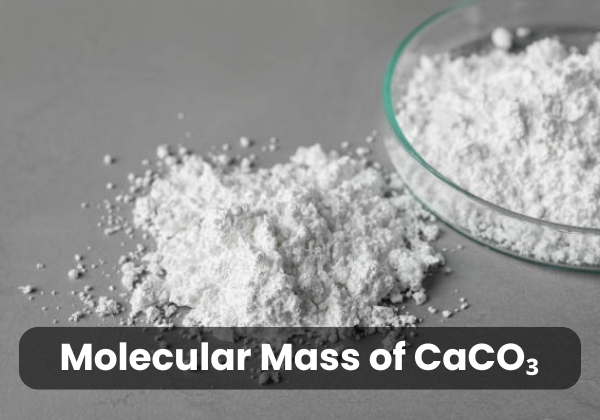
CaCO₃ stands for Calcium Carbonate, a chemical compound composed of three elements: calcium (Ca), carbon (C), and oxygen (O). It is naturally found in rocks like limestone, marble, and chalk. In biology, it forms the structural material of shells, corals, and eggshells.
Molecular Mass of CaCO₃ Definition
The molecular mass (also called molecular weight) of a compound is the sum of the atomic masses of all the atoms present in one molecule of that compound. It is expressed in atomic mass units (amu) or grams per mole (g/mol).
Atomic Masses of Constituent Elements
To calculate the molecular mass of calcium carbonate (CaCO₃), we need to consider the atomic masses of its individual elements:
| Element | Symbol | Atomic Mass (g/mol) | Number of Atoms |
|---|---|---|---|
| Calcium | Ca | 40.08 | 1 |
| Carbon | C | 12.01 | 1 |
| Oxygen | O | 16.00 | 3 |
How to Calculate the Molecular Mass of CaCO₃
Step-by-step Calculation:
-
Calcium (Ca): 1 × 40.08 = 40.08
-
Carbon (C): 1 × 12.01 = 12.01
-
Oxygen (O): 3 × 16.00 = 48.00
Total Molecular Mass of CaCO₃ = 40.08 + 12.01 + 48.00 = 100.09 g/mol
So, the molecular mass of CaCO₃ is 100.09 g/mol.
Importance of Knowing the Molecular Mass
Understanding the molecular mass of CaCO₃ is vital in the following areas:
1. Stoichiometric Calculations
In chemical reactions, molecular mass helps calculate how much of a substance is required or produced. For instance, CaCO₃ is used in reactions involving acids, and accurate molar calculations are crucial for balanced equations.
2. Pharmaceutical Applications
Calcium carbonate is commonly used in antacids. Pharmacists must use the correct molecular mass to dose medicines effectively and safely.
3. Geological Studies
CaCO₃ forms the basis of many sedimentary rocks. Its molecular mass is key in estimating composition and purity in rock samples.
4. Biological Relevance
In biology, understanding the composition and mass of materials like shells and bones (made of CaCO₃) is important in ecological and anatomical studies.
Conclusion
To summarize, Calcium Carbonate (CaCO₃) has a molecular mass of 100.09 g/mol, derived from the atomic masses of calcium, carbon, and oxygen. This basic concept not only helps students excel in exams like NEET and JEE but also plays a significant role in various scientific fields.
Understanding the molecular mass of commonly used compounds like CaCO₃ lays a strong foundation for advanced chemistry and applied sciences. Keep practicing such calculations for a solid grip on chemical fundamentals.
Molecular Mass of CaCO₃ FAQs
Q1. What is the molecular mass of CaCO₃ and how is it calculated?
A: The molecular mass of CaCO₃ (Calcium Carbonate) is 100.09 g/mol. It is calculated by summing the atomic masses of all atoms in the compound:
-
Calcium (Ca) = 40.08
-
Carbon (C) = 12.01
-
Oxygen (O) = 16.00 × 3 = 48.00
Total = 40.08 + 12.01 + 48.00 = 100.09 g/mol
Q2. Why is knowing the molecular mass of CaCO₃ important in chemistry?
A: Knowing the molecular mass of CaCO₃ is important for stoichiometric calculations, which help determine the right amounts of reactants and products in a chemical reaction. It also plays a crucial role in laboratory experiments, pharmaceuticals, and industrial formulations involving calcium carbonate.
Q3. Is molecular mass and molar mass of CaCO₃ the same?
A: Yes, in practical terms, molecular mass and molar mass are often used interchangeably. Molecular mass is expressed in atomic mass units (amu), while molar mass is expressed in grams per mole (g/mol). For CaCO₃, both values are numerically the same: 100.09, but the units differ.
Q4. In which real-life applications is the molecular mass of CaCO₃ used?
A: The molecular mass of CaCO₃ is used in various real-life applications such as:
-
Pharmaceuticals: in antacid formulations.
-
Construction: for calculating materials like cement and limestone.
-
Environmental science: to measure acid neutralization in soils.
-
Education & research: for understanding chemical reactions in academic labs.