
Molecular Mass of Benzene: Benzene is one of the most fundamental aromatic hydrocarbons in organic chemistry and holds significant importance in both academic and industrial settings. Understanding its molecular mass is essential for students preparing for competitive exams such as NEET, JEE, and other board examinations in 2025.
In this article, we will explore the molecular mass of benzene, how to calculate it, and why it matters in chemical reactions and applications.
What is Benzene?
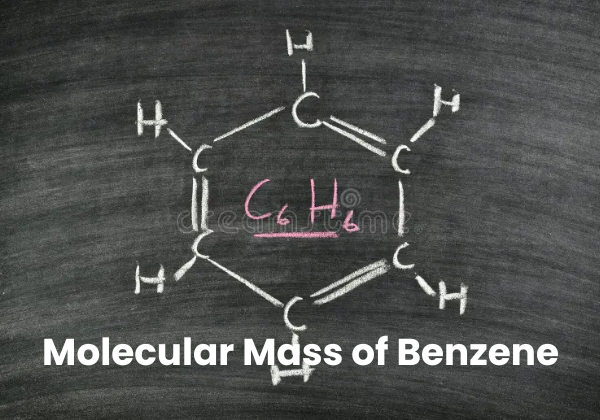
Benzene is an aromatic hydrocarbon with the chemical formula C₆H₆. It is a colorless and highly flammable liquid with a sweet odor. Benzene is widely used as an industrial solvent and is a precursor to many important chemical compounds including plastics, resins, synthetic fibers, rubber, dyes, and drugs.
Molecular Formula of Benzene
-
Chemical Formula: C₆H₆
-
Number of Carbon Atoms (C): 6
-
Number of Hydrogen Atoms (H): 6
Benzene has a cyclic structure with alternating double bonds, known as a conjugated π-electron system, which contributes to its stability and aromaticity.
Definition of Molecular Mass
Molecular mass (also referred to as molecular weight) is the sum of the atomic masses of all atoms present in a molecule. It is usually expressed in atomic mass units (amu or g/mol).
How to Calculate the Molecular Mass of Benzene (C₆H₆)?
To calculate the molecular mass of benzene:
Step 1: Atomic masses (approximate)
-
Carbon (C) = 12 g/mol
-
Hydrogen (H) = 1 g/mol
Step 2: Multiply with the number of atoms
-
6 Carbon atoms = 6 × 12 = 72 g/mol
-
6 Hydrogen atoms = 6 × 1 = 6 g/mol
Step 3: Add the total mass
-
Molecular Mass of C₆H₆ = 72 + 6 = 78 g/mol
Therefore, the molecular mass of benzene is 78 g/mol.
Significance of Molecular Mass of Benzene
1. Stoichiometric Calculations
Knowing the molecular mass is crucial for stoichiometry, which involves calculating the quantities of reactants and products in chemical reactions.
2. Chemical Reactions
In many organic reactions such as electrophilic substitution, the molecular mass of benzene is used to calculate yields and determine reaction feasibility.
3. Industrial Applications
Benzene’s molecular mass helps in the formulation of various industrial chemicals and pharmaceuticals, especially when determining concentrations and chemical dosages.
4. Academic Relevance
In competitive exams like NEET 2025 and JEE 2025, molecular mass-based questions are common in both physical and organic chemistry sections.
Benzene in the NEET & JEE Syllabus
Benzene and its derivatives are covered under:
-
Aromatic Compounds
-
Electrophilic Substitution Reactions
-
Structure and Bonding in Organic Chemistry
Understanding its molecular mass is foundational for mastering these chapters.
Benzene Molecular Weight Summary
| Property | Details |
|---|---|
| Chemical Formula | C₆H₆ |
| Molecular Mass | 78 g/mol |
| Carbon Atomic Mass | 12 g/mol |
| Hydrogen Atomic Mass | 1 g/mol |
| Uses | Solvents, plastics, dyes |
| Related Exam Topics | NEET 2025, JEE 2025 |
Conclusion
The molecular mass of benzene (C₆H₆) is a key concept in organic chemistry, especially for students preparing for competitive exams in 2025. With a molecular mass of 78 g/mol, it plays a crucial role in various chemical processes and practical applications. A strong understanding of how to calculate and apply this value can help students solve complex problems with confidence.
Molecular Mass of Benzene FAQs
Q1. What is the molecular mass of benzene?
Answer: The molecular mass of benzene (C₆H₆) is 78 g/mol. It is calculated by adding the atomic masses of 6 carbon atoms (6 × 12 = 72 g/mol) and 6 hydrogen atoms (6 × 1 = 6 g/mol), giving a total of 72 + 6 = 78 g/mol.
Q2. Why is it important to know the molecular mass of benzene?
Answer: Knowing the molecular mass of benzene is essential for stoichiometric calculations, chemical reactions, and industrial formulations. It helps in determining the right quantity of substances in reactions, especially in organic chemistry and practical laboratory work.
Q3. How is benzene represented chemically?
Answer: Benzene is represented by the chemical formula C₆H₆. It consists of a six-carbon ring with alternating double bonds (aromatic ring), making it a stable and commonly studied compound in organic chemistry.
Q4. Is the molecular mass of benzene important for NEET or JEE exams?
Answer: Yes, it is. Benzene and related compounds are part of the organic chemistry syllabus in both NEET and JEE. Questions may involve calculating molecular masses or applying the concept to solve reaction-based problems.
Q5. What are some common uses of benzene where its molecular mass is relevant?
Answer: Benzene is used in the production of plastics, synthetic fibers, rubber, dyes, detergents, and pharmaceuticals. In all these applications, knowing the molecular mass helps in determining proportions and concentrations accurately.