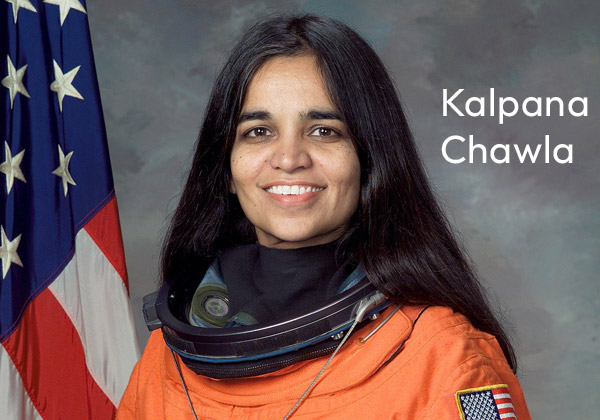

Kalpana Chawla was an astronaut whose life story inspires millions of people around the world. She faced many challenges but never gave up on her dreams. With strong determination and a deep love for exploring the unknown, she reached for the stars. This article will explore her early life and education, the important achievements she made, and the tragic event that turned her into a lasting symbol of bravery and courage.
Kalpana Chawla Early Life and Family
Birth and Childhood
Kalpana Chawla was born on March 17, 1962, in Karnal, a small town in the northern part of India, in the state of Haryana. She was the youngest child in her family, with two older sisters and an older brother. Her parents, Banarasi Lal Chawla and Sanjyothi Chawla, gave her a name that means “imagination,” which perfectly suited her curious and adventurous nature.
As a child, Kalpana was full of energy and curiosity. She was always eager to learn new things and often asked questions about the world around her. She was particularly fascinated by the sky and airplanes. Even as a young girl, she dreamed of flying and exploring the skies. She would spend hours drawing pictures of airplanes and imagining herself as a pilot, soaring high above the clouds.
Family Background and Support
Kalpana’s father, Banarasi Lal Chawla, was a hardworking businessman. He owned a small tire factory in Karnal, and although the family was not wealthy, they lived comfortably. Her mother, Sanjyothi Chawla, was a homemaker who dedicated her time to taking care of the family. Despite the traditional expectations of the time, Kalpana’s parents believed in the importance of education and supported their children’s dreams.
Kalpana Chawla Education
Schooling and Early Interests
Kalpana attended Tagore Baal Niketan Senior Secondary School in Karnal. In school, she was known for being a hardworking student. She had a special interest in science, especially in subjects related to space and flight. Even though it was not common for girls to pursue careers in science or engineering during that time, Kalpana’s family supported her interests. They encouraged her to follow her passion, even when it meant stepping into fields that were dominated by men.
Higher Education and Moving to the U.S.
After finishing high school, Kalpana decided to study Aeronautical Engineering, which is the study of how airplanes and spacecraft are designed and built. She enrolled at Punjab Engineering College in Chandigarh, where she was one of the few women in her class. Despite the challenges of being in a male-dominated field, she excelled in her studies and graduated with a Bachelor of Engineering degree in 1982.
Kalpana wanted to learn more about aerospace engineering, so she decided to move to the United States for further studies. In 1982, she went to the University of Texas at Arlington, where she earned her first Master of Science degree in Aerospace Engineering in 1984. But she didn’t stop there. Kalpana continued her education and earned a second Master’s degree in 1986 and a Ph.D. in Aerospace Engineering from the University of Colorado Boulder in 1988. Her education gave her the skills and knowledge she needed to pursue her dream of going to space.
Kalpana Chawla Personal Life
Marriage
Kalpana Chawla married Jean-Pierre Harrison in 1983. Jean-Pierre, who was from France, was a flying instructor and an aviation author. They met while Kalpana was studying in the United States. Both shared a love for flying and adventure, which helped them connect on a deeper level. Jean-Pierre supported Kalpana’s dreams and stood by her side as she pursued her career as an astronaut. Their relationship was strong, built on mutual respect and shared interests.
Children
Kalpana Chawla and Jean-Pierre Harrison did not have any children. Kalpana was deeply committed to her work and her passion for space exploration. She dedicated much of her life to her career, making significant contributions to science and inspiring people around the world.
Kalpana Chawla‘s Career
Kalpana’s dream was to travel to space, and in 1994, she took a big step towards that goal. She was chosen to become an astronaut by NASA. This was a big achievement because it meant she would be trained to go on space missions. She spent many months training, learning how to operate spacecraft, conduct experiments in space, and handle emergency situations.
When Did Kalpana Chawla Join NASA?
Kalpana Chawla began her career at NASA in 1988. She was hired as a research scientist at the Ames Research Center in California. Her job was to work on projects that studied how air moves around aircraft. This research was important for designing better and safer airplanes. Kalpana used computer models to understand how airflow affects planes, which helped improve their performance.
Kalpana Chawla‘s First Space Mission
STS-87 Mission (1997)
Overview:
Kalpana Chawla’s first space flight was on the Space Shuttle Columbia, mission STS-87, which launched on November 19, 1997. This mission was part of NASA’s Space Shuttle program and lasted about 16 days.
Role:
Kalpana served as a mission specialist. Her main job was to operate the shuttle’s robotic arm. The robotic arm was used to conduct scientific experiments and to handle equipment outside the shuttle.
Objectives:
The primary goals of the STS-87 mission were to conduct scientific experiments in space and to deploy and retrieve a space-based observatory. The mission also included studying the effects of microgravity on various physical processes.
Achievements:
The mission successfully completed its objectives, and Kalpana’s work with the robotic arm contributed to the success of the experiments. The mission provided valuable data that helped scientists understand how space conditions affect different phenomena.
Kalpana Chawla‘s Second and Last Space Mission
Kalpana Chawla’s second space flight was also aboard the Space Shuttle Columbia, on mission STS-107. This mission launched on January 16, 2003, and was intended to be a 16-day scientific research mission.
Role:
Kalpana was a mission specialist and contributed to a wide range of scientific experiments during this flight. The mission focused on a variety of fields including biology, physics, and materials science.
Objectives:
The main goal of STS-107 was to conduct experiments that could only be done in the unique environment of space. This included studying the effects of microgravity on different biological and physical processes, such as how flames burn and how materials react in space.
Achievements:
The crew conducted many important experiments and gathered valuable data before the tragic accident. Unfortunately, the mission ended in disaster when the Space Shuttle Columbia disintegrated during re-entry into Earth’s atmosphere on February 1, 2003.
Kalpana Chawla Death
Kalpana Chawla died on February 1, 2003. She was aboard the Space Shuttle Columbia, which was on a mission to conduct scientific research in space. The shuttle was supposed to return to Earth after a successful mission.
Accident in STS-107
As the shuttle was re-entering Earth’s atmosphere, something went wrong. The Columbia had been damaged during its launch when a piece of foam insulation broke off and hit the shuttle. This damage was not noticed in time, and as the shuttle came back through the atmosphere, the heat caused the damaged area to fail. The shuttle broke apart in the sky over Texas, and all seven astronauts on board were killed, including Kalpana. Kalpana chawla died at the age of 40.
Kalpana Chawla Recognition and Legacy
Recognition
Kalpana Chawla is remembered as a hero and an inspiration. After her tragic death, many people and organizations honored her achievements and her contributions to space science.
Honors and Tributes:
- Schools and Institutions: Several schools and educational institutions have been named after Kalpana Chawla. This helps keep her memory alive and encourages students to pursue their dreams.
- Awards and Scholarships: There are awards and scholarships given in her name to recognize young scientists and engineers. These are meant to support and inspire the next generation of explorers and researchers.
- Spacecraft and Satellites: A satellite named “Kalpana-1” was launched in her honor. This keeps her connection to space alive and continues her legacy in space exploration.
- Books and Films: Her life story has been featured in books and films, helping more people learn about her incredible journey and achievements.
Legacy
Kalpana Chawla’s legacy is about more than just her work in space. She is remembered for her courage, her dedication, and her role as a pioneer. She broke barriers and showed that dreams can come true with hard work and determination.
Inspiration:
Her life story inspires many people, especially young women and girls, to follow their dreams in science, technology, and exploration. Kalpana Chawla showed that even the sky is not the limit if you have the passion and perseverance to reach for the stars.
Awards Awarded to Kalpana Chawla
These awards celebrate Kalpana Chawla’s achievements and her impact on space exploration and science.
| Award | Description |
| Congressional Space Medal of Honor | This is one of the highest awards given to astronauts by the U.S. Congress. It honors their bravery and contributions to space exploration. |
| NASA Space Flight Medal | Awarded to astronauts who have completed a space mission. It recognizes their hard work and achievements in space. |
| The Kalpana Chawla Award | Given in her honor to young women who excel in the fields of science, technology, engineering, and mathematics (STEM). |
| Honorary Doctorate Degrees | Various universities awarded her honorary doctorate degrees for her contributions to science and technology. |
Popular Culture Representation of Kalpana Chawla
These representations help keep Kalpana Chawla’s story alive and inspire people around the world.
| Representation | Description |
| Books | Several books have been written about Kalpana’s life and achievements, such as “The Sky Is Not the Limit” by Kalpana Chawla and others. These books share her inspiring story with readers. |
| Movies and Documentaries | Kalpana’s life has been featured in movies and documentaries, like the documentary “Kalpana Chawla: The First Indian Woman in Space,” which highlights her journey and accomplishments. |
| Educational Programs | Many educational programs and documentaries for schools and universities include stories about Kalpana, teaching students about her life and work. |
| Memorials and Tributes | Various memorials and tributes, such as statues and plaques, have been created to honor her memory and contributions. |
Kalpana Chawla Biography FAQs
Q1. Who was Kalpana Chawla?
Kalpana Chawla was an astronaut from India who became the first woman of Indian origin to go to space. She flew on the Space Shuttle Columbia and made significant contributions to space science.
Q2. When was Kalpana Chawla born?
Kalpana Chawla was born on March 17, 1962, in Karnal, Haryana, India.
Q3. What were Kalpana Chawla’s major space missions?
Kalpana Chawla flew on two space missions. Her first mission was STS-87 in 1997 on the Space Shuttle Columbia, and her second mission was STS-107 in 2003, also on the Columbia.
Q4. What happened to Kalpana Chawla’s Space Shuttle Columbia?
The Space Shuttle Columbia broke apart upon re-entry into Earth’s atmosphere on February 1, 2003, due to damage from foam insulation that occurred during launch. All seven astronauts on board, including Kalpana Chawla, were killed.
Q5. What awards were given to Kalpana Chawla?
Kalpana Chawla received several awards, including the Congressional Space Medal of Honor and the NASA Space Flight Medal. There are also awards and scholarships named in her honor.