
So, you want to get into IIT? Good for you! That means you already understand what’s in the way of getting you that dream of getting into IIT, right? And if you are reading this right now, then chances are you are trying to understand how all of this works before you proceed any further.
Well, here is the thing: there is a lot of misinformation floating around the internet. So, let’s cut through all of that, shall we? In this article, we are going to cover everything you need to know for the JEE Advanced 2026 exam, from the exam dates to who can actually apply for the exam, the exam itself, the marking scheme, and what you can actually do.
What even is JEE Advanced?
JEE Advanced is the second stage of the Indian IIT entrance examination. It is conducted after the JEE Main examination, but only the top 2.5 lakh students of the JEE Main examination get the privilege of appearing in the JEE Advanced examination. If you pass the JEE Advanced examination, you’re in the race to get a seat in the IITs, IISc, IISERs, or some other top-ranked institutions. And by top-ranked, I mean 33 participating institutions with around 17,385 seats on offer in 2026.
What makes the JEE Advanced truly different from most other entrance tests is that it doesn’t follow a set pattern. It can change in terms of the type of questions, the marking system, or the level of difficulty. And that’s not a bug, that’s a feature. This is an examination that tests your knowledge, not your formula sheet.
Important dates for JEE Advanced 2026 Examinations
| JEE Advanced 2026 Events | Dates |
| JEE Advanced 2026 Registration Starts | April 2026 |
| Last Date to apply for JEE Advanced 2026 | May 2026 |
| JEE Advanced 2026 Admit Card | May 2026 |
| Choosing Of Scribe by PwD Candidates | May 2026 |
| JEE Advance Exam Date Out | 17 May 2026 |
Who can actually apply for JEE Advanced 2026?
This is where a lot of students get tripped up, so let’s be very clear. There are five conditions, and you need to meet all five not just some of them.
- Top 2.5 lakh in JEE Main: You need to be among the top 2,50,000 rank holders in the JEE Main 2026 B.E./B.Tech paper. All categories are counted together for this cut.
- Only two attempts allowed: And they must be in consecutive years. If you appeared in 2025, you can try again in 2026. But you can’t sit it out for a year and return a third attempt isn’t allowed.
- Age: You must have been born on or after October 1, 2001. SC/ST and PwD candidates get a 5-year relaxation, pushing the cutoff to October 1, 1996.
- Class 12 year: You should have passed in 2025 or be appearing in 2026. If you passed in 2024 or earlier, you’re not eligible no exceptions.
- No prior IIT seat: If you were ever allotted a seat at an IIT even if you didn’t physically join you’re out. The system counts even an online acceptance as having taken the seat.
If all five boxes are ticked, you’re good to go.
JEE Advanced 2026 Exam Date and Schedule
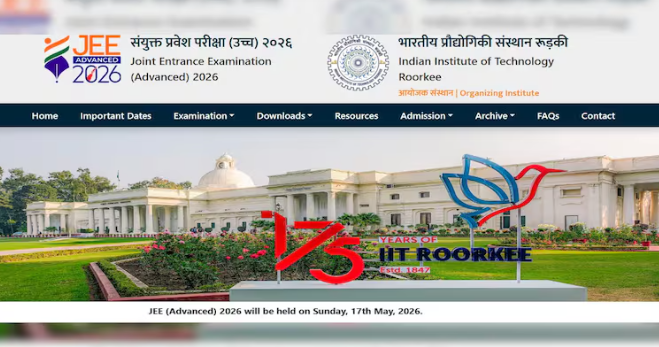
According to the latest updates, the JEE Advanced 2026 exam will be conducted on 17 May 2026.
The exam will be held in two sessions on the same day.
| Paper | Timing |
| Paper 1 | 9:00 AM – 12:00 PM |
| Paper 2 | 2:30 PM – 5:30 PM |
Both papers are compulsory for all candidates appearing in the exam.
JEE Advanced 2026 Exam Pattern
Unlike most exams, the JEE Advanced does not follow a fixed pattern. It can vary from year to year.
However, the basic format is similar.
Key Features
- Computer-based exam
- Conducts two papers on the same day
- Questions from Physics, Chemistry, Mathematics
- Variety of questions including:
- Single correct MCQs
- Multiple correct MCQs
- Numerical answer questions
- Matching type questions
Some questions may carry negative marking depending on the pattern.
How hard is JEE Advanced 2026 going to be?
Genuinely hard. That’s the honest answer.
A poll run among this year’s aspirants showed a pretty divided opinion: about 31% think it’ll be similar to last year, another 31% say it’s simply impossible to predict, 27% are bracing for something tougher, and 8% believe the difficulty really just depends on how well you’ve prepared conceptually.
That last 8% has the right mindset. Don’t spend time trying to guess what the paper will look like. The students who do well are almost always the ones with a deep, flexible understanding of Physics, Chemistry, and Maths — not the ones who tried to crack a pattern.
What’s on the syllabus For JEE Advanced 2026?
Good news: the JEE Advanced 2026 syllabus has been officially released by IIT Roorkee. And the news is that it is exactly the same as last year. Here is an overview of what is in the syllabus, subject-wise:
- Physics: Mechanics, Thermal Physics, Electromagnetism, Optics, Waves, and Simple Harmonic Motion. This subject is usually concept-heavy but tests your problem-solving skills too.
- Mathematics: Matrices, Determinants, Probability, Complex Numbers, Vectors, and Definite Integration. This is usually where students make or lose the maximum marks.
- Chemistry: Chemical Bonding, Thermodynamics, Equilibrium, Electrochemistry, and Coordination Compounds. Organic Chemistry is usually full of tricky questions that require you to practice many types of questions.
Get the syllabus in PDF form from the official website.
How the marking actually works For JEE Advanced 2026
Because the paper format can change every year, there’s no fully guaranteed breakdown. But based on how previous papers have been set, here’s how marking typically works:
- Multiple correct option questions: Full marks (+4) if you get every correct option right. Partial marks if you get some but not all. A -2 penalty if you mark even one wrong option. These are high-stakes don’t attempt them unless you’re confident.
- Numerical value questions: +3 for correct, 0 for wrong. No negative marking. Always attempt these, even if you’re not fully sure.
- Single correct MCQs and matching type: +3 for correct, -1 for wrong. Standard negative marking applies, so avoid blind guessing.
The practical takeaway: numerical questions are your safest bet when uncertain. Multiple correct questions are the most rewarding but also the most punishing if you slip up.
JEE Advanced 2026 Registration Process
The application process for JEE Advanced is completely online.
Here is a simplified step-by-step process.
Visit the official website and log in using your JEE Main roll number and password.
Fill in details such as:
- Preferred exam cities
- Category
- Language of the paper
- Upload required documents such as:
- Class 10 birth certificate
- Class 12 certificate
- Category certificate
- Pay the registration fee and submit the application form.
- Candidates should also download the completed form for future reference.
JEE Advanced 2026 Application Fee
The application fee varies based on category.
| Category | Fee |
| General (Male) | ₹3,200 |
| Female Candidates | ₹1,600 |
| SC/ST/PwD | ₹1,600 |
Payment can be made using net banking, debit card, credit card, or SBI challan.
What Happens After JEE Advanced?
Clearing JEE Advanced is only the first step toward entering IIT.
After the results are announced, qualified candidates must participate in the JoSAA counselling process.
During counselling, students:
- Register on the JoSAA portal
- Fill their preferred IITs and branches
- Receive seat allotment based on:
-
- JEE Advanced rank
- Preferences
- Seat availability
The final admission is confirmed only after completing all counselling formalities.
Five preparation habits that actually move the needle
There’s no secret formula here. But there’s definitely a smarter way and a harder-than-it-needs-to-be way to prepare. Here’s what actually works:
- Build your concepts before you start drilling problems. Students who rush into JEE-level questions without a solid conceptual foundation usually hit a wall around October or November. Spend your early months understanding the ‘why’ behind things, not just the ‘how’.
- Use previous year papers as your primary reference point. Papers from 2015 to 2025 are publicly available. Solving them tells you how questions are framed, what depth is expected, and which topics keep coming back. Don’t save these for the last month — weave them into your prep from day one.
- Do full-length mock tests under real conditions. Sitting at 9 AM on a Sunday morning with a timer running, no phone, no breaks — that’s the closest you’ll get to the real experience. Start doing this in your final three to four months, at least once every week.
- Work on your weak spots first, not your strengths. Most students instinctively spend time on what they’re already good at. It feels productive. It isn’t. Your rank improves fastest when you fix the areas you’re losing marks in, not where you’re already scoring.
- Treat sleep and rest as part of your strategy. This sounds obvious but gets ignored constantly. Running on five hours of sleep tanks your retention, your reaction time, and your ability to think clearly under pressure. No stack of extra study hours compensates for a tired brain.
Frequently Asked Questions
Q: Is there any chance of a third attempt being allowed in 2026?
No. The rule hasn’t changed and there’s been no announcement suggesting it will. You get two attempts, they must be in consecutive years, and that’s the ceiling. There’s no process to apply for an exception.
Q: I passed Class 12 in 2024. Can I still apply?
No, you can’t. The eligibility rule is clear only candidates who passed in 2025 or are appearing in 2026 are eligible. A 2024 pass-out doesn’t qualify, regardless of how well they did in JEE Main.
Q: Can I figure out my score before the official result is out?
Yes. Once IIT Roorkee releases the provisional answer key and your response sheet both expected in May you can cross-check your answers and get a rough estimate. It won’t be your official result, but it gives you something concrete while you wait for June.
Q: Do I need to register separately for JoSAA counselling?
Yes, you do. Qualifying JEE Advanced doesn’t automatically put you into the counselling system. After results are declared, you’ll need to register on the JoSAA portal, fill in your college preferences, and participate in the rounds. Keep an eye on the JoSAA schedule once the JEE Advanced result comes out.
Q: Has the JEE Advanced 2026 syllabus changed?
No change. IIT Roorkee has confirmed the syllabus is identical to 2025. Subject-wise PDFs are available for download at jeeadv.ac.in. Print them out or save them somewhere accessible they’re your master checklist for what to cover.
Q: What documents do I need for registration?
You’ll need your Class 10 birth certificate, Class 12 certificate or hall ticket, and any category certificates (SC/ST/OBC/PwD) if applicable. Foreign nationals need to submit their nationality proof. Everything goes in as a PDF between 50 and 300 KB. Check the official brochure for the exact specifications before you scan anything.
Q: Can I improve on my JoSAA seat in later rounds?
Yes, and quite significantly, sometimes. JoSAA runs several rounds of counselling. In each one, you can choose to ‘float’ your preference, which means if a better option opens up, the system moves you there. A lot of students end up with a better branch or a better institute after the second or third round. Don’t lock yourself in too early if your first allotment isn’t what you were hoping for.