JEE Advanced 2025 Paper 2 Difficulty Analysis: JEE Advanced 2025 stands as one of the most prestigious and challenging engineering entrance exams in India. It serves as the gateway to the top IITs and is known for its rigorous testing of a student’s conceptual understanding, problem-solving skills, and analytical thinking. The exam was conducted in two papers — Paper 1 and Paper 2 — both held on the same day in two different shifts.
Each paper included questions from Physics, Chemistry, and Mathematics, focusing on deep conceptual understanding rather than rote learning. The structure aimed to evaluate not just the knowledge but also the aptitude and time management abilities of candidates.
In this blog, we provide a detailed subject-wise and paper-wise analysis for Paper 2 of the JEE Advanced 2025 using charts and diagrams. This analysis will help aspirants identify important topics, question trends, and difficulty levels, enabling them to plan their preparation more effectively and confidently for the upcoming JEE Advanced exams.
Overall Difficulty Level Analysis (Paper 1 and Paper 2 Combined)
- The overall difficulty of JEE Advanced 2025 was Moderate to Difficult.
- Mathematics was found to be the most challenging section among the three.
- Physics was of moderate difficulty, with a mix of concept-based and numerical questions.
- Chemistry was relatively easier and more scoring for most students
| Subject | Difficulty Level |
| Physics | Moderate |
| Chemistry | Easy to Moderate |
| Mathematics | Difficult |
JEE Advanced 2025—Paper 2 Question Pattern Analysis
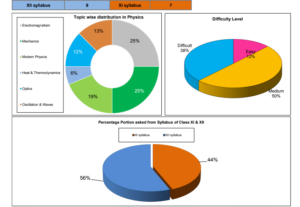
The chart provides a clear breakdown of how questions were distributed across Physics, Chemistry, and Mathematics in Paper 2. Each subject tested a unique combination of concepts, logical application, and time management. Let’s explore each subject in detail.
Physics: Conceptual & Logic-Based Questions
Paper 2 in Physics continued the trend from Paper 1, focusing more on conceptual clarity and logical thinking. Students needed to apply theoretical knowledge to real-world scenarios and think deeply to solve problems.
- Important Chapters:
- Modern Physics and Optics saw more weightage than usual.
- Mechanics and Electrodynamics had moderate representation.
- Question Nature:
- Many questions were conceptual, requiring understanding over memorization.
- A few were numerical, needing careful calculation and unit analysis.
- Difficulty Level: Moderate to Difficult
Students who focused on solving conceptual problems during practice found this section manageable.
Chemistry: Theory + Application Combo
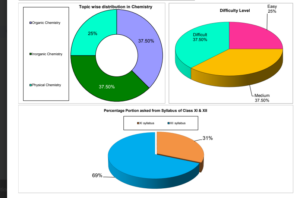
Chemistry in Paper 2 was well-balanced but leaned more towards application-based questions, especially in Organic and Physical Chemistry.
- Inorganic Chemistry:
- Direct questions were based on NCERT theory.
- Good scoring area for those who revised NCERT line by line.
- Organic Chemistry:
- Required a strong hold on reaction mechanisms and product prediction.
- Several multi-step reactions were asked.
- Physical Chemistry:
- Numerical questions tested formulas and logic.
- Included topics like Thermodynamics and Chemical Kinetics.
- Difficulty Level: Easy to Moderate
Well-prepared students who focused on standard books and NCERT found this section scoring.
Mathematics: Most Challenging of the Three
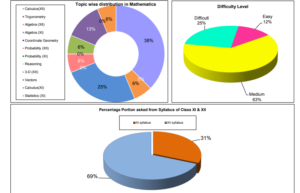
Mathematics remained the most time-consuming and challenging part of Paper 2. The paper tested a student’s ability to combine multiple topics and solve within strict time limits.
- High-Weightage Topics:
- Algebra (Matrices, Complex Numbers, Quadratic Equations)
- Vectors and 3D Geometry
- Calculus (Definite Integration, Application of Derivatives)
- Question Nature:
- Required multi-concept application in a single problem.
- Some problems were lengthy and involved tricky calculations.
- Difficulty Level: Difficult
Success in this section depended on speed, accuracy, and deep understanding of multiple concepts.
| Subject | Nature of Questions | Key Topics with High Weightage | Difficulty Level |
| Physics | Conceptual, Logical, Calculation-based | Modern Physics, Optics, Mechanics | Moderate to Difficult |
| Chemistry | Application-based, NCERT-focused | Organic Reactions, Inorganic Theory | Easy to Moderate |
| Mathematics | Multi-topic, Time-consuming, Analytical | Algebra, Vectors, Calculus | Difficult |
Comparison Between JEE Advanced 2025 Paper 1 and Paper 2
| Subject | Paper 1 Difficulty | Paper 2 Difficulty | Overall Trend |
| Physics | Moderate | Moderate to Tough | Conceptual + Numerical |
| Chemistry | Easy to Moderate | Moderate | Scoring if basics clear |
| Mathematics | Difficult | Difficult | Most time-consuming |
JEE Advanced 2025 Paper 2 Difficulty Analysis FAQs
What was the difficulty level of JEE Advanced 2025 Paper 2?
This year’s JEE Advanced 2025 Paper 2 is said to have been of moderate difficulty. Physics encouraged students to think logically and clearly.
Which subject was easiest in JEE Advanced Paper 2?
For Paper 2, Inorganic and Organic Chemistry were considered much simpler than the other topics. Most questions were from NCERT, so students who read NCERT books performed better.
What were the high-weightage topics in JEE Advanced 2025 Paper 2?
Students spent a lot of time learning about Modern Physics, Organic Chemistry and Algebra. They touched on more subjects and required students to learn the theories, concepts and skills involved in problem-solving.
How was Mathematics in JEE Advanced 2025 Paper 2?
Mathematics was the most difficult topic on Paper 2. There were challenging questions with several concepts, meaning it took a lot of time and careful attention to answer correctly.
Was NCERT helpful for JEE Advanced 2025 Paper 2 Chemistry?
NCERT was great for Chemistry, mainly in the Inorganic chapter. Those who thoroughly reviewed the NCERT found the questions simple and did well in Paper 2.