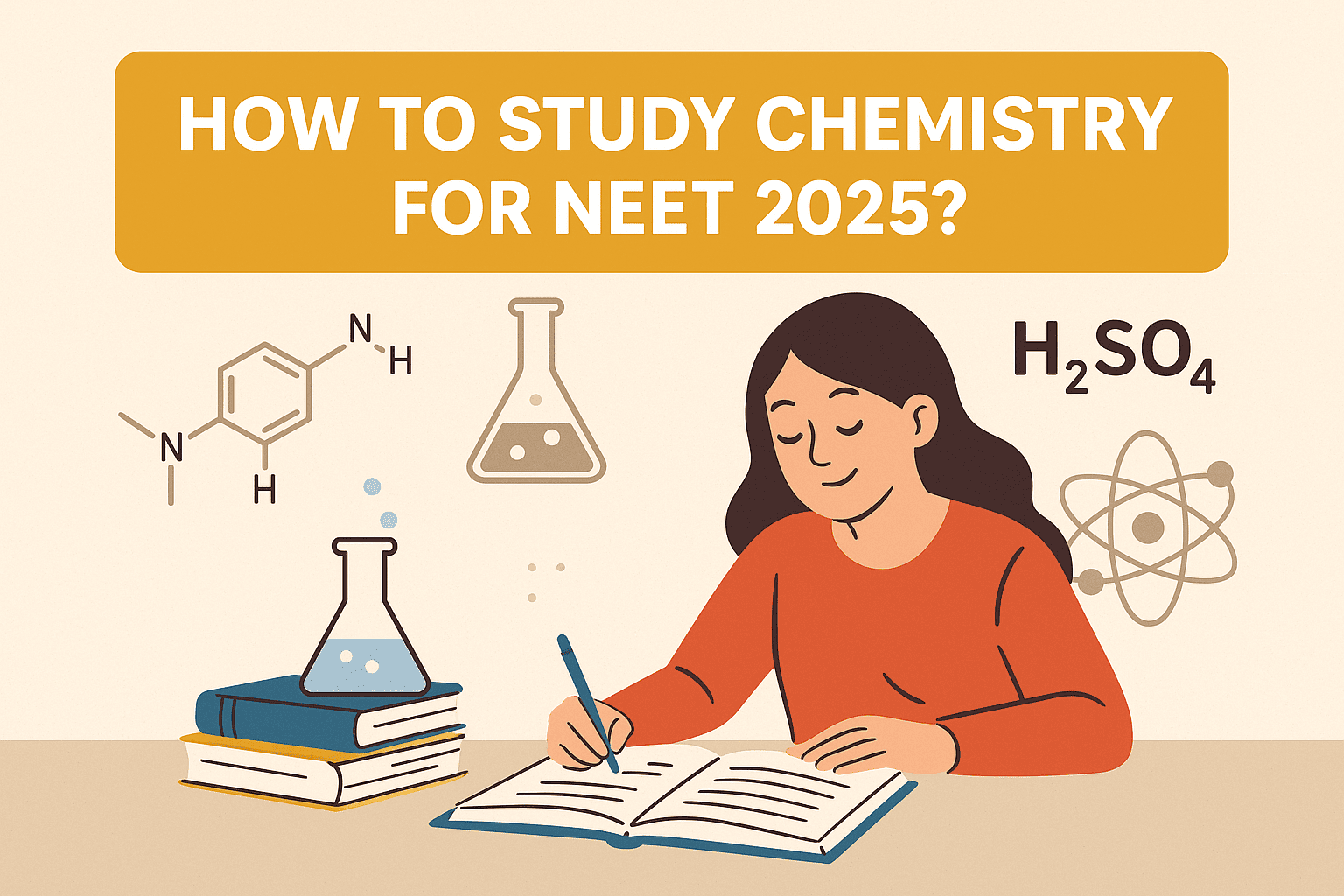

How to Study Chemistry for NEET 2025?: Chemistry is one of the three main subjects in the NEET exam. It holds equal weightage with Physics and Biology. Many students feel Chemistry is easier compared to Physics, but it still needs smart preparation and a deep understanding of concepts.
If studied properly, Chemistry can help you score high in NEET 2025. In this blog, we will discuss how to study Chemistry effectively, the important topics, the best books, and tips to crack NEET Chemistry.
Why Is Chemistry Important in NEET?
Chemistry carries 180 marks out of 720 in NEET. There are 45 questions in the Chemistry section, covering:
- Physical Chemistry
- Organic Chemistry
- Inorganic Chemistry
Getting command over Chemistry helps increase your total score. Most questions are NCERT-based, so reading your NCERT books properly is the first step.
NEET Chemistry Syllabus 2025 (Class 11 and 12)
Let’s take a look at the full syllabus for NEET 2025 as per NTA and coaching experts:
Class 11 Chemistry Syllabus:
| Chapter Name |
| Some Basic Concepts of Chemistry |
| Structure of Atom |
| Classification of Elements & Periodicity |
| Chemical Bonding and Molecular Structure |
| States of Matter: Gases and Liquids |
| Thermodynamics |
| Equilibrium |
| Redox Reactions |
| The s-Block Element |
| Some p-Block Elements |
| Organic Chemistry – Basic Principles |
| Hydrocarbons |
| Environmental Chemistry |
Class 12 Chemistry Syllabus:
| Chapter Name |
| The Solid State |
| Solutions |
| Electrochemistry |
| Chemical Kinetics |
| Surface Chemistry |
| The p-Block Elements |
| The d-Block and f-Block Elements |
| Coordination Compounds |
| Haloalkanes and Haloarenes |
| Alcohols, Phenols, and Ethers |
| Aldehydes, Ketones and Carboxylic Acids |
| Organic Compounds Containing Nitrogen |
| Biomolecules |
| Polymers |
| Chemistry in Everyday Life |
Important Topics for NEET Chemistry 2025
Not all topics are equally important. Some chapters have higher weightage and are more scoring. Here’s a list of important chapters:
Most Important Topics (High Weightage):
| Type | Topics |
| Physical | Thermodynamics, Equilibrium, Chemical Kinetics, Electrochemistry |
| Organic | General Organic Chemistry (GOC), Aldehydes, Ketones, Haloalkanes, Alcohols, Amines |
| Inorganic | Chemical Bonding, Coordination Compounds, p-Block Elements, Periodic Table |
Moderately Important:
- s-Block and d-Block Elements
- Surface Chemistry
- Solutions
- Biomolecules
- Environmental Chemistry
Focusing more on GOC, Chemical Bonding, Thermodynamics, and Electrochemistry can give you a good score.
Best Books for NEET Chemistry Preparation
Here is a list of the most recommended books for NEET Chemistry:
| Book Title | Use For |
| NCERT Chemistry Class 11 & 12 | Must-read for theory and concepts |
| Physical Chemistry by O.P. Tandon | Numerical and concept clarity |
| Organic Chemistry by Morrison & Boyd | Deep understanding of organic chemistry |
| Modern ABC Chemistry | Extra theory and practice questions |
| MTG NCERT at Your Fingertips | Objective questions from NCERT |
| MS Chauhan for Organic Chemistry | Practice questions and problem-solving |
Tip: Always complete NCERT first. Around 80–90% of questions are directly or indirectly from NCERT.
How to Study Chemistry for NEET 2025 (Section-Wise)?
Physical Chemistry Preparation
Physical Chemistry involves formulas and numerical problems. It is like Physics, but slightly easier.
Tips:
- Understand the derivation and meaning of formulas.
- Learn concepts like mole concept, thermodynamics, and equilibrium deeply.
- Practice a lot of numerical problems.
- Revise formulas regularly.
- Solve previous year’s NEET questions.
Chapters to Focus on:
- Thermodynamics
- Equilibrium
- Chemical Kinetics
- Electrochemistry
- Solutions
Organic Chemistry Preparation
Organic Chemistry is all about concepts, mechanisms, and reactions.
Tips:
- Start with General Organic Chemistry (GOC).
- Learn reaction mechanisms step-by-step.
- Make a chart of named reactions (e.g., Cannizzaro, Aldol, etc.)
- Practice structure identification questions.
- Solve MCQs regularly.
Chapters to Focus on:
- General Organic Chemistry
- Haloalkanes and Haloarenes
- Alcohols, Phenols, Ethers
- Aldehydes, Ketones, and Carboxylic Acids
- Amines
Inorganic Chemistry Preparation
Inorganic Chemistry is more about memorisation. It includes periodic table trends, group properties, and compound characteristics.
Tips:
- Read NCERT line by line and underline important points.
- Memorise oxidation states, electronic configurations, and colours of compounds.
- Make flashcards for revision.
- Focus on block-wise elements and coordination compounds.
Chapters to Focus on:
- Chemical Bonding
- p-Block Elements
- d- and f-Block Elements
- Coordination Compounds
Periodic Table
Chemistry Study Plan for NEET 2025
A proper study plan will help you complete the syllabus on time and keep you on track.
Sample Weekly Plan:
| Day | Task |
| Monday | Study Physical Chemistry Theory (1 topic) |
| Tuesday | Solve numerical problems from that topic |
| Wednesday | Study Organic Chemistry Mechanisms |
| Thursday | Practice MCQs + Solve Previous Year Questions |
| Friday | Study Inorganic Chemistry from NCERT |
| Saturday | Revise difficult reactions and short notes |
| Sunday | Weekly mock test and full revision |
Time Management:
- Study Chemistry for at least 2–3 hours daily.
- Use the Pomodoro technique (25 min study, 5 min break) to stay focused.
- Spend 70% of your time on concept-building and 30% on revision and tests.
Revision Tips for NEET Chemistry
Regular revision is the key to remembering chemical formulas, reactions, and tricky concepts. Without revision, you may forget even the topics you once mastered. Here are some smart and simple tips to revise NEET Chemistry effectively:
1. Make Short Notes and Flashcards
- Write key formulas, reactions, and named reactions in short notes.
- Make flashcards for p-block elements, periodic trends, and functional groups.
- Keep these handy for quick daily revision.
2. Revise NCERT Line-by-Line
- NCERT is the base of NEET Chemistry. Read it again and again.
- Focus on the in-text points, summary, and exercises.
- Highlight and mark important lines to revise later.
3. Solve Previous Year Questions (PYQs)
- PYQs help you identify the pattern and frequently asked questions.
- Solve them topic-wise right after revising a chapter.
- It improves retention and gives exam confidence.
4. Use Mind Maps and Flow Charts
- Make mind maps for reaction mechanisms, periodic trends, and block elements.
- Visual revision is more effective and helps retain for longer.
5. Weekly and Monthly Revisions
- Revise completed chapters every Sunday.
- Make a habit of revising all important topics at least once a month.
Pro Tips to Score 160+ in Chemistry
If you want to score 160+ out of 180 in NEET Chemistry, you need more than just reading the chapters. Here’s how toppers plan their strategy:
1. Master NCERT Textbooks
- Do not skip even a single line of NCERT, especially for Inorganic Chemistry.
- 80–90% of questions are directly from NCERT.
2. Break Chemistry into 3 Sections
- Prepare Physical, Organic, and Inorganic separately.
- Use different strategies for each: concepts + numericals for Physical, mechanisms for Organic, and factual learning for Inorganic.
3. Focus on High-Weightage Chapters
- Prioritise chapters like GOC, Thermodynamics, Equilibrium, Chemical Bonding, and Coordination Compounds.
- These have higher chances of appearing in NEET.
4. Practice Daily MCQs
- Solve at least 100 Chemistry MCQs daily.
- Use NEET-specific books like MTG Fingertips or Allen modules for practice.
5. Give Full-Length Mock Tests
- Take regular mock tests under exam conditions.
- Analyze your mistakes and revise those areas again.
How to Study Chemistry for NEET 2025? FAQs
Q1. What is the best way to study Chemistry for NEET 2025?
Answer: Start with NCERT books for Class 11 and 12. Understand concepts, make notes, and practice MCQs. Focus more on high-weightage topics and solve previous year NEET questions regularly.
Q2. How to remember organic chemistry reactions for NEET?
Answer: Use flowcharts, reaction series, and practice them daily. Make a revision sheet of all named reactions and revise it weekly. Understanding the mechanism helps retain them better.
Q3. Which chapters are most important in NEET Chemistry?
Answer: Chapters like Thermodynamics, Equilibrium, Chemical Bonding, GOC, Alcohols, Aldehydes, Haloalkanes, Coordination Compounds, and p-Block elements are most important due to frequent questions in NEET.
Q4. Is NCERT enough for NEET Chemistry preparation?
Answer: Yes, NCERT is enough for scoring 140–150 in NEET Chemistry. For higher scores (160+), refer to additional books like MS Chauhan (Organic) and O.P. Tandon (Physical) for extra practice.
Q5. How much time should I give to Chemistry daily for NEET?
Answer: You should give at least 2–3 hours daily to Chemistry. Divide it into 1 hour of theory, 1 hour of practice, and 1 hour of revision or solving MCQs. Be consistent every day.