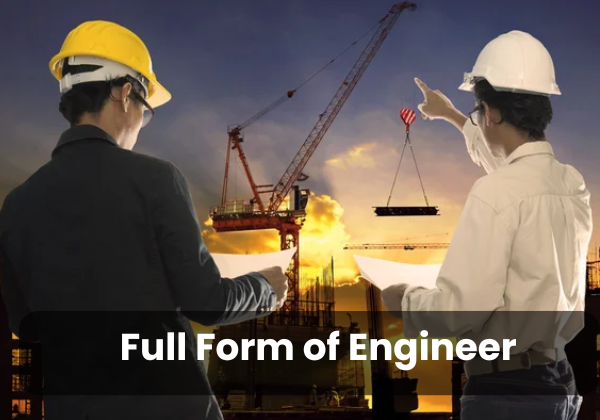

Full Form of Engineer: In the modern world, the term “Engineer” stands as a symbol of innovation, problem-solving, and technical excellence. Whether it’s constructing skyscrapers, designing microprocessors, or building bridges across rivers, engineers are at the forefront of change. But have you ever wondered, what is the full form of Engineer? Is it an acronym, or is it a title born from historical significance? This article explores the full form of Engineer, its origin, types, and its career scope in 2025.
What is the Full Form of Engineer?
Unlike many technical terms, ENGINEER is not an acronym, and hence, it does not have a standardized full form. The term is derived from the Latin word ‘ingeniator’, meaning “cleverness” or “to contrive or devise.” Over time, the word evolved into “engineer”, signifying a person who designs or constructs engines or machines and now broadly refers to professionals engaged in technical and scientific problem-solving.
However, in informal and educational contexts, people often create creative full forms for motivational or illustrative purposes. One such popular backronym (non-official) is:
ENGINEER – “Energetic Nerd Generating Ideas for Entire Nation’s Empowerment and Revolution.”
While this full form is not official, it captures the essence of what engineers do—innovate, ideate, and contribute to national and global development.
Who is an Engineer?
An Engineer is a trained professional who applies the principles of science and mathematics to develop economical solutions to technical problems. Engineers are the bridge between scientific discoveries and their practical applications in society. They play a key role in almost every industry, from technology and construction to healthcare and energy.
Types of Engineering Branches
Engineering is a vast field with numerous specializations. Here are some of the most popular branches of engineering in 2025:
| Branch | Description |
|---|---|
| Computer Science Engineering (CSE) | Focuses on computing systems, software development, and artificial intelligence. |
| Mechanical Engineering | Deals with machines, dynamics, thermodynamics, and production. |
| Civil Engineering | Specializes in construction, infrastructure, and structural design. |
| Electrical Engineering | Involves study and application of electricity and electronics. |
| Electronics & Communication Engineering (ECE) | Combines electronic hardware with communication systems. |
| Artificial Intelligence & Machine Learning (AIML) | A new-age branch focusing on AI algorithms and intelligent systems. |
| Biomedical Engineering | Integrates medical sciences with engineering principles to develop healthcare technology. |
Educational Path to Become an Engineer
To become a certified engineer in India, students typically follow this academic path:
-
Class 10+2 (Science stream with PCM)
-
Qualify Engineering Entrance Exams – JEE Main, JEE Advanced, or state-level exams.
-
Pursue a B.Tech/B.E. Degree in the chosen specialization (4-year undergraduate course).
-
Optional Higher Education – M.Tech, MBA, or specialization certifications.
Institutes like IITs, NITs, and top private universities play a crucial role in shaping future engineers.
Career Opportunities for Engineers in 2025
With the rapid growth of technology, digitalization, and infrastructure, the demand for skilled engineers is higher than ever. Here’s a glimpse of the promising career paths:
-
Software Developer / App Developer
-
Design Engineer
-
Data Analyst / Data Scientist
-
AI/ML Engineer
-
Project Manager
-
Civil Site Engineer
-
Embedded System Engineer
-
Electrical Consultant
-
Robotics Engineer
-
Environmental Engineer
Engineers can work in government jobs, multinational companies, research labs, startups, or even launch their own ventures.
Future of Engineering in India
India is aiming to become a global hub for engineering excellence by 2030. Initiatives like ‘Digital India’, Smart Cities Mission, and Make in India are boosting demand for engineers across all sectors. With emerging technologies like 5G, IoT, blockchain, and quantum computing, the scope for engineers will only continue to expand in the coming years.
Conclusion
While the word “Engineer” has no official full form, it signifies a role of immense responsibility, creativity, and transformation. Engineers are the builders of a smarter, more sustainable future. If you’re aspiring to become an engineer, know that you’re stepping into a career that not only shapes the nation but the world.
Full Form of Engineer FAQs
Q1. Does the word ENGINEER have a full form?
Answer: No, the word ENGINEER is not an acronym and does not have an official full form. It is derived from the Latin word “ingeniator”, meaning someone who is clever or skilled at devising solutions. However, people sometimes create backronyms like “Energetic Nerd Generating Ideas for Entire Nation’s Empowerment and Revolution” for creative or motivational purposes.
Q2. What does the term ‘Engineer’ actually mean?
Answer: An Engineer is a professional who uses scientific and mathematical principles to design, develop, and improve technology, infrastructure, and machinery. They play a vital role in problem-solving across industries such as software, construction, electronics, and mechanical systems.
Q3. What is the eligibility to become an engineer in India?
Answer: To become an engineer in India, students must complete Class 12 with Physics, Chemistry, and Mathematics (PCM) and qualify competitive exams like JEE Main/Advanced or state-level entrance exams. This is followed by a 4-year B.E./B.Tech degree in a chosen branch of engineering.
Q4. Why is engineering considered a prestigious career in India?
Answer: Engineering is regarded as a prestigious career in India because it offers high job demand, stable income, and opportunities across diverse fields like IT, manufacturing, and research. Moreover, engineers are seen as nation-builders who contribute to innovation and technological progress.