
The transistors are the major electronic components that carry and direct current in electrical switches. Broadly classified, Bipolar Junction Transistors (BJT) are available in two platforms: NPN & PNP. Both amplify or switch current to accomplish the equivalent task but have completely different structure, current flow and working. This blog points out these differences between NPN and PNP transistors.
What is a Transistor?
The transistors are the major electronic components that carry and direct current in electrical switches. Broadly classified, Bipolar Junction Transistors(BJT) are available in two platforms: NPN & PNP. Both amplify or switch current to accomplish the equivalent task but have completely different structure, current flow and working. This blog points out these differences in plain English and in detail.
Structure of NPN and PNP Transistors
The distinction between the NPN and PNP transistors begins with the way they are built:
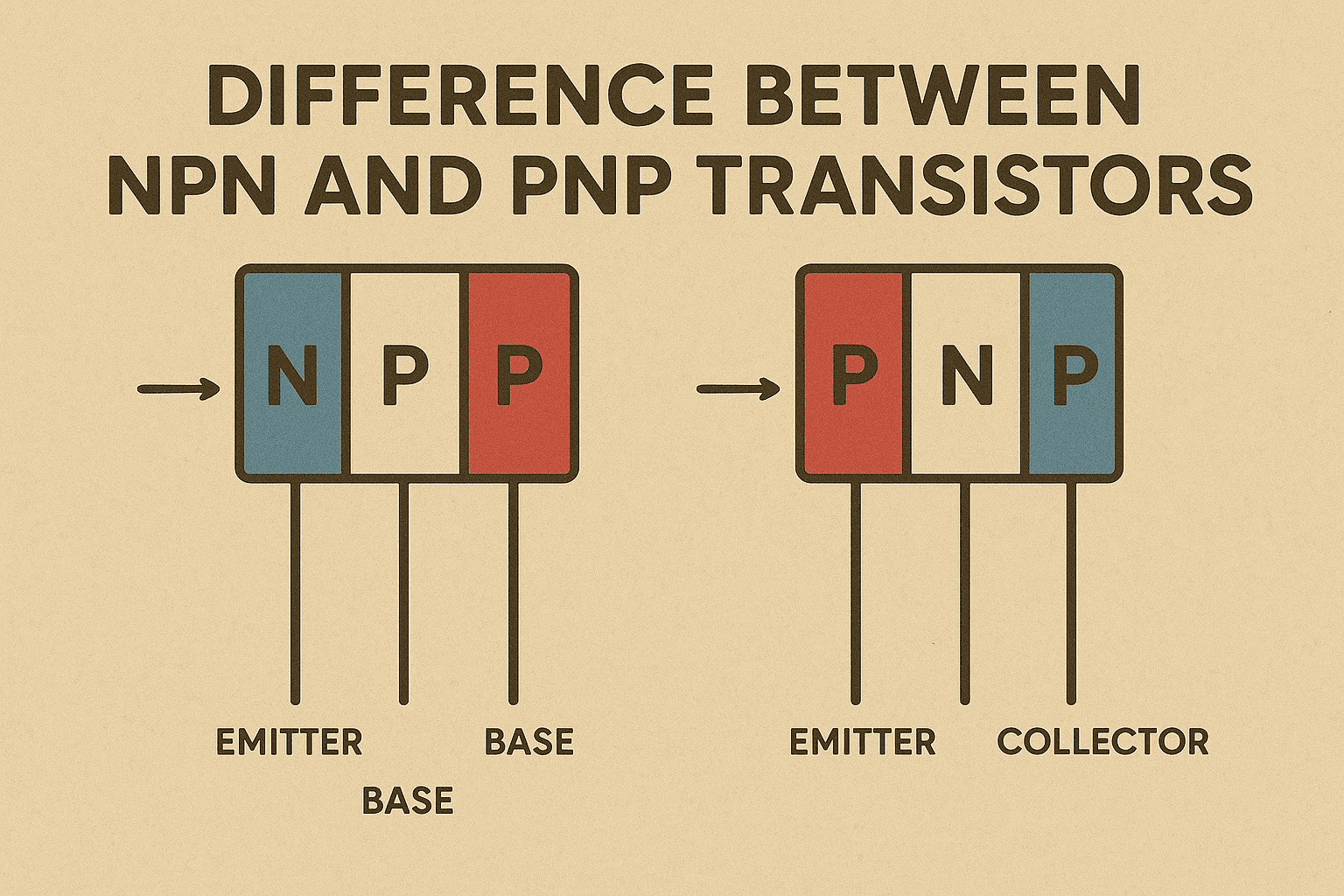
- An NPN transistor is constructed with two n-type semiconductors bracketing a p-type semiconductor in the middle. It implies that electrons are the rearmost charge carriers
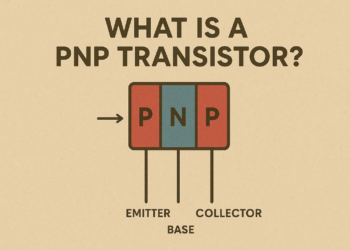
- A pnp transistor consists of two p-type semiconductor layers between an n-type layer. Here, the mobile charge carriers are holes (positive charge carriers).
This layout has a side effect on the current flow and the functioning of the transistor.
How Current Flows in NPN and PNP Transistors?
The problem is that the flow of currents is opposite:
- In an NPN transistor electrons flow between the collector and emitter. A small positive voltage relative to the emitter will turn the base on. In this one, the electrons (negative charge) are the carriers that the device flows through.
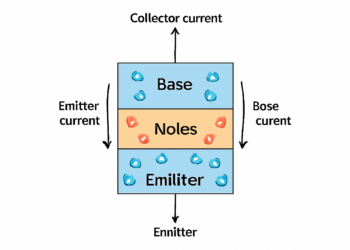
- In a PNP transistor, the flow of current is between the emitter and the collector. The base has to be at a small negative voltage relative to the emitter to switch ON. The holes (positive charges) are the carriers in this case.
How to Switch NPN and PNP Transistors ON and OFF?
The use of switching is dependent on the voltage of the base:
- The NPN transistors are switched ON to a small positive voltage on the base with reference to the emitter. This induces movement of electrons, hence conduction of the transistor.
- Typical NPN transistors become ON with a small negative signal applied to the base with respect to the emitter. This causes holes to flow and the transistor conducts.
To turn OFF
- In NPN, the removal of positive base voltage will block electric flow.
- In PNP the removal of negative base voltage prevents the hole current.
Detailed Comparison Table
| Feature | NPN Transistor | PNP Transistor |
| Structure | Two N-type materials separated by a P-type material | Two P-type materials separated by an N-type material |
| Majority Charge Carriers | Electrons | Holes |
| Current Flow Direction | Collector to Emitter | Emitter to Collector |
| Base Voltage to Turn ON | Positive relative to emitter | Negative relative to emitter |
| Arrow on Symbol | Points outward (away from emitter) | Points inward (toward emitter) |
| Switching Speed | Faster due to electron mobility | Slower compared to NPN |
| Conductivity Level | Higher conductivity (electrons are more mobile) | Lower conductivity (holes are less mobile) |
| Common Applications | Amplifiers, high-speed switching, digital circuits | Amplifiers, positive voltage control circuits |
| Base Current Flow | From base to emitter | From emitter to base |
NPN or PNP Transistors Working Principle
Transistor: Applying a little positive signal current on the base causes the emitter to inject current into the base. Most of these electrons pass through the thin base region and are attracted into the collector under reverse bias. The current of the collector is quite larger than the current of the base; this enables a major amplification.
When a small negative current is sent to the base, the emitter ejects holes, which go through the base and towards the collector, where they are attracted to it. The electrical current in and out of the device is manipulated in an inverted fashion.
Why Use NPN or PNP Transistors?
- NPN transistors are more widely used because electrons move faster and more freely than holes. This results in better performance for switching and amplification tasks.
- PNP transistors are used when the circuit requires a positive supply control or complementary arrangements with NPN transistors, such as in push-pull amplifier circuits.
Applications of NPN and PNP Transistors
- NPN transistors are often used in switching circuits, amplifiers, digital logic circuits, and microcontroller interfaces due to their fast switching.
- PNP transistors are found in circuits where the load is connected to the positive supply and needs to switch the positive side, like in relay driver circuits or complementary transistor pairs.
FAQs
What do NPN and PNP stand for in transistors?
NPN means negative-positive-negative, and PNP is positive-negative-positive, concerning the semiconductor channel inside the device.
How do NPN and PNP transistors differ in current flow?
In NPN, the current flows between the base and emitter; in PNP, between the emitter and collector and is controlled by the polarity of the base voltage.
Which transistor type is faster, NPN or PNP?
PNP transistors are also typically slower due to the faster velocity of electrons (their charge carriers) relative to holes.
When should I use an NPN transistor over a PNP?
NPNs can be used to switch low-side and more rapid switches; PNPs are used to switch high-side.
Can NPN and PNP transistors be used together?
Yes, they are often paired in complementary circuits like push-pull amplifiers to efficiently amplify signals or switch currents.
Conclusion
The important thing to know when building electronic circuits is the distinction between NPN and PNP transistors. Although both are used to control current, the voltage requirements and overall current direction differ in that they are used in different roles. In many circuits NPN transistors are used due to their faster movement of electrons, whereas PNP transistors find useful applications in complementary circuits and in special switching applications. This understanding will systematically help in the choice of transistors and the reliability of circuit performance.
Also Read
Difference Between NPN and PNP Transistors
PNP Transistor
NPN Transistor
What is a Transistor
What is Fet?
Bipolar Junction Transistor (BJT)
Characteristics of a Transistor
Uses of Transistors