
Integration is a fundamental concept in calculus, crucial for solving mathematical and real-world problems. It involves summing up infinitesimally small quantities to determine total values, such as areas under curves. Integration is divided into definite integrals, which calculate total quantities between two points, and indefinite integrals, which find general antiderivatives.
Techniques like substitution, integration by parts, and partial fractions help solve complex integrals. Integration has broad applications, from computing areas and volumes to addressing problems in physics and probability. When exact solutions are challenging, numerical methods like the Trapezoidal Rule and Simpson’s Rule provide approximations. This article talks about the concept of integration in detail, covering its definition, types, and techniques.
What is Integration?
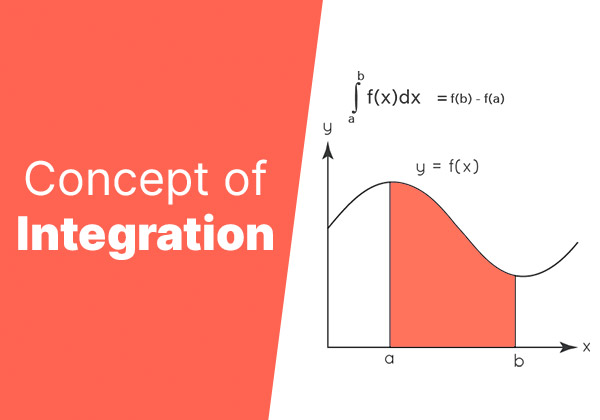
Integration is a mathematical process used to find the total amount of something that can be represented as a sum of many small parts. Imagine you want to find the area under a curve on a graph. Integration helps you calculate this area by adding up an infinite number of tiny slices.
In simpler terms, if you have a curve that represents a function, integration allows you to measure the space under that curve between two points. This process is useful for figuring out things like the total distance traveled over time, the total amount of a substance, or even the area of irregular shapes.
There are two main types of integration:
- Definite Integration: This calculates the exact total amount between two specific points. For example, finding the area under a curve from point A to point B.
- Indefinite Integration: This finds the general formula for the area under the curve without specific limits, which includes a constant because there are many possible areas that could fit the same curve.
Integration is a fundamental tool in mathematics with many practical applications in science, engineering, and everyday life.
History and Development of Integration
The history and development of integration is a fascinating journey through the evolution of mathematical thought. Here’s a simplified overview:
- Ancient Greeks: Eudoxus of Cnidus used the method of exhaustion to approximate areas and volumes, laying early groundwork for integration.
- Islamic Golden Age: Mathematicians like Al-Khwarizmi and Omar Khayyam advanced techniques for solving equations and calculating areas, influencing later integration methods.
- 16th to 17th Century: Isaac Newton and Gottfried Wilhelm Leibniz independently developed calculus, introducing integration principles. Leibniz’s notation, including the integral sign ∫\int∫, became standard.
- 18th Century: Leonhard Euler explored integration techniques, while Augustin-Louis Cauchy formalized integration with rigorous definitions and proofs.
- 19th Century: Bernhard Riemann introduced the Riemann integral, defining it as the limit of sums of areas of rectangles. Henri Lebesgue later expanded integration theory with the Lebesgue integral.
- 20th Century and Beyond: Modern developments refined integration methods and introduced numerical techniques for complex integrals, impacting fields like physics and computer science.
Basic Concepts and Terminology
Understanding integration involves several key concepts and terms. Here’s a simple breakdown:
- Integral: The concept of integration revolves around finding the total accumulation of a quantity. For example, it often involves calculating the area under a curve defined by a function. The integral is a fundamental concept in calculus and helps us understand how quantities accumulate over an interval.
- Antiderivative: An antiderivative is a function whose derivative is the original function you are working with. Essentially, it reverses the process of differentiation. When you integrate a function, you are finding its antiderivative, which represents the general form of the function before differentiation.
- Definite Integral: This type of integral calculates a specific total value, such as the area under a curve, between two points. It provides a numerical result that represents the accumulation of the quantity over the given interval.
- Indefinite Integral: This integral determines the general form of the antiderivative without specifying exact bounds. It includes a constant term because there are multiple functions that can differ by a constant and still have the same derivative.
- Bounds/Limits of Integration: These are the specific points that define the interval over which the integral is calculated in a definite integral. They set the range from which you are measuring the total accumulation.
- Integrand: The function being integrated, which is placed inside the integral sign. It represents the quantity that is being accumulated or summed.
- Differentiation: The process of finding the derivative of a function, which measures how the function changes. It is essentially the reverse of integration, which measures total accumulation.
- Fundamental Theorem of Calculus: This theorem bridges differentiation and integration, stating that the integral of a function’s derivative over an interval is equal to the difference in the function’s values at the endpoints of the interval.
Types of Integration
Integration comes in a few different types, each useful for different situations. Here’s a simple breakdown:
1. Definite Integration
Definite integration is a fundamental concept in calculus used to determine the total accumulation of a quantity over a specific interval. This type of integration measures the net area under a curve between two distinct points on the x-axis. The interval is defined by two limits, often referred to as the lower and upper bounds. By calculating the definite integral, one can find out how much a quantity accumulates between these bounds. This method is particularly useful for determining precise values, such as the total distance traveled or the area under a curve representing various phenomena.
Definite integration has numerous applications across different fields. For instance, in physics, it can be used to find quantities like work done by a force over a distance or the total charge distributed over a region. In economics, definite integrals can help in calculating total revenue or cost over a certain period. The result of a definite integral is a specific numerical value, providing clear insights into the quantity being measured within the given range.
2. Indefinite Integration
Indefinite integration, unlike definite integration, does not specify particular limits for the interval. Instead, it focuses on finding a general formula for the accumulated quantity, which includes an arbitrary constant. This type of integration provides a family of functions that represent the possible accumulated values for any interval. The constant of integration accounts for the fact that there are infinitely many functions that differ by a constant but have the same derivative.
Indefinite integration is crucial for understanding the general behavior of functions and their accumulated quantities. It helps in finding the antiderivative, or the original function, from its derivative. This process is essential in solving differential equations and understanding how different functions relate to one another. For example, in physics, indefinite integrals can be used to derive the general form of a position function from a velocity function. In engineering, it helps in determining general solutions for systems described by differential equations.
3. Improper Integration
Improper integration handles cases where standard methods can’t be applied due to issues like infinite limits or discontinuities in the integrand. It extends integration to more complex scenarios, such as functions approaching infinity or having singularities. There are two main situations in improper integration: integrals with infinite limits and integrals with discontinuous functions. For infinite limits, the integral is evaluated as the limit of definite integrals with finite bounds. For functions with singularities, special techniques are used to address these points.
Improper integrals are crucial in fields like probability theory, where they help in calculating probabilities and expected values for distributions with infinite ranges. They are also important in physics for analyzing phenomena involving infinite quantities, such as field behaviors at large distances.
4. Multiple Integration
Multiple integration extends integration to functions with more than one variable, allowing for the calculation of areas, volumes, and other quantities in higher dimensions. It involves integrating over multi-dimensional domains: double integration for two-dimensional areas and volumes, and triple integration for three-dimensional volumes.
This method is crucial in fields like physics and engineering for solving complex problems involving irregular solids and varying densities. Multiple integration can be performed using various coordinate systems, such as Cartesian, polar, cylindrical, and spherical, enhancing calculation efficiency and accuracy. Understanding different types of integration—definite, indefinite, improper, and multiple—is essential for applying integration effectively in various contexts.
Different Integration Techniques
Here are some common techniques used to solve integrals, explained in simple terms:
1. Substitution
- What It Is: Substitution is a technique used to simplify integrals by changing the variable of integration. This method is particularly helpful when an integral involves a function and its derivative.
- How It Works: You choose a new variable to replace a part of the integrand that makes the integral easier to evaluate. By transforming the integral into a simpler form using this new variable, you can solve it more effectively. After finding the integral in terms of the new variable, you convert it back to the original variable.
2. Integration by Parts
- What It Is: Integration by parts is useful for integrals involving the product of two functions. It’s based on the idea of breaking down the integral into simpler parts.
- How It Works: This technique involves selecting parts of the integrand to simplify the process of integration. One part is chosen to be differentiated, and the other part is integrated. This approach transforms the integral into a different form, making it easier to solve.
3. Partial Fractions
- What It Is: Partial fractions are used to simplify complex rational functions into simpler fractions that are easier to integrate.
- How It Works: You decompose a complex fraction into a sum of simpler fractions with unknown constants. By breaking down the original fraction into these simpler components, you can integrate each part separately. This method is particularly effective when dealing with integrals of rational functions where the numerator and denominator are polynomials.
4. Trigonometric Substitution
- What It Is: Trigonometric substitution is used to simplify integrals involving square roots of quadratic expressions by substituting trigonometric functions.
- How It Works: You replace the variable in the integrand with a trigonometric function, which simplifies the expression under the square root. This substitution leverages trigonometric identities to make the integral easier to solve. After integrating using the trigonometric function, you convert the result back to the original variable.
5. Integration by Partial Fractions
- What It Is: This technique is employed for integrating rational functions where both the numerator and the denominator are polynomials.
- How It Works: You decompose the complex fraction into simpler fractions that can be integrated individually. This decomposition involves expressing the original fraction as a sum of simpler fractions with unknown constants. Each simpler fraction can then be integrated separately, making the overall integration process more manageable.
Each of these techniques is designed to make specific types of integrals easier to solve, depending on the function you’re dealing with.
Numerical Methods for Integration
Numerical methods for integration are techniques used to approximate the value of an integral when an exact analytical solution is difficult or impossible to obtain. These methods are especially useful when dealing with complex functions or data that cannot be easily integrated using traditional calculus techniques.
Trapezoidal Rule
The Trapezoidal Rule approximates the area under a curve by dividing the interval into smaller segments and approximating each segment with a trapezoid. By summing the areas of these trapezoids, you estimate the total integral. This method works well when the function is relatively linear over each small interval.
Simpson’s Rule
Simpson’s Rule improves upon the Trapezoidal Rule by using parabolic segments to approximate the area under the curve. Instead of approximating each segment with a trapezoid, Simpson’s Rule fits a parabola to each interval, providing a more accurate approximation for functions that are smooth and continuous.
Midpoint Rule
The Midpoint Rule estimates the integral by evaluating the function at the midpoint of each interval and using this value to calculate the area. This method can be more accurate than the Trapezoidal Rule for some functions, particularly when the function varies significantly within each interval.
Romberg Integration
Romberg Integration is a more sophisticated method that uses a sequence of approximations with progressively finer intervals. It combines results from simpler methods to improve accuracy iteratively. This technique leverages previous computations to refine the estimate, making it particularly useful for achieving high precision.
Gaussian Quadrature
Gaussian Quadrature is a numerical integration method that approximates the integral by selecting optimal points and weights for evaluating the function. This method is highly efficient and accurate, especially for polynomials and smooth functions, by strategically choosing points to minimize errors.
Challenges and Common Mistakes
Challenges
- Complex Functions: Integrals with complex or composite functions can be tricky. Use substitution or integration by parts to simplify.
- Improper Integrals: Integrals with infinite limits or discontinuities require careful handling. Break into parts and evaluate limits.
- Choosing Techniques: Selecting the right integration method can be difficult. Practice and recognize the best fit for each problem.
- Numerical Errors: Approximation methods can introduce errors. Refine methods or increase intervals for better accuracy.
- Multiple Variables: Integrating functions with more than one variable can be complex. Use techniques like Fubini’s Theorem.
Common Mistakes
- Omitting Constant: Forgetting the constant of integration CCC in indefinite integrals.
- Incorrect Limits: Using wrong or inconsistent limits in definite integrals.
- Misapplying Techniques: Using incorrect methods or formulas.
- Algebraic Errors: Making mistakes in algebraic manipulation.
- Ignoring Discontinuities: Failing to address discontinuities or infinite points in the function.
Practical Examples and Problems
Area Calculation
Integrals are frequently used to find the area under curves. For instance, they can determine the area between a curve and the x-axis over a specific interval. This application is essential in various fields, including economics, where it helps in calculating total revenue over time.
Volume Determination
In geometry and engineering, integration helps calculate the volume of solids by revolving a curve around an axis. This method is used to find volumes of objects like tanks and pipes, which have shapes defined by specific functions.
Physics Applications
In physics, integration is used to solve problems involving motion and forces. For example, it helps in calculating the work done by a force or the center of mass of an object, which are crucial for understanding physical systems.
Probability and Statistics
Integration is used in probability theory to find probabilities and expected values for continuous random variables. This application is crucial for statistical analysis and decision-making in fields like finance and insurance.
Engineering Problems
Engineers use integration to solve various practical problems, such as determining the stress distribution in materials or the amount of fluid flowing through a system. These calculations are vital for designing and analyzing structures and systems.
Concept of Integration FAQs
Q1. What is integration in calculus?
Integration is a fundamental concept in calculus that involves finding the total accumulation of a quantity, such as area under a curve. It is the reverse process of differentiation and can be used to calculate areas, volumes, and other quantities.
Q2. What are the main types of integrals?
The main types of integrals are definite and indefinite integrals. Definite integrals calculate the total quantity between two specific points, while indefinite integrals find the general form of a function's antiderivative, including an arbitrary constant.
Q3. How does the Fundamental Theorem of Calculus work?
The Fundamental Theorem of Calculus links differentiation and integration. It states that the integral of a function's derivative over an interval can be calculated using the function's values at the interval's endpoints, and vice versa, integrating a function produces its antiderivative.
Q4. What are some common techniques for solving integrals?
Common techniques for solving integrals include substitution, integration by parts, partial fractions, trigonometric substitution, and numerical methods like the Trapezoidal Rule and Simpson's Rule. Each method simplifies different types of integrals.
Q5. What are practical applications of integration?
Integration is used in various practical applications such as calculating areas under curves, volumes of solids of revolution, arc lengths, work done by variable forces, and expected values in probability. It is essential in fields like physics, engineering, and statistics.