-
Call Now
1800-102-2727


NCERT Solutions for Class 10th English Chapter 2- Nelson Mandela: Long Walk To Freedom
Chapter 2 of the NCERT English textbook, Nelson Mandela: Long Walk to Freedom, is an inspiring account from the autobiography of Nelson Mandela, the first black president of South Africa. This lesson sheds light on his journey, his struggles, and his famous speeches during his fight against apartheid. The chapter reflects on Mandela's dedication to freedom and equality for all, irrespective of their skin color, race, or social status.
Overview of Nelson Mandela’s Fight for Freedom
Nelson Mandela was born in 1918 and lived through an era of severe racial discrimination in South Africa, where the white minority ruled over the black majority. He played a pivotal role in dismantling the apartheid system, which segregated people based on their race. Mandela’s fight wasn’t just for the oppressed black population but also for the oppressors, as he believed that true freedom could only be achieved when both the oppressed and the oppressors were liberated from the cycle of hatred and prejudice.
Nelson Mandela’s Presidency and the Promise of Equality
On May 10, 1994, Nelson Mandela was sworn in as South Africa’s first black president. This event marked a historic moment, as it was the first time a black leader took charge in a country long dominated by racial injustice. In his inaugural speech, Mandela thanked the distinguished guests and the people of South Africa for their trust. He vowed that the country would never return to the oppression and racial discrimination it once suffered.
Mandela promised a democratic system where every individual would be treated equally, and the government would work without discrimination. He emphasized that freedom was not only important for the oppressed but also for the oppressors, as those who deny freedom to others are, in essence, enslaving themselves.
Two Obligations: Family and Nation
Mandela’s speech highlights two major obligations that every individual holds: one towards their family and the other towards their country. He believed that while fulfilling these duties, people should work towards a society that values human dignity and equality.
Mandela also expressed deep sorrow for the countless lives lost in the struggle against apartheid. He regretted not being able to personally thank many of those who sacrificed their lives for the cause of freedom. However, he cherished their memory and acknowledged that their sacrifices were instrumental in achieving the dream of a free South Africa.
The Message of Love Over Hatred
One of the core messages of the chapter is Mandela’s belief in love and unity. He stressed that no one is born hating another person because of their race, religion, or background. Hatred is learned, and just as people can be taught to hate, they can also be taught to love and respect one another. Mandela’s life and message continue to inspire generations to choose compassion over animosity.
Lessons from the Chapter
Through Nelson Mandela: Long Walk to Freedom, students learn valuable life lessons, such as:
- Bravery: True courage is not the absence of fear but the ability to overcome it.
- Equality: Everyone, regardless of their background, deserves to be treated with dignity and respect.
- Unity: The path to a peaceful society lies in understanding and cooperation between people of all races.
Key Points and Famous Quotes from the Chapter
- Mandela was the first democratically elected black president of South Africa.
- He fought against apartheid, a system of racial segregation, for decades.
- His speech focused on unity, freedom, and the idea that even oppressors need to be freed from hatred.
- One of his famous quotes from the chapter is: “I learned that courage was not the absence of fear, but the triumph over it.”
Download Nelson Mandela: Long Walk to Freedom Questions and Answers PDF
NCERT Class 10th English Chapter 2- Nelson Mandela: Long Walk To Freedom Question Answers
Comprehension Check
Q1. Where did the ceremonies take place? Can you name any public buildings in India that are made of sandstone?
Answer: The ceremonies took place in the campus of the Union Building of Pretoria.
The Parliament House in New Delhi, the Rashtrapati Bhavan in New Delhi, the Supreme Court of India in New Delhi and Madras High Court in Chennai are some examples of Indian public buildings that are made of sandstone.
Q2. Can you say how 10 May is an ‘autumn day’ in South Africa?
Answer: 10 May is an ‘autumn day’ in South Africa because on this day there was the largest gathering of international leaders on South African soil for the installation of South Africa’s first democratic, non-racial government.
Q3. At the beginning of his speech, Mandela mentions “an extraordinary human disaster”. What does he mean by this? What is the “glorious … human achievement” he speaks of at the end?
Answer: By human disaster Mandela means to say that coloured people have suffered a lot due to discrimination in the hands of whites. He considered it as great glorious human achievement that a black person became the president of a country where the blacks are not considered as human being and are treated badly.
Q4. What does Mandela thank the international leaders for?
Answer: Mandela felt privileged to be the host to the nations of the world because not too long ago, the South Africans were considered outlaws. He thus thanked all the international leaders for having come to witness his investiture as President since this event could be considered as a common victory for justice, peace and human dignity.
Q5. What ideals does he set out for the future of South Africa?
Answer: Mandela set out the ideals of poverty alleviation, removal of suffering of people. He also set the ideal for a society where there would be no discrimination based on gender or racial origins.
Oral Comprehension Check
Q1. What do the military generals do? How has their attitude changed, and why?
Answer: The highest military generals of the South African defence force and police saluted Mandela and pledged their loyalty.
Their attitude towards blacks had taken great change. Instead of arresting a black they saluted him.
Q2. Why were two national anthems sung?
Answer: On the day of the inauguration, two national anthems were sung, one by the whites, and the other by the blacks. This symbolized the equality of blacks and whites.
Q3. How does Mandela describe the systems of government in his country (i) in the first decade, and (ii) in the final decade, of the twentieth century?
Answer
- In the first decade of the twentieth century, the white-skinned people of South Africa patched up their differences and erected a system of racial domination against the dark- skinned people of their own land, thus creating the basis of one of the harshest and most inhumane societies the world had ever
- In the last decade of the twentieth century, the previous system had been overturned forever and replaced by one that recognized the rights and freedoms of all peoples, regardless of the colour of their
Q4. What does courage mean to Mandela?
Answer: For Mandela courage does not mean the absence of fear but a victory over fear. According to him brave men need not be fearless but should be able to conquer fear.
Q5. Which does he think is natural, to love or to hate?
Answer: For Mandela, love comes more naturally to the human heart than hate.
Oral Comprehension Check
Q1. What “twin obligations” does Mandela mention?
Answer: Mandela mentions that every man has twin obligations. The first is to his family, parents, wife and children; the second obligation is to his people, his community and his country.
Q2. What did being free mean to Mandela as a boy, and as a student? How does he contrast these “transitory freedoms” with “the basic and honourable freedoms”?
Answer: Like any other kid for Mandela also the freedom meant a freedom to make merry and enjoy the blissful life. Once anybody becomes an adult then antics of childhood looks like
transitory because most of the childish activity is wasteful from an adult’s perspective. Once you are adult then someday you have to earn a livelihood to bring the bacon home, then only you get an honourable existence in the family and in the society.
Q3. Does Mandela think the oppressor is free? Why/Why not?
Answer: Mandela does not feel that the oppressor is free because according to him an oppressor is a prisoner of hatred, who is locked behind the bars of prejudice and narrow-mindedness. He feels that both the oppressor and the oppressed are robbed of their humanity.
Thinking about the Text
Q1. Why did such a large number of international leaders attend the inauguration? What did it signify the triumph of?
Answer: The presence of large number of international leaders was a gesture of solidarity from international community to the idea of the end of apartheid. It signified the triumph of good over evil, the triumph of the idea of a tolerant society without any discrimination.
Q2. What does Mandela mean when he says he is “simply the sum of all those African patriots” who had gone before him?
Answer: Mandela wants to pay his tribute to all the people who had sacrificed their lives for the sake of freedom. he feels that he is the sum of all those African patriots who had gone before him because those heroes of yesterday years had paved the path of co-operation and unity for him. Therefore, he got the support of his people to be able to come to power to bring equality for his own people.
Q3. Would you agree that the “depths of oppression” create “heights of character? How does Mandela illustrate this? Can you add your own examples to this argument?
Answer: Yes, I agree that the “depths of oppression” create “heights of character”. Nelson Mandela illustrates this by giving examples of great heroes of South Africa who sacrificed their lives in the long freedom struggle. India is full of such examples. During our freedom struggle there was a galaxy of leaders of great characters. Probably the oppression of British rule created so many men of such characters. If we compare this with the quality of political leaders India is having today, then Nelson Mandela seems to be absolutely right.
Q4. How did Mandela’s understanding of freedom change with age and experience?
Answer: With age Nelson Mandela realised that he had a lot of responsibilities of his people, his community and his country. As a boy, Mandela did not have a hunger for freedom because he thought that he was born free. He believed that as long as he obeyed his father and abided by the customs of his tribe, he was free in every possible manner. He had certain needs as a teenager and certain needs as a young man. Gradually, he realized that he was selfish during his boyhood. He slowly understands that it is not just his freedom that is being curtailed, but the freedom of all blacks. It is after attaining this understanding that he develops a hunger for the freedom of his people.
Q5. How did Mandela’s ‘hunger for freedom’ change his life?
Answer: Mandela realized in his youth that it was not just his freedom that was being curtailed, but the freedom of all blacks. The hunger for his own freedom became the hunger for the
freedom of his people. This desire of a non-racial society transformed him into a virtuous and self-sacrificing man. Thus, he joined the African National Congress and this changed him from a frightened young man into a bold man.
Thinking about Language
Q1. There are nouns in the text (formation, government) which are formed from the corresponding verbs (form, govern) by suffixing − (at)ion or ment. There may be change in the spelling of some verb − noun pairs: such as rebel, rebellion; constitute, constitution.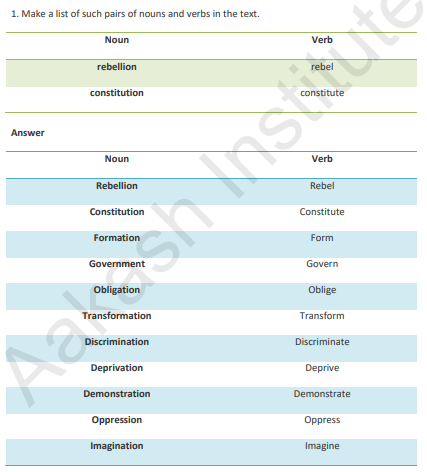
Q2. Read the paragraph Fill in the blanks with the noun forms of the verbs in brackets.
Martin Luther King’s__________(contribute) to our history as an outstanding leader began when he came to the_________________(assist) of Rosa Parks, a seamstress who refused to give up her seat on a bus to a white passenger. In those days American Blacks were confined to positions of second class citizenship by restrictive laws and customs. To break these laws would mean___________(subjugate) and__________(humiliate) by the police and the legal system. Beatings,___________(imprison) and sometimes death awaited those who
defied the System. Martin Lither King’s tactics of protest involved non-violent (resist) to racial injustice.
Answer: Martin Luther King’s contribution (contribute) to our history as an outstanding leader began when he came to the assistance (assist) of Rosa Parks, a seamstress who refused to give up her seat on a bus to a white passenger. In those days American Blacks were confined to positions of second class citizenship by restrictive laws and customs. To break these laws would mean subjugation(subjugate) andhumiliation(humiliate) by the police and the legal system. Beatings,imprisonment(imprison) and sometimes death awaited those who defied the System. Martin Luther King’s tactics of protest involved non-violent resistance (resist) to racial injustice.
II. Here are some more examples of ‘the’ used with proper names. Try to say what these sentences mean. (You may consult a dictionary if you wish. Look at the entry for ‘the’)
- Mr Singh regularly invites the Amitabh Bachchans and the Shah Rukh Khans to his
- Many people think that Madhuri Dixit is the Madhubala of our
- History is not only the story of the Alexanders, the Napoleons and the Hitlers, but of ordinary people as well.
Answer
- This means that Mr Singh regularly invites famous personalities such as Amitabh Bachchan and Shah Rukh Khan to his
- This means that Madhuri Dixit is compared to a landmark in acting in the form of legendary actress
- This means that history is not only the story of the great fighters and leaders such as Alexander, Napoleon and Hitler, but also of ordinary people.
III. Match, the italicised phrases in Column A with the phrase nearest meaning in Column
B. (Hint: First look for the sentence in the text which the phrase in column A occurs.) A B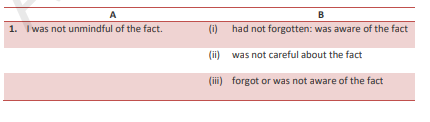
|
2. When my comrades and I were pushed to our limits |
(i) |
pushed by the guards to the wall |
|
(ii) |
took more than our share of beatings |
|
|
(iii) |
felt that we could not endure the suffering any longer |
|
|
3. To reassure me and keep me going |
(i) |
make me go on walking |
|
(ii) |
help me continue to live in hope in this very difficult situation |
|
|
(iii) |
make me remain without complaining |
|
|
4. The basic and honourable freedoms of … earning my keep… |
(i) |
earning enough money to live on |
|
(ii) |
keeping what I earned |
|
|
(iii) |
getting a good salary |
|
|
Answer |
||
|
A |
B |
|
|
1. I was not unmindful of the fact |
(i) |
had not forgotten; was aware of the fact |
|
2. When my comrades and I werepushed to our limits |
(iii) |
felt that we could not endure the suffering any longer |
|
3. To reassure me and keep me going |
(ii) |
help me continue to live in hope in this very difficult situation |
|
4. The basic and honourable freedoms of …earning my keep… |
(i) |
earning enough money to live on |
Nelson Mandela: Long Walk to Freedom Questions and Answers PDF
"Nelson Mandela: Long Walk to Freedom" is an inspiring autobiography that tells the story of Nelson Mandela's journey from his early life to becoming the first black president of South Africa. It highlights his struggles against apartheid, his fight for justice, and his dream of equality for all people. This book is a powerful reflection of his dedication to freedom and fairness. You can easily download the "Nelson Mandela: Long Walk to Freedom" PDF using the provided link to read this remarkable story.
Download Nelson Mandela: Long Walk to Freedom Questions and Answers PDF
Nelson Mandela: Long Walk to Freedom Important Question Answers
Q1: What is the main theme of the chapter?
Ans: The main theme of Nelson Mandela: Long Walk to Freedom is the fight for freedom, equality, and the end of racial discrimination. It also highlights the importance of love and unity in creating a peaceful society.
Q2: What are the two obligations that Nelson Mandela mentions?
Ans: Nelson Mandela talks about two obligations: one towards family and the other towards the nation. He believed that both these responsibilities are crucial for building a better society.
Q3: Why did Nelson Mandela believe that even the oppressors were not free?
Ans: Mandela believed that those who oppress others are also prisoners of hatred and prejudice. By denying freedom to others, they too are trapped in a cycle of ignorance and injustice.
Q4: What is the significance of Mandela’s inaugural speech?
Ans: Mandela’s inaugural speech marked a turning point in South African history. It symbolized the end of apartheid and the beginning of a new era of equality, justice, and freedom for all citizens of the country.
Q5: What message does Mandela convey about love and hatred?
Ans: Mandela conveyed that no one is born hating another person. Hatred is something that is taught, and if people can learn to hate, they can also be taught to love. Love, according to Mandela, is more natural and powerful than hatred.


Talk to Our Expert

 Call Now
 Let's Chat
 Share
Share