-
Call Now
1800-102-2727


JEE Main Important Physics Formulas Sheet
Preparing for JEE Main becomes much easier when all the important JEE Main Physics formulas are organised in one place. On this page, you will find easy JEE Main Physics formula sheets, key formulas for JEE Main that you need for quick revision, whether you are solving questions, revising concepts, or practising mock tests. These JEE Main Physics formula sheets are designed to save time and help you revise faster before exams.
JEE Main Formula Hub — Chapter-Wise Formulas (Physics | Chemistry | Maths)
Access complete chapter-wise JEE Main Physics formulas, JEE Main Chemistry formulas, and JEE Main Maths formulas prepared from the Aakash Rapid Revision Formula Bank. Click any chapter to get the full JEE Main formula sheet with free PDF download.
How Can JEE Main 2026 Important Physics Formulas Help?
Every JEE Main Physics formula you memorise removes one more point of failure in the exam hall. The important JEE Main Physics formulas listed on this page cover all high-weightage chapters — from Kinematics and Newton's Laws to Electrostatics and Modern Physics — giving you a single-source JEE Main Physics formula sheet for revision.
Important Formulas of Physics for JEE Mains 2026
The Physics section of JEE Main is often seen as tough by students because of long formulas, derivations, and many different topics. According to the JEE Main Physics Syllabus 2026, it includes chapters like Mechanics, Electricity and Magnetism, Thermodynamics, Optics, and Modern Physics. To do well in this section, it is very important to remember and practice key JEE Main Physics formulas. Having the important JEE Main 2026 Physics formulas in one place helps in quick revision and makes solving questions easier. Let's look at some must-know JEE Main Physics formulas for JEE Main 2026.
Kinematics Formulas — Chapter-wise PDF
Kinematics is the foundation of JEE Main Physics formulas. These motion formulas appear in 1–2 questions every JEE Main session.
| Quantity | JEE Main Physics Formula |
|---|---|
| Displacement | (Initial velocity + Final velocity) / 2 × Time taken |
| Final velocity | (Initial velocity + Acceleration) × Time taken |
| Acceleration | (Final velocity - Initial velocity) / Time taken |
| Average speed | Total distance / Total time |
| Average velocity | Total displacement / Total time |
Newton's Laws of Motion — Chapter-wise PDF
These JEE Main Physics important formulas from Laws of Motion are direct and high-scoring — at least 1 question per session.
| F = m × a (Newton's Second Law of Motion) |
| Weight = m × g (where g is the acceleration due to gravity) |
| Force of friction = μ × N (where μ is the coefficient of friction and N is the normal force) |
| Impulse = Force × Time |
Work, Energy, and Power Formulas — Chapter-wise PDF
Work, Energy, and Power is one of the most formula-dense chapters in JEE Main Physics formulas 2026.
| S.No | JEE Main Physics Formula |
|---|---|
| 1 | Work = Force × Displacement × cos θ |
| 2 | Potential Energy = m × g × h |
| 3 | Kinetic Energy = 0.5 × m × v² |
| 4 | Total Mechanical Energy = Kinetic Energy + Potential Energy |
| 5 | Power = Work done / Time taken |
Electric Charge and Fields Formulas — Chapter-wise PDF
Electrostatics contributes the highest number of questions in JEE Main Physics. These JEE Main Physics important formulas must be memorised for full marks.
| S.No | JEE Main Physics Formula |
|---|---|
| 1 | Electric Field = Force per unit charge = F/Q |
| 2 | Electric Potential = V/d |
| 3 | Electric Potential Energy = q × V |
| 4 | 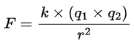 (Coulomb's Law) |
Energy of electric dipole: U = −pE
Energy of a magnetic dipole: U = −μBC
Electric Charge: Q = ±ne (where e = 1.60218 × 10⁻¹⁹), SI unit of Electric Charge is Coulomb (C)
Coulomb's Law — Electrostatics JEE Main PDF
Coulomb's Law is the most-tested JEE Main Physics formula in Electrostatics. One direct question appears in almost every JEE Main session.
Electrostatic Force (F) = k[q₁q₂/r²] and in Vector Form:
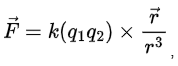
Where q₁ and q₂ are Charges on the Particle, r = Separation between them,
 = Position Vector,
 = Constant =

Electric Current — Current Electricity JEE Main PDF
Current Electricity JEE Main Physics formulas cover Kirchhoff's laws, resistance, and Ohm's law — 1–2 questions per JEE Main session.
The current at Time t =
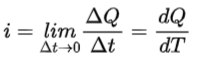
Where 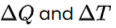 = Charges cross an Area in time
SI unit of Current is Ampere (A) and 1A = 1 C/s
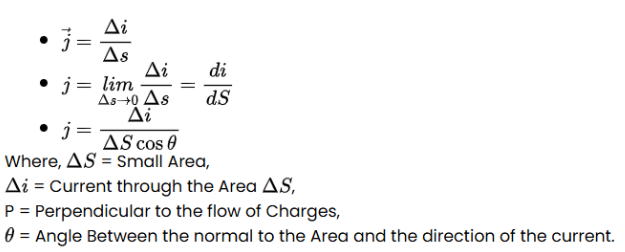
Average Current Density
Kirchhoff's Law — Current Electricity JEE Main PDF
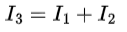
Law of Conservation of Charge — one of the most applied JEE Main Physics formulas in circuit analysis:
Resistance Formula — Current Electricity JEE Main PDF

Lorentz Force — Magnetic Effects JEE Main PDF
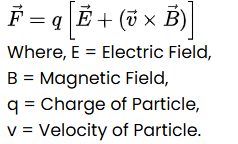
The Lorentz Force JEE Main Physics formula combines electric and magnetic force on a charge — directly tested in Magnetic Effects chapter.
Magnetic Flux — EMI JEE Main PDF
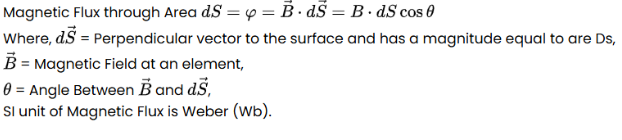
Magnetic Flux is a core JEE Main Physics important formula — forms the basis of Faraday's law and EMI questions.
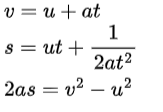
Straight Line Equation of Motion (Constant Acceleration) — Kinematics JEE Main PDF
These three JEE Main Physics formulas (equations of motion) are used in almost every Kinematics and Projectile question.
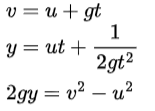
Gravitational Acceleration Equation of Motion — Gravitation JEE Main PDF
Motion in Upward Direction:
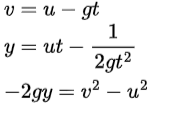
Motion in Downward Direction:
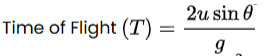
Projectile Equation of Motion — Kinematics JEE Main PDF
Projectile motion JEE Main Physics formulas — Range, Time of Flight, and Maximum Height — appear in at least 1 question per session.
 |
 |
 |
Where, u = initial velocity, v = final velocity, a = constant acceleration, t = time, x = position of particle.
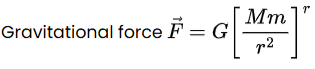
Laws of Gravity — Gravitation JEE Main PDF
Universal Law of Gravitation — Key JEE Main Physics Formula:
 |
 |
Work Done by Constant Force — Work Energy Power JEE Main PDF:
 |
 |
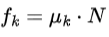
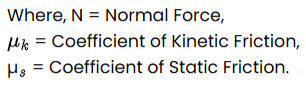
Kinetic Friction — Laws of Motion JEE Main PDF:
 |
 |
 |
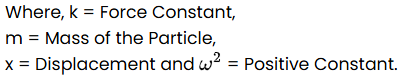
Simple Harmonic Motion — Oscillations JEE Main PDF:
SHM is one of the most formula-heavy chapters in JEE Main Physics important formulas. These formulas are tested in 1–2 questions per session.
 |
 |
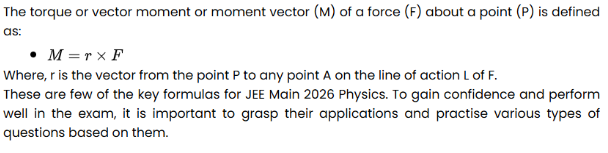
Torque — Rotational Motion JEE Main PDF:
Torque is a direct JEE Main Physics formula used in every Rotational Motion question.
 |
FAQs — JEE Main Physics Formulas 2026
Common questions about JEE Main Physics formula sheets, important JEE Main Physics formulas, and how to use them effectively for JEE Main 2026 preparation.
Q1. Why are important JEE Main Physics formulas needed for JEE Main 2026?
Important JEE Main Physics formulas are the base of JEE Main 2026 preparation. They help you solve numerical questions faster, revise before exams, and avoid mistakes during calculations. A student who knows all JEE Main Physics important formulas by heart can solve questions at least 30–40% faster in the exam.
Q2. Do these JEE Main Physics formula sheets follow the JEE Main 2026 syllabus?
Yes, all important JEE Main Physics formulas listed on this page are prepared strictly according to the latest NTA JEE Main 2026 syllabus. Every formula — from Kinematics and Newton's Laws to Modern Physics and Optics — is aligned with the official JEE Main Physics syllabus.
Q6. Are JEE Main Physics formulas more important than Chemistry and Maths?
All three subjects are equally important for JEE Main 2026. JEE Main Physics formulas help with numericals (highest calculation-based questions), Chemistry formulas help in quick recall, and Maths formulas are key for problem-solving speed. Use the Formula Hub above to access all three subjects' chapter-wise JEE Main formula sheets.
Q7. When should I start revising JEE Main Physics formulas?
You should start revising JEE Main Physics important formulas from the beginning of your preparation and continue till the exam day. The earlier you build familiarity with the JEE Main Physics formula sheet, the more instinctive your recall becomes during the actual JEE Main exam.
Q8. Can JEE Main Physics formula sheets help in last-minute JEE Main 2026 preparation?
Yes, JEE Main 2026 Physics formula sheets are perfect for last-minute revision as they save time and help you recall concepts quickly. Use the chapter-wise JEE Main Physics formulas PDF links in the Formula Hub above to download free PDFs for each chapter.
Q9. Are these JEE Main Physics formula PDFs useful for mock tests and practice sessions?
Absolutely. These important JEE Main Physics formula PDFs are very useful while practising questions and analysing mock test performance. After each mock test, cross-check which JEE Main Physics formulas you missed — and revise them from the chapter-wise PDF sheets available above.

Talk To Our Experts

 Call Now
 Let's Chat
 Share
Share