-
Call Now
1800-102-2727



Anomalous Properties of Oxygen: Introduction, Structure, Allotropes, Physical Properties, Anomalous Properties, Uses of Oxygen, Practice Problems & Frequently Asked Questions(FAQs)
The significance of oxygen to human existence cannot be emphasised.
Everyone is aware that without oxygen, life cannot be sustained for more than a few minutes. In addition to being essential for life, it is also utilised in many aspects of daily living.
How frequently have you seen astronauts monitoring the amount of oxygen that is available in their cylinders?
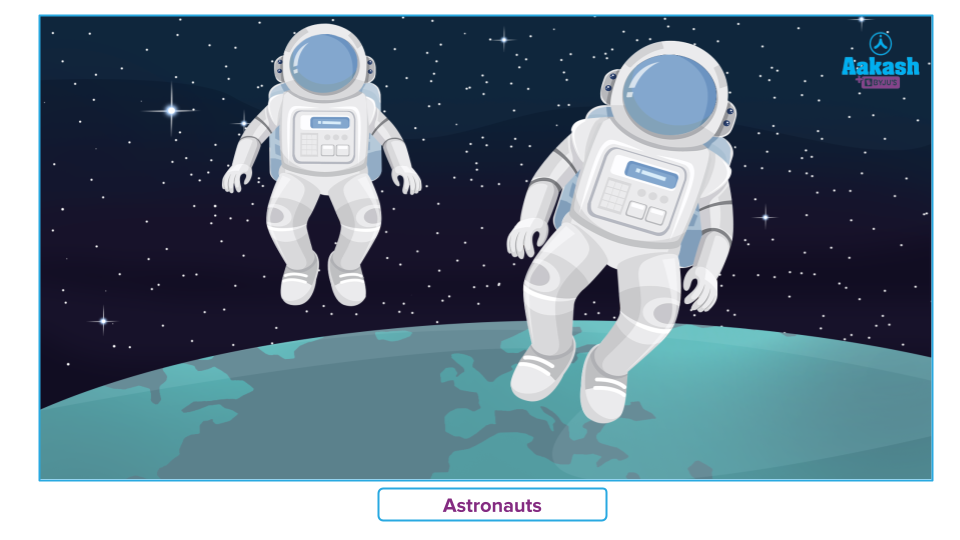
Almost all space movies feature a similar sequence, and to be honest, keeping people alive in space even in reality requires this. Understand why?
This is due to the fact that only the planet Earth has an atmosphere with a high enough concentration of oxygen to support life, and that oxygen is essential for human survival.
This is so that our bodies can breathe and the cells can make energy. Without oxygen, our cells cannot produce energy or perform any other essential tasks that are required to keep us alive. Thus, every cell in our body uses oxygen to oxidise glucose and produce energy.
Table of Content:
- Introduction of Oxygen
- Structure of Oxygen
- Allotropes of Oxygen
- Physical Properties of Oxygen
- Anomalous Properties of Oxygen
- Uses of Oxygen
- Practice Problems
- Frequently Asked Questions(FAQs)
Introduction of Oxygen:
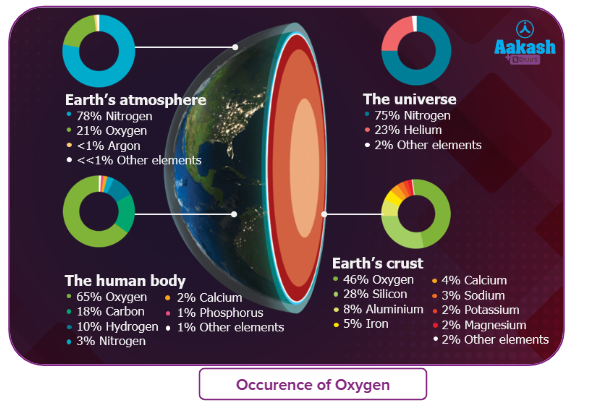
One of the most crucial elements in the atmosphere is oxygen. This element is necessary for the survival of all life on Earth, in its gaseous diatomic form. With an atomic mass of 8, oxygen is a member of group 16, period 2 of the current periodic table. It is the first chalcogen family member. Oxygen makes up 21% of the earth's atmosphere, and metals in their oxide forms make up more than 50% of the crust.
The chemical formula for oxygen is O2, and also called dioxygen. Oxygen forms a covalent bond with another oxygen atom. It is diatomic because it only needs two electrons to complete its octet, which it can get from another oxygen atom. Due to its electronegative nature, oxygen is very reactive.
Structure of Oxygen:
Two double bonds between two oxygen atoms satisfy the Lewis structure of oxygen. Because there are lone pairs of electrons on both oxygen atoms, the O2 molecule is linear and has strong electronegativity and reactivity. The oxygen molecule can be written as O=O, and the covalent bond between the two atoms. The O2 molecule's bond length is 121 pm and its bond energy is 498 KJ mol-1.
Allotropes of Oxygen:
When discovered in nature, a few chemical elements have the ability to exist in two or more different forms, or allotropes. Allotropy is a property that can be seen in elements like carbon, oxygen, phosphorus, tin, and sulphur.
The fact that the atoms are arranged differently into molecules or crystals explains the various physical characteristics displayed by an element's allotropes.An element's allotropes can vary in their chemical stability.
Dioxygen (O2) is the most prevalent allotrope of elemental oxygen.
Trioxygen (O3), also referred to as ozone and an extremely reactive allotrope of oxygen, is the next important allotrope. Ozone forms in the upper atmosphere when oxygen (O2) that has been split by ultraviolet (UV) radiation combined with atomic oxygen.
Physical Properties of Oxygen:
- The diatomic gas oxygen is colourless, flavourless, odourless, and paramagnetic by nature.
- Oxygen has an atomic mass of 8 u and a molar mass of 32 g mol-1.
- While the boiling point of oxygen gas is -183o C, its melting point is -218.4o C.
- Although oxygen gas in its pure state is not flammable, it promotes combustion.
- Oxygen gas has a density of 1.429 gL-1, making it denser than air.
- Although only gently soluble in water, it is sufficiently soluble for aquatic life to survive there. Oxygen's solubility is extremely temperature-dependent and declines as temperature goes up.
Anomalous Properties of Oxygen:
Group 16 of the periodic table is where oxygen is located. But unlike the other members of its family, oxygen exhibits some exceptional qualities because of some distinctive characteristics. In reality, oxygen's unusual properties are primarily caused by its-
i) small atomic radius,
ii) high electronegativity, and
iii) lack of vacant d-orbitals.
The peculiar characteristics of oxygen include the following:
- While other members of the same group have polyatomic states due to strong p-p bonds that are not possible in the case of oxygen, oxygen exists in a diatomic state.
- While the other members of the group are solid, oxygen is a gas. This is because oxygen has weak van der Waals forces and can create p-p bonds.
- We will discuss about p-p bonding in oxygen molecule.
- Atomic orbitals overlap to create -bonds in a way that keeps their individual axes perpendicular to the internuclear axis and parallel to one another. The orbitals produced by lateral or sidewise overlapping are made up of two charged clouds in the shape of saucers, one above and one below the plane of the participating atoms.
- Two p-orbitals from neighbouring atoms that are parallel in orientation overlap sideways to form pi-bonds.
- Because it happens on the side of the two p-orbital lobes, overlapping in pi-bonds is less extensive than it is in sigma bonds. Therefore, pi-bonds are weaker than sigma-bonds.
- The p-orbital of the centre atom and the p-orbital of the other atom create a p-p bond.
- For instance, because its outermost shell lacks any vacant d-orbitals, oxygen (O2) cannot form a p-d bond but forms p-p bonds. The p-p is shown in the below figure

- With the exception of OF2, where it displays +2 and -1 in peroxides and -12 in superoxides, oxygen mainly exhibits oxidation states of -2. Since fluorine is the most electronegative element, it can cause oxygen to be in its positive oxidation state.
- Unlike the other members of its group, which exhibit oxidation states -2, +2, +4 and +6 oxygen cannot extend its oxidation state above that. For instance, the oxidation states of sulphur are +4, +6, and +6 respectively in SO2 , H2SO4 and SO3. This is because oxygen doesn't contain any vacant d-orbitals.
- While other gases are diamagnetic, oxygen is paramagnetic.
- Due to its high electronegativity and potential to form hydrogen bonds, the hydride of oxygen i.e.water, is liquid as opposed to the hydrides of other elements in group 16 which are gases.
- Due to the partial negative charge on oxygen, water molecules exhibit strong hydrogen bonds, which are absent in H2S but present in H2O. Oxygen compounds are more ionic than those of the other group members because of oxygen's strong electronegativity.
- Its covalency is only four, whereas the other elements can display covalency beyond four, because it lacks d-orbitals.
Uses of oxygen:
- For life to exist on Earth, dioxygen is necessary. All living things use it when breathing.
- In hospitals, oxygen cylinders are used for artificial respiration.
- Oxygen is utilised in welding with oxy acetylene, and it is also used to create oxy-hydrogen torches, which are used to cut metals.
- In rockets, liquid oxygen is used as fuel.
- It is used in metallurgical processes to purge the impurities from metals because of its oxidising nature.
- An explosive used in coal mining is a mixture of liquid oxygen and charcoal powder.
- In cutting and welding operations, it is used.
- In the production of steel, oxygen is essential for the smelting of iron.
- Ethylene glycol, a component of antifreeze agents and coolants, is created through a series of reactions involving oxygen and ethylene.
- In order to maintain the oxygen pressure and ensure proper ventilation, advanced astronaut suits also use oxygen as a low-pressure gas.
Practice Problems:
Q1. Why does aluminium not undergo degradation in nature?
(A) It is an electronegative element
(B) It has an octet configuration
(C) It has a tough oxide layer
(D) It reacts at low temperature
Answer: (C)
Solution: An inert metal is aluminium. This means that when it forms naturally, it quickly reacts with airborne oxygen to form a strong, non-corrosive oxide layer. This layer prevents any other substance from reacting with aluminium metal.
Q2. What is carbon monoxide's nature?
(A) Acidic
(B) Basic
(C) Neutral
(D) None of these
Answer: (C)
Solution: When carbon monoxide reacts with water, it does not exhibit acidic or basic properties. As a result, it is neutral oxide.
Q3. When heated, ammonium dichromate produces:
(A) Chromic oxide and nitrogen
(B) Chromic acid and ammonia
(C) Chromic acid and hydrogen
(D) All of these
Answer: (A)
Solution: Nitrogen gas and chromium oxide are released during the decomposition of ammonium dichromate when it is heated. The reaction is given below
Q4. Among the following, which cannot be an octatomic solid?
(A) Oxygen
(B) Sulphur
(C) Selenium
(D) None of the above
Answer: (A)
Solution: Other elements (S, Se, and Te) occur as octatomic solids while oxygen is a diatomic gas at ambient temperature. The oxygen atom forms a p-p double bond with another oxygen atom to create the O=O molecule because of its small size and strong electronegativity. At ambient temperature, oxygen exists as a diatomic gas because the van der Waals forces that attract the oxygen molecules are weak.
Frequently Asked Questions(FAQs):
Q1. Why does sulphur exist as a solid while dioxygen exists as a gas
Answer: Because of the higher interelectronic repulsions in the smaller oxygen atoms, the O—O bond is significantly weaker than the S—S bond.
Additionally, oxygen forms multiple p-p bonds due to its larger electronegativity and smaller atomic radius. As a result, molecular oxygen exists as O2 molecules that are only loosely bound by van der Waals forces. As a result, at room temperature, it is a gas.
On the other hand, because of its larger radii, sulphur has a lower affinity to form p-p multiple bonds. Sulphur forms strong S—S single bonds because of its larger atomic size and low electronegativity, which accounts for its catenation property and causes it to exist as S8molecules with a puckered-ring structure. Sulphur is a solid as a result of this larger association, at room temperature.
Q2. Why is oxygen paramagnetic?
Answer: The paramagnetic properties of oxygen molecules could not be explained by the VBT(valence bond theory). The molecular orbital comes into play at this point. An oxygen atom's electronic configuration is 1s2 2s22p4 according to VBT(valence bond theory). According to VBT(valence bond theory), bonds are created by atomic orbitals; as a result, electrons are paired at the time of overlapping, making oxygen a diamagnetic species. However, according to experiment, oxygen molecules have a paramagnetic nature, which molecular orbital theory explains.
According to the MOT(molecular orbital theory), oxygen atoms overlapping atomic orbitals combine to form orbitals. The molecular orbital electronic configuration can be stated as
We can see that there are two electrons in the above-written electronic configuration, and they enter into two different pi degenerate orbitals. It is possible to describe the oxygen molecule as paramagnetic because it has two unpaired electrons. The two unpaired electrons in oxygen are the cause of its paramagnetic properties.
Q3. Why is Hydrogen sulphide (H2S) a gas and water (H2O) a liquid?
Answer: At room temperature, water is a liquid and hydrogen sulphide is a gas. because water has powerful hydrogen bonds due to oxygen’s high electronegativity. So, water has a high boiling point and is a liquid at normal temperature.
While the S-H bond is significantly less polar than the O-H bond and sulphur is less electronegative than oxygen. As a result, hydrogen sulphide is a gas and has no hydrogen bonds.
Q4. Kerosene oil is used to store sodium metals. Why?
Answer: Kerosene or dry mineral oil are used to store the sodium and potassium metals. These two metals belong to Group 1 of the periodic table. All of the metals in that category are highly reactive with water, including moisture in the air.
Due to its extreme reactivity, sodium and potassium react violently with the oxygen, carbon dioxide, and moisture in the air, potentially igniting a fire. Since sodium doesn't react with kerosene, it is kept submerged in it to stop this explosive reaction. These metals are shielded from any airborne moisture that could trigger a reaction in them that could be potentially violent.

Important Concepts of Chemistry
- Conformation
- Hydrogen Peroxide
- Physical and Chemical Properties of Potassium
- What is Distillation
- Human Digestive System
Important Concept Pages
NEET Related Links
- NEET Exam 2022
- NEET 2022 Exam Dates
- NEET Mock Test
- NEET Answer Key Solutions
- NEET Previous Year Question Papers
- NEET Rank Predictor
- NEET 2022 Admit Card
- NEET Result
JEE Main Related Links
- JEE Main 2022
- JEE Main Mock Tests
- JEE Main 2022 Syllabus
- JEE Main Answer Key & Solutions
- JEE Main Previous Year Question Papers
- JEE Crash Course

 Call Now
 Let's Chat
 Share
Share