-
Call Now
1800-102-2727



Respiratory quotient
Introduction:
- Definition: The ratio of the volume of CO2 released to the volume of O2 taken in respiration is called the respiratory quotient and is denoted as R.Q.
- Formula:

- The value of R.Q. depends upon the nature of the respiratory substrate (the organic food matter oxidized in respiration) and its oxidation.
Respiratory quotient of different respiratory substrates:
Carbohydrates:
- When carbohydrates such as hexose sugars are oxidized in respiration, the value of R.Q. is 1 or unity because vol. of CO2 evolved equals to the vol. of O2 absorbed as is shown by the following equation:

- R.Q. = Vol. of CO2/ Vol. of O2 = 6/6 = 1 or unity
- RQ for carbohydrates is 1.
Fats:
- When fats are the respiratory substrates, the value of R.Q. becomes less than one because they are poorer in oxygen in comparison to carbon and they require more O2 for their oxidation which is obvious from the following equation:

- R.Q. = Vol. of CO2/ Vol. of O2 = 102/145 = 0.7 (less than one)
- The RQ for fats is approximately 0.7.
- Fats are oxidized in respiration usually during the germination of fatty seeds.
Proteins:
- The value of R.Q. is also less than one when proteins are the respiratory substrates.
- The RQ for protein is approximately 0.9.
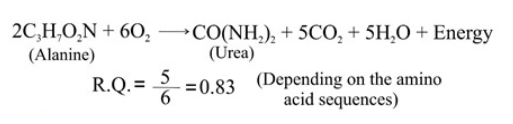
Organic acids:
- When organic acids are oxidized in respiration the value of R.Q. becomes more than one.
- It is because organic acids are rich in oxygen and require less O2 for their oxidation e.g.,

R.Q. = Vol. of CO2/ Vol. of O2 = 4/3 = 1.3 (more than one)
Partial oxidation of carbohydrates:
- In some succulent plants like Opuntia, Bryophyllum, etc carbohydrates are incompletely oxidized to organic acids in dark without the evolution of CO2, hence the value of R.Q. remains zero in the dark.

R.Q. = Vol.of CO2/ Vol. of O2 = 0/3 = 0 - During anaerobic respiration, due to the absence of O2 the value of R.Q. is always very high or infinite.

R.Q. = Vol. of CO2/ Vol. of O2 = 2/0 = infinite
Frequently Asked Questions: FAQs
Q1: What is the formula of respiratory quotient?
Answer: Respiratory quotient is the ratio of the volume of CO2 exhaled to the volume of O2 inhaled.
Q2: Which substrate has a respiratory quotient equal to 1?
Answer: Carbohydrates have a respiratory quotient equal to 1 as the amount of carbon dioxide released is equal to the amount of oxygen utilized for respiration.
C6H12O6 (Glucose) + 6O2 → 6CO2 + 6H2O
Q3: Which substrate has a respiratory quotient less than 1?
Answer: Proteins and fats have a respiratory quotient less than 1 as the amount of carbon dioxide released is less than the oxygen utilized for respiration.
2C51H98O6 (Tripalmitin) + 145O2 → 102CO2 + 98H2O
Q4: Which substrate has a respiratory quotient more than 1?
Answer: Organic acids have a respiratory quotient more than 1 as the amount of carbon dioxide released is more than the oxygen utilized for respiration.
C4H6O5 (Malic acid) + 3O2 → 4CO2 + 3H2O
Q5: In which condition is the respiratory quotient equal to infinity?
Answer: Partial oxidation of carbohydrates in case of anaerobic respiration leads to respiratory quotient equal to infinity as no oxygen is used and carbon dioxide is formed during respiration.
C6H12O6 (Glucose) → 2CO2 + 2C2H5OH (Alcohol)

 Call Now
 Let's Chat
 Share
Share